| Rubidium
|
|
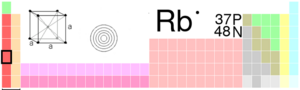
| General Info
|
| Atomic Symbol
|
Atomic symbol::Rb
|
| Atomic Number
|
Atomic number::37
|
| Atomic Weight
|
Atomic weight::85.47 g/mol
|
| Chemical series
|
Alkali metals
|
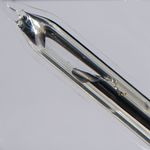
| Appearance
|
grey white
|
| Group, Period, Block
|
1, 5, s
|
| Electron configuration
|
[Kr] 5s1
|
| Electrons per shell
|
2,8,18,8,1

|
| CAS number
|
CAS number::7440-17-7
|
| Physical properties
|
| Phase
|
Solid
|
| Density
|
Density::1.532 g/ml
|
| Melting point
|
Melting point::38 °C
|
| Boiling point
|
Boiling point::688 °C
|
| Isotopes of Rubidium
|
| iso
|
NA
|
half-life
|
DT
|
DE (MeV)
|
DP
|
| 83Rb
|
syn
|
86.2 d
|
ε
|
-
|
83Kr
|
| 83Rb
|
syn
|
86.2 d
|
γ
|
0.52, 0.53, 0.55
|
-
|
| 84Rb
|
syn
|
32.9 d
|
ε
|
-
|
84Kr
|
| 84Rb
|
syn
|
32.9 d
|
β+
|
1.66, 0.78
|
84Kr
|
| 84Rb
|
syn
|
32.9 d
|
γ
|
0.881
|
-
|
| 84Rb
|
syn
|
32.9 d
|
β-
|
0.892
|
84Sr
|
| 85Rb
|
72.168%
|
85Rb is stable with 48 neutrons.
|
| 86Rb
|
syn
|
18.65 d
|
β-
|
1.775
|
86Sr
|
| 86Rb
|
syn
|
18.65 d
|
γ
|
1.0767
|
-
|
| 87Rb
|
27.835%
|
4.88x10¹⁰ y
|
β-
|
0.283
|
87Sr
|
|
| All properties are for STP unless otherwise stated.
|
Rubidium is part of the alkali metal series which is group 1 in the periodic table. It has the color of silver and a melting point of 60 celsius. It is the 23rd most abundant element in the Earth's crust and it can also be found in the sea. It was discovered by German chemists in 1861 while they were looking through the mineral lepidolite.
Properties
Rubidium is an Alkali metal group which is located in group 1 from the periodic table. It's a a soft and silvery looking element which has a melting point of 40°C. [1] It has a boiling point of 688°C and it remains solid at room temperature. [2] Although it reacts violently with water, it ignites when it contacts air. [3]The element reacts violently when it comes in contact with hydrogen (water) in any form including ice. It can alloy with various elements such as; gold, cesium, sodium, and potassium. Just like other alkali metals, Rubidium forms amalgam when it alloys with mercury. [4] The element is very similar to Potassium and it is also the 23rd most abundant element in the Earth's crust. Because it's similar to the element potassium, it can be obtained when one eats his food. [3]
Occurrences
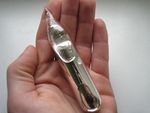
Element Rubidium isolated and held in a bottle
Rubidium can be found throughout the terrestrial crust. [5] Rubidium is considered relatively abundant thoughout the Earth. It can be found through the earth's crust and also sea water or mineral springs. It is abundant as Nickel, Copper, Zinc, and Chromium. [6] Even though it is abundant throughout the nature, no minerals that are found in nature has Rubidium as their main constituent. Because Rubidium is widely spread and hard to extract, pure Rubidium is expensive. [5] Even though it is not found as the main constituent, it can be still found in the nature in compounds like leucite, pollucite, and zinnwaldite. [7]
Uses

Photo of a Rubidium fountain atomic clock.
Rubidium is slightly radioactive even though we can obtain it through our food. [3] Rubidium-87 is well known for its small amount of radioactive property in it. Using that radioactive property, it is used to date rocks. Rubidium is also used as a getter (trace gas remover) in a vacuum cleaner which removes the traces of gas from the vacuum. [8] Because Rubidium can be easily ionized, researchers often use Rubidium to make Ionic engines for space vehicles but it is proven that Caesium is more efficient than Rubidium is. [1] Even though Caesium is proven to be better than Rubidium for ionic engines, Rubidium is better for the fluids that are used for the shuttle because it forms ion in a higher temperature. [9] When Rubidium bonds with Silver and Iodine, it is very useful to make thin film batteries. [2] Rubidium's properties are also very good to make special glasses or ceramics. [8] Rubidium Chloride is used in Biochemistry to induce cells to take up DNA. Rubidium Chloride is the most used compound from rubidium family.
History
Rubidium was found in 1861 by German scientists Robert Bunsen and Gustav Kirchhoff. They were analyzing samples of the mineral lepidolite with the spectroscope and suddenly they saw lights that were not familiar. Bunsen later isolated the element from lepidolite and it was Rubidium itself. [2] Rubidium in the mineral lepidolite was so tiny that Bunsen had to use 150kg of the ore to extract it from the mineral. [8] When they were looking through the spectroscope, Rubidium appeared red and in fact the name Rubidium means the 'Dark Red'. Now Rubidium is classified as an alkali metal in group 1 in the periodic table. [1]
References


