Assyria

Assyria (Akkadian: 𒀸𒋗𒁺, Ashūr; Hebrew: אשור, ʼAshūr; Aramaic: ܐܫܘܪ, Āshūr or ܐܬܘܪ, Āthūr; Arabic: أشور, Ashūr; Greek: Ἀσσυρία, Assuriā) was an ancient nation-state centered on the Upper Tigris river, in northern Mesopotamia (present day northern Iraq), that came to rule regional empires a number of times through history. It was named for its original capital, the ancient city of Ashur (modern Qal'at Sherqat) which in turn was named after Asshur, the son of Shem and progenitor of the Assyrians.
The Assyrian empire emerged shortly after the Global Flood and came to its greatest strength during the period of the Divided Kingdoms of Israel. It conquered and permanently dispersed the Northern Kingdom and attempted an invasion of the Southern Kingdom shortly thereafter. It is credited even with holding a brief sway over Egypt until Nabopolassar and Astyages led a joint force against its capital city of Nineveh and destroyed it in 612 BC. Assyria was also sometimes known as Subartu, and after its fall, from 612 BC through to the late 7th century AD variously as Athura, Syria (Greek), Assyria (Latin) and Assuristan (Persian).
Assyria has never again been an independent nation, and indeed its name was all but forgotten until a 19th Century archaeologist named Austen Henry Layard finally discovered the ruins of Nineveh and Nimrud (Calah).
The term Assyria can also refer to the geographic region or heartland where Assyria, its empires and the Assyrian people were centred. The modern Assyrian Christian minority in northern Iraq, northeast Syria, southeast Turkey, and northwest Iran are the descendants of the ancient Assyrians.
Geography
The core of Assyria lay in the northern Tigris River Valley in modern Iraq. At one time, the Assyrian Empire included parts of modern Turkey, Azerbaijan, Armenia, and northern Syria. At its greatest extent, this empire held sway over Egypt as well.
Approximate land area: 50,000 mi2, chiefly mountainous
Principal rivers: Tigris River and Euphrates River
Principal cities:
History

Biblical descent
The progenitor of Assyria was Asshur, second named son of Shem, the son of Noah according to the Table of Nations. For that reason, Assyria can be no older than 2348 BC, or most likely 2503 BC, which corrects James Ussher's date for the Global Flood for an early birth of Abraham and a "long sojourn" of the Israelites in Egypt. (For details, see here.)
Founding
The earliest powers in the region were Sumer, Akkad, and Babylonia. The secular chronology is unsettled, and the Bible is silent on the development of the Assyrian nation or its history sooner than the visit of Jonah to Nineveh, capital of the Assyrian Empire during the final years of the Northern Kingdom (Jonah 3 ). No authority seems to claim any definite Assyrian records or artifacts any earlier than 2400 BC.
The first capital of what became the Assyrian Empire was the city of Asshur—the same name as the son of Shem named above. Assyrian lore says that the original Asshur was a god. Easton's Bible Dictionary (1897) says that Asshur was founded in 1700 BC, which would have been during the Sojourn of the Israelites in Egypt. The Catholic Encyclopedia (1917), however, says that Asshur was founded far earlier. These two sources also argue that Asshur was originally a Babylonian colony. The relevant Scriptural authority reads as follows:
"And Cush begat Nimrod: he began to be a mighty one in the earth. He was a mighty hunter before the LORD: wherefore it is said, Even as Nimrod the mighty hunter before the LORD. And the beginning of his kingdom was Babel, and Erech, and Accad, and Calneh, in the land of Shinar. Out of that land went forth Asshur, and builded Nineveh, and the city Rehoboth, and Calah, And Resen between Nineveh and Calah: the same is a great city." — Genesis 10:8-12
"Out of that land went forth Asshur" could suggest that the city of Asshur was a Babylonian colony. But one must bear in mind that all of humanity was settled in the land of Shinar, and under King Nimrod they began building the Tower of Babel, until God scattered the nations:
"And the whole earth was of one language, and of one speech. And it came to pass, as they journeyed from the east, that they found a plain in the land of Shinar; and they dwelt there. And they said one to another, Go to, let us make brick, and burn them thoroughly. And they had brick for stone, and slime had they for morter. And they said, Go to, let us build us a city and a tower, whose top may reach unto heaven; and let us make us a name, lest we be scattered abroad upon the face of the whole earth. And the LORD came down to see the city and the tower, which the children of men builded. And the LORD said, Behold, the people is one, and they have all one language; and this they begin to do: and now nothing will be restrained from them, which they have imagined to do. Go to, let us go down, and there confound their language, that they may not understand one another's speech. So the LORD scattered them abroad from thence upon the face of all the earth: and they left off to build the city. Therefore is the name of it called Babel; because the LORD did there confound the language of all the earth: and from thence did the LORD scatter them abroad upon the face of all the earth." — Genesis 11:1-9
This was a great migration from which all the descendants of Shem, Ham, and Japheth went their separate ways, including, of course, Mizraim, who founded Egypt.
Early History
The Assyrians always had a reputation as a militaristic people, similar to the Romans. The first empire-building monarch was Shamshi-Adad, who conquered Asshur and a number of other kingdoms, and put his son in charge of Asshur. When he died, his son Ishme-Dagan entered into a power struggle with Hammurabi, the famous Lawgiver of Babylonia. Hammurabi won that struggle, and the cities of Assyria were reduced to vassal status. The northern part of the country, including Asshur, came under the domination of another empire-building tribe, the Hurrians—who in turn lost the initiative and the advantage to the Hittites centuries later.
Middle Assyrian Period
Ashur-uballit I first asserted Assyrian independence when the Hittites were distracting the Hurrians. He made an alliance with the then-King of Babylon and pledged his daughter in marriage to that king. Subsequently the Babylonian king was murdered, and Ashur-uballit marched into Babylon to avenge the murder.
Later, King Adad-nirari I established a pattern of conquest and expansion. His son and grandson Shalmaneser I and Tukulti-Ninurta I continued this policy in their reigns. Ashur-Resh-Ishi defeated Nebuchadnezzar I in battle in the power vacuum following the collapse of the Hittite empire.
Tiglath-Peleser I was the first true empire-builder in Assyrian history. He drove westward clear to the eastern shore of the Mediterranean Sea. This occurred during the era of the Judges in Israel.
Neo-Assyrian Empire

The rulers immediately following Tiglath-Peleser I were weak and ineffectual. This period of weakness ended during the 10th Century BC—and that this occurred following the division of the United Kingdom of Israel into two Kingdoms Northern and Southern might or might not be coincidental.
The chronology of this period is unsettled and in sharp dispute—and this dispute has given rise to another dispute on Biblical chronology. At the heart of this dispute is whether Shalmaneser III was contemporary with King Ahab of the Northern Kingdom—and whether Ahab contributed troops to a coalition force that Shalmaneser marched into battle at Qarqar.
What is known is that Assyria grew in military strength and prosperity under a succession of very strong rulers, beginning with Adad-nirari II and his immediate successors Ashur-Nasir-Pal II and Shalmaneser III. However, the first King of Assyria to bear mention in Scripture is a king called "Pul" (2_Kings 15:19 and 1_Chronicles 5:26 ). Secular sources identify this Pul with Tiglath-Pileser III, who, as all agree, took over the throne after a bloody revolution in or about 747 BC. However, the Bible clearly says that this Pul had dealings with King Menahem of Israel, while Tiglath-peleser fought a war against Pekah of Israel (who came later) and had dealings with Jehoahaz I of Judah. Therefore, Pul was likely not Tiglath-peleser at all, but rather his grandfather Ashur-Dan III. Ussher also identifies this monarch as the one who received a visit from the prophet Jonah, and came to repentance as a result.
Tiglath-peleser's successor was that Shalmaneser V who captured Samaria. Here the chronology is the most unsettled of all, for secular sources assert that a king named Sargon II murdered Shalmaneser, completed the taking of Samaria, and continued in command until finally dying and leaving the kingdom to his son, Sennacherib. Ussher asserts, however, that "Sargon" is simply another name for Sennacherib.
In any event, Sennacherib tried to invade the Southern Kingdom, but had to break off after a dire pestilence struck down most of his men on the battlefield. This incident took place during the reign of Hezekiah and was associated with the famous roll-back-of-the-sundial incident.
After Sennacherib came Esarhaddon, who captured and imprisoned King Manasseh for a short time (2_Chronicles 33:12-13 ). He also moved his capital to Babylon, fought battles with the Cimmerii and the Medes, and also fought a campaign in Phoenicia and captured the city of Sidon. He attacked Egypt twice; the second time he made Egypt an Assyrian province.
Assur-bani-pal, however, could not maintain Assyrian hegemony in Egypt. Babylonia attempted a rebellion, which Assur-bani-pal quashed—but the effort left the Assyrian economy exhausted. At this time, too, Scythian marauders attempted an invasion in the region, and this might have been the final distraction that was to prove Assyria's final undoing.
Decline and Fall

The last king of all Assyria was Ashur-etil-ilani, known also as "Saraco" or "Kineladanos." Toward the end of his reign, Nabopolassar made his treaty with Astyages, a Median territorial governor and son of Cyaxeres I. Their joint force attacked Nineveh and reduced it to a ruin. Secular sources suggest that a king-in-exile, Ashur-uballit II, attempted to hold out in the city of Harran for a few more years; if he did, he did not last long as Nabopolassar continued to erase Assyria as an independent nation.
Successive Foreign Rule
For centuries afterward, the Assyrians were largely forgotten—a fate they had, ironically, visited upon the Ten Tribes of the Northern Kingdom, called "The Lost Tribes" to this day. A succession of superpowers held sway in the region, beginning with Babylonia, continuing with an alliance of Media and Persia, and continuing further with Alexander the Great and his successors (chiefly the Seleucid Empire). Next came the "Two Kings," Mithridates of Pontus and Tigranes of Armenia; these ultimately fell before the power of Rome in the person of Pompey the Great, Special High Commissioner to the Middle East for the Senate of Rome.
The region later formed part of the Byzantine Empire. Muhammad conquered it in the 7th Century AD, and upon his death the land became part of the Rashidun Caliphate. Next came the Ottoman Empire, which held the region for five centuries until the Ottomans lost it to a loose alliance of Arab tribes under the advisorship of Major T. E. Lawrence of the British Army during the First World War. Today the region exists as a number of Arab nation-states.
Archaeological Rediscovery
Until 1849, most archaeologists refused even to admit that any such country as Assyria had ever existed—this despite its prominent mention, not only in the Bible, but also in the writings of many ancient authors including Berosus, Polyhistor, Ctesias, Herodotus, Abydenus, Apollodorus, Alexander of Miletus, Josephus, Georgius Syncellus, Diodorus Siculus, and Eusebius. James Ussher used many of these as his sources.
Then in 1849, exploration of the Assyrian territory began in earnest, with the eventual excavation of Nineveh. Unfortunately, these explorers assumed that the earlier histories of the region were inherently unreliable, and chose instead to rely completely on their best interpretation of the various inscribed cylinders and other artifacts that they have since discovered. This ultimately led them to construct a chronology that was irreconcilable with a strict reading of 1 and 2 Kings and 1 and 2 Chronicles (not to mention a number of the prophetic books). Edwin R. Thiele proposed a "solution" to the problem that involved a tremendous telescoping of the reigns of several Kings of Israel and Judah. Modern defenders of James Ussher have denounced this solution as subordinating Scripture to so-called "evidence" that, they maintain, is not even exact. The dispute remains unsettled today.
Modern Assyrians
Today, the Assyrian people (Neo-Aramaic: ܣܘܪܝܐ, Sūrāyē; ܣܘܪܝܝܐ, Sūryāyē; ܐܬܘܪܝܐ, Āthūrāyē; ܐܪܡܝܐ, Ārāmayē) still live in their ancestral homeland, which is currently divided between Northern Iraq, Syria, Western Iran, and Turkey's Southeastern Anatolia Region but, many have migrated to the Caucasus, North America and Europe during the past century. Assyrians traditionally belong to either the East Syrian Rite Assyrian Church of the East, the Ancient Church of the East (both of which are Nestorian), and the Chaldean Catholic Church (whose members are often referred to as Chaldeans or Chaldo-Assyrians) or the West Syrian Rite Syrian Orthodox Church and the Syriac Catholic Church (also known as Syriacs or Jacobites). They speak various Neo-Aramaic dialects (such as Western Neo-Aramaic, Turoyo, Assyrian, and Chaldean) which are written using Syriac script, a derivative of the ancient Aramaic script. Assyrians also may speak one or more languages of their country of residence, usually Arabic, Armenian, Persian or Turkish.
Assyrian Art

Assyrian cavalry charging
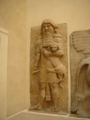
The Hero Overpowering a Lion
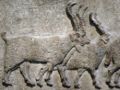
Deportation of conquered people following defeat by Tiglath-Peleser III


 Browse |
 Browse |
See Also
- Assyrian chronology
- Rulers of Assyria
- Biblical chronology dispute
- Individual entries on Assyrian cities and rulers
References
- Assyria by Wikipedia
- Assyria at Washington State University
- Assyria in the Catholic Encyclopedia
- Assyria in Easton's Bible Dictionary of 1897
- Assyria in the Encyclopedia of the Orient
- Assyria at Minnesota State Univesity
- Map of Assyria at HyperHistory.com
- Annals of the Kings of Assyria at the University of Chicago
- Sargon is Sennacherib by Damien Mackey
- The Starting Point, or the Captivity Era of Israel and Judah at Historicism.com (Discusses the Fall of Samaria and the Fall of Jerusalem in an eschatological context)
| ||||||||||||||||||||


| |||||||||||||||||||||||

