Church

The earliest Christian church is in the third-century at Dura Europos, near the Euphrates river. It was a house that was remodeled as a church, but destroyed by Sassanians around 256 AD.[1] There are several different definitions within the wider public regarding what church actually means.
A church is either:
- A place of worship, and more specifically a place of Christian worship.
- A building to house a Christian religious service.
- A corporate organization that concerns itself with the staffing of places of worship, the training of pastoral or other staff, and the discipleship of lay worshipers.
- The entire body of Christ, the definition given in the Bible.
The English word church derives from the Old English cirice, which had its origin from the pre-Christian Germanic word kirika. This last came from the Greek κυριακὴ οἰκία, kuriakē oikia ("house of the Lord"). The term κυριακή, kuriakē replaced the Greek term ἐκκλησία, ekklēsia ("gathering of the called out ones") and the Latin basilica (originally used to describe a Roman public building) within the Germanic populations of Christendom, beginning about 300 AD.[2]
History of the Church
- Main Article: History of Christianity
The original Church came into being when the Holy Spirit descended on believers through their confession of Christ as their Lord and Savior on the day of Pentecost, after Christ’s resurrection. The event (Acts 2 ) was marked by the believers being heard by the people present in their home languages. After this point, the Church spread through the evangelization of the Apostles as well as through the efforts of local believers. The New Testament writers referred to the Church as one body of Christ, and it was officially subdivided only along geographical lines. For example, in the First Letter to the Corinthians Paul identified the believers there as “the church of God in Corinth” (1Corinthians 1:2 ). The first members of the Church were Jewish, but Acts 10 describes how Peter was told in a vision that the Gospel was to be given to Jews and Gentiles alike. The Apostles spread the story of Christ at least as far as the city of Rome. Saint Thomas Christians in India claim that their church was founded in the first century by the Thomas.
The church structure as known today primarily began in the early European world. In 313 AD, after much persecution of the Church, Constantine I (a self professed Christian) and Licinius passed the Edict of Milan, which decreed toleration of Christianity. In 391, Theodosius I made Christianity the state religion of the Roman Empire. Upon the collapse of the empire, the Catholic Church maintained its influence into the era popularly known as the "Dark Ages." The Catholic Church remained the primary form of Christianity in Europe until the Protestant Reformation in the sixteenth century. It was after this point, when scores of Europeans were breaking from the Roman Church, that Christianity branched off into numerous independent denominations on a massive scale.
Modern Church
Denominations
- Main Article: Denomination
- The Catholic Church
- The Orthodox Church
- Lutheranism - Lutheran Reformed
- Baptist
- Presbyterianism - Reformed Presbyterian
- Anglicanism - The Anglican Communion, or the Church of England
- Methodism
- Episcopal Church in the United States of America (the American "province" of the Anglican Communion)
- Seventh-day Adventist Church
- Assemblies of God
- International Church of the Foursquare Gospel
Gallery
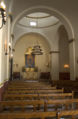
Mission Concepcion, San Antonio Texas
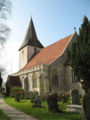
Church in Bosham, West Sussex, England.


References
- ↑ Larry W. Hurtado, The Earliest Christian Artifacts: Manuscripts and Christian Origins (William B. Eerdmans Publishing Company 2006), pg. 2
- ↑ Christian Church by Wikipedia
External Links
- Wikipedia - Christian Church
- Catholic Encyclopedia - The Church
- Catholic Encyclopedia - Church History
- Catholic Encyclopedia - Apostolic Churches
- Catholic Encyclopedia - Hierarchy of the Early Church
- When & Where Did The New Testament Church Begin?
| |||||||||||||||||||||||


