Sun

The sun is the astronomical object from which we receive sunlight (heat and light also known as solar radiation). All of the planetary objects within our solar system revolve around the sun. It is classified as a G2 V star whose name comes either from the Greek, helios or from the Latin word sol).[7]
Nomenclature
The G2 class is the the second level of hottest stars within the yellow G class. A "V" star in this class is a yellow dwarf star--but the Sun is in fact in the 95th percentile in its class by size and mass of other stars in its immediate region.[7]
History
Biblical
The Bible says:
God made two great lights—the greater light to govern the day and the lesser light to govern the night. He also made the stars. Genesis 1:16
This took place during the fourth day of Creation Week. More to the point, the Sun is a part of God's creation, not a "god" in its own right.
Mythological
In contrast, virtually every other civilization has regarded the Sun as one of many gods. The Egyptians called the Sun Ra or Re, a deity whom, they said, created the world.[10] The Egyptians also called the sun-disk Aten, and for a brief period (during the reign of Pharaoh Amenhotep IV or Akhenaten), actually worshipped Aten as the one and only god of the universe.[11] In Babylonia and Assyria the sun was called Shamash, a god who, because he could see everything happening on earth, was also associated with truth and justice.[12] The Greeks at first regarded Helios as a son of heaven and earth but later came to associate the Sun with their god of truth, Apollo.
The most common theme in all the sun-worship cults is the association of the sun with truth and justice personified. The second most common theme is the regarding of the sun as the creator.
Orbital characteristics and galactic relationships
The Sun orbits the galactic center at a distance less than half the total estimated radius of the galaxy, and in an orbit inclined about 25° from the galactic plane. The eccentricity of the Sun's orbit is 0.07, about average in comparison to the eccentricities of the planets and dwarf planets of the solar system. At present the Sun lies 50 light years north of the galactic plane and is continuing to climb north of it as it approaches perigalacticon.[13]
Properties and Characteristics
The sun accounts for 99.8% of our solar system's total mass. With a mass of 2 x 1030 kg, an atmospheric temperature of about 5800 K, and a luminosity of 4x10²⁰ megawatts, the sun is by far the most extraordinary object during the day-time sky and of our solar system. However within our Milky Way galaxy it is one of probably 100 billion of the same types of stars.
The tremendous light and heat that the sun releases (solar radiation), and the delicate position that the Earth occupies in relation to the sun, combine to make the sun an integral part of sustaining life.
Core temperatures reach 15,000,000 K (K = Kelvin) while the sun's surface or photosphere temperature is 5,800 K. When the photosphere is hit by the heat of the sun the temperature drops to a minimum of 4,000 K. It then continues further until it encounters a thin layer of atmosphere roughly 10,000 kilometers deep called the chromosphere and reverses trend to rise to 8,000 K. Even further is another part of the sun's total atmosphere called the corona that blends in with interplanetary space. The coronal temperature can exceed 20 million degrees.
Energy production and transport
The standard model of the solar system asserts that the Sun produces its energy through nuclear fusion.[14] The sun uses a type of nuclear fusion called the proton-proton chain reaction. This is when a nucleus with one proton (hydrogen) is fused with another proton, creating a two particle nucleus. Then it fuses to become a three particle, then finally a four particle. The final four particle nucleus contains two neutrons and two protons, which is the element called helium. There are also energy and many other products that are released.
The favored model for energy production relies on tremendous pressures resulting from the sun's own mass to overcome the natural electrostatic repulsive forces that normally keep hydrogen atoms from coming together and fusing.[7]
The model for hydrogen fusion includes these three equations:


Here, represents an electron, H means hydrogen, He means helium, represents a gamma photon, represents a small, uncharged particle called a neutrino that is not supposed to have any proper mass, and the energy unit eV, or electron volt, is the product of the charge on a single electron and the standard unit of electromotive force or electromotive potential.


The energy produced varies as the fourth power of the temperature--and at the temperatures thought to prevail in the sun's core, matter exists, not as ordinary matter with atomic nuclei and electrons, but as plasma--a form of super-hot matter in which atoms are totally denuded of their electrons.
The first equation above is assumed to be the rate-limiting step. The neutrinos produced should have an energy of 0.26 MeV--too little energy to be detectable by current technology. But processes occurring after this step ought to produce higher-energy neutrinos that would be detectable. Such neutrinos have been detected, but at a flux much smaller than predicted. This indicates that the presumed rates for these subsequent processes are higher than the true rates, or else the neutrinos produced somehow transform to a different type of neutrino that would be unobservable. That in turn would imply that neutrinos do have rest mass.[7]
According to current models, some of this energy is transferred to the surface by convection in the outer 20-30% of the body of the sun.[14] Helium in this convective zone rises to or near the surface, releases its heat, and then sinks back to the center. Helium absorbs radiation more readily than does hydrogen, and for that reason the sun is always getting marginally brighter with the passage of time.[7]
The remaining energy is transferred in the gamma photons, which must take a "random walk" to reach the corona of the Sun. Current models suggest that the sunlight generated by these processes takes 50 million years to reach the surface.[14]
Problems with the Standard Model
The standard model asserts that the power plant inside the Sun is a particular form of chain-reaction nuclear fusion. This has never been directly measured nor proven. The multi-stage sequence of reactions to achieve this fusion have never been successfully repeated in a loop (e.g. a fusion reactor). This is because each stage fully consumes the available fuel as it proceeds to the next stage. There is not even a theoretical model through which such a sustained/repeating chain-reaction can be achieved. Experiments with tokamak-style and the JET (Joint European Torus)[15] showed fusion is possible through alternative methods, but never translated to the type of fusion purported in the Sun.
The standard model asserts that the Sun transports heat using convection. If this is true, it is only body in human existence that does so.
The standard model asserts that the Sun's magnetic field is a result of its rotation. The Sun however, if proportionally reduced to the size of a beach-ball, would be off-tolerance from being a perfect sphere by less than the width of a human hair[16]. The only thing in human existence "more" spherical than the Sun are artificially-manufactured plastic ball-bearings. If the Sun rotates, it should show flattening at the equator, yet it does not.
Coronal heating is an unexplained anomaly. The standard model requires that the area nearest the surface should be the hottest visible part of the Sun. However, Sun's surface is around 6000 degrees Kelvin and the photosphere is around 4000 degree Kelvin. As we rise 200km above this, the temperature rapidly rises to over 1 million degrees Kelvin, and up to 20 million degrees Kelvin as far as one Solar diameter away from the Sun[17]. The only explanation offered for this extreme difference is an effect called "magnetic reconnection" which has never been proven[18]. In fact, no observation of magnetic fields of any kind have shown a propensity to break or reconnect, as this is not the nature of a magnetic field. One must keep in mind that a magnetic field line is imaginary. It is like the border-lines drawn on a map. The lines only exist on paper but not in the real world. Therefore magnetic field lines cannot connect or reconnect because they are imaginary, and this is a poor explanation of the behavior.
An important observation: The standard model purports that the Sun's core is 15 million degrees Kelvin, yet over 1 Solar diameter away from the surface, the temperature is over 20 million degrees Kelvin. The hottest part of the Sun is not even a part of the Sun's mass. The standard model has never sufficiently explained this.
Sunspots
The earliest observations of sunspots might have been made in the fourth century BC by the Greeks. Chinese astronomical records dating back to 28 BC include descriptions of changing dark patches on the sun that might have been sunspots.[19]
Galileo Galilei in 1613 was the first astronomer to study sunspots in any detail. It was a revolutionary observation, and one that clashed greatly with Western man's ideas of the heavens, propounded chiefly by Aristotle, as a perfect, unblemished place.[19][20]
An amateur astronomer, Heinrich Schwabe, was the first to note the sunspot cycle in 1843.[21] The sunspots are dark on account of their cooler temperature. This in turn is due to strong magenetic fields which allow the transport of heat via convective motion in the sun. At times these sunspots can be 50,000 miles in diameter and appear in two bands, one being north and the other south in the direction of the sun's equator.
Observations have also shown that the number and location of sunspots come and go in a semi-periodic 9.5 to 11-year solar cycles. At the start of this cycle they are about 30 degrees from the equator. Midway through, the cycle of the number of sunspots observed is maximum, usually about 15 degrees from the equator. Near the end of this on average 10.8-year cycle, the sunspots are very near the equator.[22][23]
Star Spots
The sunspot effect is visible on other stars such as Betelgeuse[24]. However, some star-spots are massive, covering 10,000 times the area of a common sunspot and a very large proportion of the star itself[25], with no explanation in the standard model.
The solar magnetosphere
The magnetosphere oscillates in synchrony with the sunspots in a twenty-two-year cycle. The current amplitude of that cycle is 3.5 * 1029 N-m-T. This amplitude has been decaying since creation, but relatively slowly, with a half-life of 13,170 Julian years. In fact, according to Humphreys[8], the sun's magnetic field has lost perhaps 25 percent of its strength since creation.
Measurements of the sun's magnetic dipole moment have not been exact enough to demonstrate whether the amplitude of the field's oscillations is constant or decaying. If those oscillations are in fact decaying, then the Sun cannot be a dynamo.[8]
Problems for uniformitarian theories posed by the Sun
Uniformitarians commonly estimate that the Sun is about 4.5 billion years old, has consumed about half its nuclear fuel (hydrogen), and will begin to die within about 5 billion years.[26]
But they also must admit that the sun continues to brighten as it continues to fuse hydrogen into helium. In fact, by uniformitarian estimates, the sun ought to be 40% brighter today than it was when the planets formed and 33% brighter than it was when life purportedly first formed (3.8 billion years ago by evolutionary assumptions). This is called the Faint Young Sun anomaly. In short, the Earth would have been covered with ice at the time life supposedly formed. If the Earth was in fact hot enough at that time, then the Earth ought to be much hotter today than it once was. The evolutionary timeframe applied to the fossil record is incongruous with these conditions.[7][27] Uniformitarians answer that the Earth's atmosphere might be compensating for this increased brightness. (But these are often the same scientists who insist that industrial and transport-related introduction of carbon dioxide into Earth's atmosphere threatens to overheat the Earth, with potentially disastrous results.)
Uniformitarians have also had to admit that the sun rotates about 200 times more slowly than the nebula hypothesis would predict, simply on account of the contraction of the solar mass into its present volume. This violates of the Law of Conservation of Angular Momentum. This "angular momentum" problem has been apparent for hundreds of years and remains unresolved to this day.[27]. In fact (see Anomalies section above) the Sun is near-perfectly spherical, suggesting that it does not rotate at all (otherwise the equator would bulge and the poles would be flattened).
The sun's equatorial plane is inclined 7.25° to the ecliptic. (See Earth.) By the nebula hypothesis, that inclination should be zero. The errant inclination poses an especially acute problem for the orbit of Neptune. Uniformitarians have speculated that a collision with an even larger object knocked the sun off a true perpendicular to its present inclination--but no scientist has offered a convincing speculation as to what that object might be.[27]
Conventional astronomers, Carl Sagan among them, insist that our star is mediocre and unremarkable. Yet the G-type of star is relatively rare, and furthermore its mass and position in the galaxy lie within very narrow tolerances for the support of life. The sun is also a singular star, not part of a binary--also a rare finding--and is remarkably stable in its energy output. These facts combine to make the sun an unusually hospitable star for a planet to have life on it.[27]
Finally, the only reason that uniformitarians can cite for a great age of the Sun is the apparent great age of the Earth.[7]. At least one astronomer has frankly admitted that the Sun itself gives no clue to any such tremendous age, and that the acceptance of a very young age of the Sun, like the six-thousand-plus years calculated by James Ussher, might logically follow from a modicum of new evidence:[27][28]
| “ | There is no evidence based solely on solar observations, Eddy stated, that the sun is 4.5-5 x 10⁹ years old. "I suspect," he said, "that the Sun is 4.5-5 billion years old. However, given some new and unexpected results to the contrary, and some time for frantic recalculation and theoretical readjustment, I suspect that we could live with Bishop Ussher's value for the age of the earth and sun. I don't think we have much in the way of observational evidence in astronomy to conflict with that." | ” |
Electric Sun
The Electric Sun Theory has been gradually taking foothold, having a strong following among people who have grown weary of the standard model and its lack of explanatory power.
The Electric Sun is part of a larger theoretical framework of the Electric Universe. The observations, prediction and explanatory power of the EU are accurate and very compelling. Here are some of the highlights of this theory, which strongly deviates from the standard cosmological model.
- The primary force holding the universe together is not gravity, but electromagnetism, as it is over a trillion, trillion, trillion, trillion times more powerful than gravity
- Rejects the notion of dark matter, which its proponents assert is an escape device for people who believe that gravity is king.
- Purports that gravity is actually a representation of the electromagnetic force rather than an independent force
- The universe and all of space around us is teeming with electrically charged particles
- The particles align into currents, which in turn form twisted-pair Birkeland currents, which scale across the heavens in millions of light years
- Rejects the notion that stars can form through the accretion of matter in space, a theory that has never provided the required explanatory lift regarding the trillions of stars in the heavens
- The Snake Nebula, when viewed with the Submillimeter Array, shows stars forming as a group, aligned along a path like a string of pearls, which defies the standard model but dovetails with the EU
- Stars are formed along the paths of these currents and are not formed via accretion of dust
- Planets are formed by similar means but do not ignite as the stars do, and become satellites of the stars, or may be captured by the influence of a star
- The electromagnetic effect of a "z-pinch" has more than enough power to compress dusty plasma into a star-sized ball, generating a star, and resolving the mystery of star formation
- Stars sit in the path of a current because they were formed there, and this explains many of the anomalies associated with the Sun, including the accelerating solar wind, apparent rotation, coronal heating, and cometary activity.
- Explains the faint-young-Sun paradox, since the Sun would not require so much time to ignite and become viable at full-strength.
- Stars therefore, are cathode transistors, with a primary job of receiving electric current and regulating or stabilizing it over time
- Supernovas will be surrounded by a predictable count of toroids in a ring (e.g. Crab Nebula), an effect reproducible in lab experiments.
- Galaxies will output plasma jets through their axis
- Rejects the reality of Black holes, which have never been observed, and defy both physics and their own mathematical models
- Rejects many aspects of Einstein's special and general relativity (a growing sentiment among many physicists) but EU proponents also do not attempt to explain the cosmos in terms of gravity per Newtonian dynamics. The EU is a complete departure from both.
The Electric Sun and Electric Universe theories seem to form an alignment with creationism, so is tempting to embrace. However, there is no affinity for creationism among the proponents of these theories. They often align with observations that dovetail with creationist predictions, but seem to have an underpinning philosophy that is atheistic. The reader is cautioned to be circumspect and wise about how such observations align with the creation model without wholesale endorsement of these theories and perhaps even their underpinning assertions about origins that may (or may not) include a personal Creator. For example, their web sites include a paper containing a scathing critique of Darwinism from a secular scientist. While the critique is accurate and compelling, this scientist later proposes that DNA came from a giant, ancient machine (about the size of a planet) that has gone about the universe, impersonally seeding it with life forms.
Gallery

A coronal mass ejection (CME)

The magnetosphere deflects the flow of most solar wind particles around the Earth.

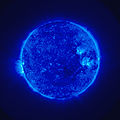
Sun in ultraviolet


Satellites
The satellites of the Sun include all the planets and dwarf planets, and most of the asteroids. [[Satellite::{{#ask:Primary::Sun|link=none|limit=250|sep=| ]][[Satellite::}}| ]] {{#compound_query:Primary::SunMember of::planet
- ?Periapsis#AU=Perihelion
- ?Apoapsis#AU=Aphelion
- ?Orbital eccentricity=Eccentricity
- ?Sidereal period#a=Sidereal year
- ?Inclination#°
- ?Planet mass#M⊕=Mass
- ?Sidereal day#h
|Primary::SunMember of::Dwarf planet
- ?Periapsis#AU=Perihelion
- ?Apoapsis#AU=Aphelion
- ?Orbital eccentricity=Eccentricity
- ?Sidereal period#a=Sidereal year
- ?Inclination#°
- ?Dwarf planet mass#M⊕=Mass
- ?Sidereal day#h
|format=table |intro = This table lists all planets and dwarf planets. To sort by any listed property, use the sortation device in the column header. |}} {{#compound_query:Date of discovery::+Primary::SunMember of::planet
- ?Date of discovery
- ?Discoverer
- ?Name origin
- ?Member of=Celestial class
|Date of discovery::+Primary::SunMember of::dwarf planet
- ?Date of discovery
- ?Discoverer
- ?Name origin
- ?Member of=Celestial class
| sort=Date of discovery | order=ascending | format=timeline | timelinebands=DECADE,CENTURY | timelineposition=end }}
References
- ↑ Trapp, Andrew. "Timescales in Open, Flat, and Very Large Closed Universes." From Now Until the End of Time... Accessed January 17, 2008.
- ↑ 2.0 2.1 Author unknown. "Entry for 'Apogalacticon'." <http://everything2.com/> July 22, 2001. Accessed January 17, 2008.
- ↑ 3.0 3.1 Calculated
- ↑ 4.0 4.1 4.2 4.3 4.4 4.5 4.6 Williams, David R. "Sun Fact Sheet." Goddard Space Flight Center (NASA), September 1, 2004. Accessed January 17, 2008.
- ↑ 5.0 5.1 5.2 5.3 5.4 5.5 5.6 5.7 Harvey, Samantha. "Sun Facts and Figures." NASA, April 26, 2007. Accessed January 17, 2008.
- ↑ This day is actually a synodic day and is the period for the same point on the Sun's equator to appear again directly facing the Earth.
- ↑ 7.0 7.1 7.2 7.3 7.4 7.5 7.6 7.7 7.8 "Entry for 'Sun'." Encyclopædia Britannica, 2008. Encyclopædia Britannica Online. Accessed March 5, 2008.
- ↑ 8.0 8.1 8.2 8.3 8.4 Humphreys, D. R. "The Creation of Planetary Magnetic Fields." Creation Research Society Quarterly 21(3), December 1984. Accessed April 29, 2008.
- ↑ Estimated
- ↑ Dunn, Jimmy. "Re (Ra) and Re-Horakhty." <http://www.touregypt.net/>. Accessed March 5, 2008.
- ↑ Dunn, Jimmy. "The Egyptian God Aten Before and After Akhenaten." <http://www.touregypt.net/>. Accessed March 5, 2008.
- ↑ MacKenzie, Donald A. "Chapter XI: The Golden Age of Babylonia." Myths of Babylonia and Assyria, IndyPublish.com (ISBN 1421962977), December 30, 2005, pp. 240-259. Accessed March 5, 2008, at <http://www.sacred-texts.com/>
- ↑ LeDrew, Glenn. "Our Galactic Home." AstroNotes, 1997. Accessed January 17, 2008.
- ↑ 14.0 14.1 14.2 "Sunspots: Modern Research, Page 2." The Exploratorium, 1998. Accessed March 5, 2008.
- ↑ http://en.wikipedia.org/wiki/Joint_European_Torus
- ↑ http://www.scientificamerican.com/gallery/well-rounded-sun-stays-nearly-spherical-even-when-it-freaks-out/
- ↑ http://en.wikipedia.org/wiki/Corona
- ↑ http://en.wikipedia.org/wiki/Sun
- ↑ 19.0 19.1 "Sunspots: History." The Exploratorium, 1998. Accessed March 5, 2008.
- ↑ Paul describes a region called the "third heaven" as the actual "heaven" where God has His throne. See II_Corinthians 12:2 . But the Bible was not yet readily available to laymen in Galileo's day, and Western man might naturally confuse God's heaven with the lesser "heaven" that we call "outer space" today.
- ↑ "The Sunspot Cycle." The Exploratorium, 1998. Accessed March 5, 2008.
- ↑ "The Sun." Curious about Astronomy? Ask an Astronomer, Cornell University, October 18, 2007. Accessed March 5, 2008.
- ↑ "Factors Affecting Global Temperature." Ponder the Maunder. Accessed March 5, 2008.
- ↑ http://www.scientificamerican.com/gallery/star-spots-on-betelgeuse/
- ↑ http://www.noao.edu/noao/noaonews/dec99/node2.html
- ↑ "Entry for the Sun." Gateway to the Future, <http://library.thinkquest.org/>. Accessed March 5, 2008.
- ↑ 27.0 27.1 27.2 27.3 27.4 Psarris, Spike. Our Created Universe. Seattle Creation Conference, 2007. Video presentation, 55 minutes.
- ↑ Eddy, John. Remarks at a seminar reported in Geotimes, 23:18, September, 1978. Quoted in Pierce, Larry, "The Forgotten Archbishop", in James Ussher, The Annals of the World, Larry Pierce, ed., Green Forest, AR: Master Books, 2003 (ISBN 0890513600), pp. 891-2.

The Sun
Related Links
- Sun by Wikipedia
- Yaron, Ofer. "The Galactic Environment of the Sun." Department of Geophysics and Planetary Sciences, Tel Aviv University, Tel Aviv, Israel, n.d. Accessed January 17, 2008.
- Sunspots The Exploratorium, 1998.
See also


| |||||||||||||||||||||||||||||

