Titan

Titan (Greek Τῑτάν first-generation god), or Saturn VI, is the largest satellite of Saturn, the second-largest planetary satellite in the solar system (after Ganymede), and the only body other than Earth to have bodies of liquid on its surface for any length of time. Until recently most astronomers believed that Titan was the only celestial body other than Earth to have a dense atmosphere. Titan is twentieth in order from Saturn and the sixth satellite of dwarf planet size (consistent with its official IAU catalog designation as "Saturn VI").
The most exciting finds on Titan to date are the liquid hydrocarbon "seas," containing among them more hydrocarbons than the entire proved reserves of oil and natural gas on earth.[8]
Discovery and naming
The Dutch astronomer Christiaan Huygens[4] first discovered Titan on March 25, 1655. He used a telescope far more refined than the one that Galileo Galilei had earlier used to discover four of the moons of Jupiter.[9] This was the first of Saturn's moons to be discovered, so Huygens named the object he found Saturni Luna (Latin for "Saturn's moon"). Giovanni Domenico Cassini and other astronomers would eventually discover eight more moons of Saturn, including at least five inside of Titan. With Cassini's discoveries of the first four of these, Titan's name was changed to "Saturn IV." Titan now bears the catalog designation of "Saturn VI," the identifier that the International Astronomical Union has now assigned it. Recent deep-space robotic missions have discovered that a total of nineteen moons orbit inside Titan, and another forty outside it.[10]
Titan got its common name from John Herschel (son of the astronomer William Herschel). He gave Titan a generic name for the Titans of mythology, and also named the other seven moons then known after specific deities among the Titans.[11]
Orbital and rotational characteristics
Titan follows a slightly eccentric orbit at a mean distance of 1.22 million kilometers from Saturn's center (or rather, the barycenter of the Saturnine system). Its sidereal month is 15.85 Julian days, as is the length of its sidereal day. Astronomers therefore consider it in tidal lock with Saturn.
Titan is also in a 3:4 orbital resonance with the satellite Hyperion, the next farther satellite in the Saturnian system.
Physical characteristics
Titan is slightly larger in radius than Mercury (and Earth's Moon), and is more massive than any of the dwarf planets Eris, Pluto, and Ceres by one to two orders of magnitude. Titan was once thought to be the broadest of all satellites, but the Voyager 1 probe showed that Titan's large apparent diameter was due to its atmosphere, and in fact Ganymede is slightly larger in radius than is Titan.[12].
Titan's bulk is probably half water ice and half rock, in several layers with a rock center and several layers of various crystalline forms of ice.[12]
Magnetometric experiments have not shown any appreciable magnetic dipole moment on Titan at present.[13]
Atmosphere
The atmosphere of Titan is probably its most salient distinguishing feature. Its pressure at the surface is 1.6 times that at sea level on Earth, or roughly the pressure at the depth of an average swimming pool.[14] This atmosphere is composed chiefly of nitrogen and various hydrocarbon compounds that give Titan its orange color.[3]
The constituents of Titan's atmosphere are listed in this table:[15]
| Name | Formula | Concentration |
|---|---|---|
| Major constituents | Percent | |
| Nitrogen | N2 | 87-99 |
| Argon | Ar | 0-6 |
| Methane | CH4 | 1-6 |
| Minor constituents | ppm | |
| Hydrogen | H2 | 2000 |
| Ethane | CH3CH3 | 20 |
| Acetylene | HC#CH | 4 |
| Ethylene | H2C=CH2 | 1 |
| Propane | CH3CH2CH3 | 1 |
| Methylacetylene | H3CC#CH | 0.03 |
| Diacetylene | HC#C-C#CH | 0.02 |
| Hydrogen cyanide | HC#N | 1 |
| Cyanogen | N#C-C#N | 0.02 |
| Cyanoacetylene | HC#C-C#N | 0.03 |
| Acetonitrile | H3C-C#N | 0.003 |
| Carbon monoxide | C=O | 50 |
| Carbon dioxide | O=C=O | 0.01 |
The argon finding is significant because much of it is 40Ar, an isotope usually associated with volcanism. The currently favored interpretation is that Titan has multiple "cryovolcanos" that erupt with water ice and ammonia.[16]
The atmosphere is not of uniform composition. Clouds, presumably of methane, do form. Furthermore, Huygens' images of the surface show clear signs of erosion and formations that look like dry riverbeds, a sign that rain occurs—though the rain is of methane, not water.[12] However, the data do not indicate the looked-for "ocean" of methane, but rather indicate something akin to the seasonal rivers and lakes seen on earth.[12][16]
Until 2005, Titan was regarded as the only natural satellite in the solar system to have a true atmosphere. But the Cassini-Huygens mission has already demonstrated that Saturn's inner moon Enceladus also has an atmosphere, believed composed of ionized water vapor from repeated eruptions from volcanoes and/or geysers on its surface. This "atmosphere" is constantly escaping from Enceladus, perhaps to persist as the E ring of Saturn's ring system. Thus it requires a continuous source of replenishment. The theories of Enceladus' volcanic and/or geothermal activity are an attempt to explain this replenishment.[17]

Liquid Hydrocarbons on Titan
Until the Cassini spacecraft arrived at Saturn, most astronomers understood that Titan's atmosphere had methane as a significant component, and speculated that this methane must derive from a surface ocean of methane. Yet initial observations of Titan's south pole disclosed no such ocean,[18] and indeed not more than two small lakes.[19] But observations of the north pole revealed vast liquid hydrocarbon deposits in the form of multiple lakes and streams, rather than a world-covering ocean.[19][20] These findings easily surpass all the known hydrocarbon reserves on Earth. Yet Lorenz et al. note that while the liquid lakes appear adequate in the short term to replenish methane lost through photolysis, they could not keep the atmosphere supplied with methane over deep time.
Video
{{#ev:youtube|iRCpTvS_BmY}} NASA animation of Cassini as it mapped the north pole region of Titan, and of the hydrocarbon lakes. Credit: JPL/NASA/USGS.
The Prebiotic-Abiotic Controversy
Before the launch of the Cassini-Huygens mission (see below), speculations on whether Titan had the required elements for abiogenesis were rife.[3] Specifically, scientists believed that the methane in Titan's atmosphere would combine photochemically to yield ethane, ethylene (ethene), acetylene (ethyne), and hydrogen cyanide, and thus form amino acids.[3][14]
The Huygens lander has thus far found no biological process, though it has found the suspected constituents, and more. But gas-chromatograph mass spectrophotometric findings have also shown that the bulk of the methane on Titan is actually 13C methane—not the 12C methane that one would normally expect from biological processes.[21] Scientists at the Goddard Space Flight Center conclude that this methane is vented to the surface from a supply that was somehow trapped deep beneath the surface when Titan was formed. Furthermore, this lends further support to Thomas Gold's 1998 hypothesis that Earth's own supplies of oil and natural gas are in fact abiotic in origin.[22]
This latest finding militates against the speculation that life might exist on Titan. Many scientists believe that Titan's chemistry and physical features are of a type that could have given rise to the earliest chemicals required for life, had Titan been much closer to the Sun than it actually is. That speculation predates the Cassini-Huygens mission and includes a model suggesting that Titan harbored a vast underground reservoir of ammonia solution.[23] That particular model depended on the methane and the cyanide being biogenic, but as has been noted above, the methane certainly is not biogenic.
Possible Subsurface Ammonia Ocean
The ammonia-water "aquifer" might yet exist, however, as a vast subsurface ocean. The 40Ar findings certainly suggest this.[16] But recently Cassini's controllers carefully mapped fifty of Titan's landmarks and then discovered an apparent shift of all fifty landmarks by as much as 30 km (less than 20 miles). This finding suggests that the moon's crust is somehow decoupled from its core and is floating on top of a liquid layer. Astronomers believe that this layer lies 100 km (over 60 miles) deep to the rocky surface.[24]
Problems for Uniformitarian Theories
The most serious problem that Titan poses for uniformitarian theories is that astronomers still have not found the vast reserves of methane that would be necessary to maintain the current level of methane in the atmosphere over deep time. Lorenz and his colleagues state flatly that Titan must be subject to drastic climate change unless an as-yet unaccounted-for internal source of methane is replenishing the atmosphere "at exactly the right rate" (emphasis added).[20]
Yet the findings suggesting an ammonia aquifer 100 km deep to the surface make such an internal source much more difficult to explain. This is especially so if, as suspected, the entire surface of Titan floats on the ammonia ocean beneath it with no connection to the core.
Observation and Exploration
In the 300-plus years since its discovery, the only study of Titan was by observation with Earth-based telescopes. Visiting mission::Pioneer 11 made a brief flyby of Saturn in 1979 and took several low-quality images. Visiting mission::Voyager 1 and Visiting mission::Voyager 2 were next to visit Saturn in 1980 and 1981; Voyager 1 did make a close flyby of Titan, but its instruments could not penetrate the thick haze of the Titanian atmosphere.[3]
In 1994 the Hubble Space Telescope took photographs of an apparent "continent" on the Saturnian face of Titan.[14]
The first truly comprehensive study of that system is the Visiting mission::Cassini-Huygens mission, which launched on October 15, 1997 and arrived in the Saturnian system on July 1, 2004.[3] The major innovation of this mission was the use of radar equipment aboard the orbiter and the lander, to penetrate the haze.
Huygens was designed to land, and to study the atmosphere and the surface in detail on the way down. Huygens landed fully functional on Titan on January 14, 2005. It remained functional for three hours while it sent back many images and much data on the composition, including the carbon-isotopic ratio, of the Titanian atmosphere.
Cassini continues to study Titan and the rest of the Saturnine system. Its mission was originally scheduled to run for four years, ending in July 2008, but NASA has announced a two-year extension with multiple rendezvous with Titan and additional rendezvous with Enceladus, Rhea, Dione, and Helene. Mission planners also suggest that after two years, Cassini might still have enough fuel for another two-year extension, and speak hopefully of specific future missions to Titan and Enceladus.[25]
In fiction
Titan was a frequent staple of science fiction in the 1950's and 1960's. Specifically:
- Robert A. Heinlein conceived of Titan as an ideal location for a cold-regions field-testing laboratory for emergency survival equipment.
- Carey Rockwell conceived of Titan as a mining colony. He never made clear exactly what sort of mineral wealth Titan might possess, but the hydrocarbons alone (and in a reducing atmosphere) might have been a good candidate, had Mr. Rockwell known then what NASA and the ESA know today.
- Larry Niven envisioned Titan as an exclusive and expensive resort destination. He conceived of a resort built on Titan's Saturnine face, where guests could gaze at Saturn and its rings. He wrote this concept, of course, before Voyager 1 made its flyby and was unable to photograph the surface of Titan through the haze. Moreover, Titan's orbit is only slightly inclined with respect to the ring plane, so that even had the atmosphere been clear, the view might not have been as spectacular as Mr. Niven might have imagined.
Gallery
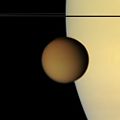
Titan transits Saturn just south of the ring plane
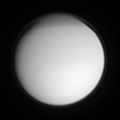
Titan's hazy atmosphere in ultraviolet light

Three false-color mosaics of Titan showing changes in its atmosphere within three months
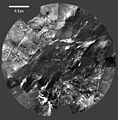
Surface of Titan from 17 to 8 km up, from Huygens lander as it descended
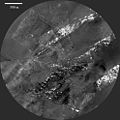
Surface of Titan from 7 to 0.5 km up, from Huygens lander as it descended
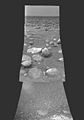
Surface of Titan, from Huygens lander after it landed

Surface of Titan, in color, from Huygens lander


References
- ↑ 1.0 1.1 "Titanic complexity," Space Science Institute, Jet Propulsion Laboratory, NASA, February 13, 2006. Accessed February 16, 2008.
- ↑ 2.0 2.1 "Gazetteer of Planetary Nomenclature: Planetary Body Names and Discoverers." US Geological Survey, Jennifer Blue, ed. March 31, 2008. Accessed April 17, 2008.
- ↑ 3.0 3.1 3.2 3.3 3.4 3.5 3.6 3.7 3.8 Hamilton, Calvin J. "Saturn's Moon Titan." SolarViews, 2001. Accessed February 16, 2008.
- ↑ 4.0 4.1 "Discoverer of Titan: Christiaan Huygens." ESA Space Science, European Space Agency, April 24, 2007. Accessed February 16, 2008.
- ↑ 5.0 5.1 5.2 5.3 5.4 5.5 Calculated
- ↑ 6.0 6.1 6.2 "Planetary Satellite Mean Orbital Parameters," Solar System Dynamics, JPL, NASA. Accessed February 16, 2008.
- ↑ 7.0 7.1 7.2 "Planetary Satellite Physical Parameters." Solar System Dynamics, JPL, NASA. Accessed February 16, 2008.
- ↑ Corsi, Jerome R. "New data: Maybe oil isn't from dead dinos." WorldNetDaily, February 15, 2008. Accessed February 16, 2008.
- ↑ Van Helden, Albert. "Huygens's Rings, Cassini's Division, & Saturn's Children." Dibner Library Lecture, October 27, 2004. Accessed February 16, 2008.
- ↑ The list of Saturn's moons might not yet be complete, and does not include three moons that recent observations have suggested but not yet proved.
- ↑ Lassell, "Satellites of Saturn," Monthly Notices of the Royal Astronomical Society, 8:42, November 12, 1847. Accessed February 16, 2008.
- ↑ 12.0 12.1 12.2 12.3 Arnett, Bill. "Entry for Titan." The
Nine8 Planets, May 27, 2005. Accessed February 16, 2008 - ↑ Backes, Heiko, Neubauer, Fritz M., Dougherty, Michele K., et al. "Titan's Magnetic Field Signature During the First Cassini Encounter." Science, 308(5724):992-995, May 13, 2005. doi:10.1126/science.1109763 Accessed May 16, 2008.
- ↑ 14.0 14.1 14.2 "Entry for Titan." Solar System Exploration, NASA, September 7, 2007. Accessed February 16, 2008.
- ↑ "Entry for Titan's Atmosphere." Cassini-Huygens mission, European Space Agency, February 15, 2005.
- ↑ 16.0 16.1 16.2 "Seeing, touching and smelling the extraordinarily Earth-like world of Titan." Cassini-Huygens project, European Space Agency, January 21, 2005. Accessed February 16, 2008.
- ↑ "Cassini finds atmosphere on Enceladus." ESA Cassini-Huygens, March 16, 2005. Accessed February 16, 2008.
- ↑ "No oceans on Titan, say researchers." <http://physorg.com/>, August 4, 2005. Accessesd May 16, 2008.
- ↑ 19.0 19.1 "Titan's surface organics surpass oil reserves on Earth." European Space Agency, February 13, 2008. Accessed May 16, 2008.
- ↑ 20.0 20.1 Lorenz, Ralph D., Mitchell, Karl L., Kirk, Randolph L., et al. "Titan's inventory of organic surface materials." Geophysical Research Letters, vol. 35, L02206, January 29, 2008. doi:10.1029/2007GL032118 Accessed May 16, 2008.
- ↑ "Titan's Mysterious Methane Comes From Inside, Not The Surface." Press release, Goddard Space Flight Center, NASA, November 30, 2005. Accessed February 16, 2008, from <http://www.spaceref.com/>
- ↑ "'Fossil fuel' theory takes hit with NASA finding." WorldNetDaily, December 1, 2005. Accessed February 16, 2008.
- ↑ Fortes, A. B. "Exobiological Implications of a Possible Water-Ammonia Ocean Inside Titan." Icarus, 146(2):444-452, August 2000. doi:10.1006/icar.2000.6400 Accessed February 16, 2008. Full text available to subscribers or for a fee.
- ↑ Brown, Dwayne, and Martinez, Carolina. "Cassini Spacecraft Finds Ocean May Exist Beneath Titan's Crust." NASA, March 20, 2008. Accessed May 16, 2008.
- ↑ Brown, Dwayne, and Martinez, Carolina. "NASA Extends Cassini's Grand Tour of Saturn." NASA, April 15, 2008. Accessed May 16, 2008.
 Browse |
Related link
| |||||||||||||||||||||||||||||


| ||||||||||||||||||||||||||||||||||||||

