Mimas


Mimas or Saturn I is the eighth moon of Saturn in order of distance, the sixth moon of Saturn to be discovered, and the seventh heaviest.[8] It is also the smallest known body in the solar system that maintains a hydrostatic equilibrium shape.
Discovery and naming
William Herschel discovered Mimas on July 18, 1789.[9]
Sir John Herschel, his son, suggested the current names of the seven largest satellites of Saturn, including Mimas. Titan received a generic name, and the other six received names of the Titans of mythology. Mimas was a giant who fell in battle against either Hephaestus or Ares in the Titan-Olympian War.[10]
Orbital characteristics
Mimas is in a somewhat eccentric orbit around Saturn. Its semimajor axis is 185,520 km, and thus it is outside the main body of the rings but within the E ring. Its sidereal day is about 22.5 hours.
Rotational characteristics
Mimas is in tidal lock with Saturn.[11]
Physical characteristics
Mimas is slightly more dense than water, and thus is probably composed mostly of water ice.[2][11][12] The tidal interaction between it and Saturn causes it to assume an ellipsoidal shape. Its radial semi-axis is 209 km.[4]
Surface
The surface of Mimas is covered with multiple impact craters. Most of these are very deep, apparently because Mimas is not large enough for its self-gravity to relax the surface.[13]
The largest and most prominent impact crater is named Herschel, after the discoverer.[8] It measures 130 km in diameter and 10 km deep. Its walls rise 5 km high, and its central mountain rises 6 km above the floor.[11][2][12] The Cassini orbiter has photographed apparent fracture marks on the side of Mimas opposite Herschel. This last has caused debate among astronomers as to how great an impact a body can suffer without shattering.[2][12] In fact, some astronomers even speculate that a much larger body once occupied Mimas' place in the Saturnian system, and suffered a shattering impact. The fragments then reassembled themselves to form Mimas.[12]
The remaining craters vary in diameter from 20 km to 40 km.[2] Curiously, the south pole region has few craters larger than 20 km in diameter.[2]
Observation and Exploration
Visiting mission::Voyager 1 was the first to visit and photograph Mimas. In the process, Voyager 1 discovered the Herschel crater.
The Cassini orbiter has taken many more images of much higher quality. Its closest rendezvous with Mimas took place on August 2, 2005. No further rendezvous are currently planned.
Gallery
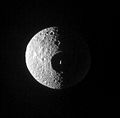
Mimas, looking directly at Herschel by Cassini

Mimas, with Herschel at upper right, in false colors, showing surface constituent variation
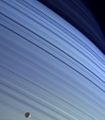
Mimas against Saturn's northern hemisphere. The lines are the shadows of Saturn's rings.


References
- ↑ 1.0 1.1 "Gazetteer of Planetary Nomenclature: Planetary Body Names and Discoverers." US Geological Survey, Jennifer Blue, ed. March 31, 2008. Accessed April 17, 2008.
- ↑ 2.0 2.1 2.2 2.3 2.4 2.5 2.6 2.7 2.8 Hamilton, Calvin J. "Entry for Mimas." Views of the Solar System, 2001. Accessed June 13, 2008.
- ↑ 3.0 3.1 3.2 3.3 3.4 3.5 Calculated
- ↑ 4.0 4.1 4.2 4.3 4.4 4.5 4.6 4.7 4.8 4.9 Williams, David R. "Saturnian Satellite Fact Sheet." National Space Science Data Center, NASA, November 23, 2007. Accessed June 4, 2008.
- ↑ "Classic Satellites of the Solar System." Observatorio ARVAL, April 15, 2007. Accessed June 12, 2008.
- ↑ Jacobson, R.A., Spitale, J., Porco, C.C., and Owen, W.M., Jr. "The GM Values of Mimas and Tethys and the Libration of Methone." Astron. J. 132:711-713, 2006. doi:10.1086/505209 Accessed June 13, 2008.
- ↑ "Planetary Satellite Physical Parameters." Solar System Dynamics, JPL, NASA. Accessed June 14, 2008.
- ↑ 8.0 8.1 "Entry for Mimas." The Planetary Society, n.d. Accessed June 13, 2008.
- ↑ Arrago, M. "Herschel." Annual Report of the Board of Regents of the Smithsonian Institution, 1871, pp. 198-223
- ↑ Lassell, William. "Satellites of Saturn." Monthly Notices of the Royal Astronomical Society, 8(3):42-43, January 14, 1848. Accessed June 4, 2008.
- ↑ 11.0 11.1 11.2 Hubbard, William B. "Mimas." Encyclopædia Britannica. 2008. Encyclopædia Britannica Online. 14 June 2008.
- ↑ 12.0 12.1 12.2 12.3 Arnett, Bill. "Entry for Mimas." The
Nine8 Planets, August 4, 2005. Accessed June 14, 2008. - ↑ Thomas, P.C., Veverka, J., Helfenstein, P., et al. "Shapes of the Saturnian Icy Satellites." 37th Annual Lunar and Planetary Science Conference, 2006. Accessed June 13, 2008.
 Browse |
Related Links
| |||||||||||||||||||||||||||||


| ||||||||||||||||||||||||||||||||||||||

