Ribonucleic acid

Ribonucleic acid (RNA) is similar to DNA in that it is also a chain (or polymer) of nucleotides with the same 5' to 3' direction of its strands. However, the ribose sugar component of RNA is slightly different chemically than that of DNA. RNA has a 2' oxygen atom that is not present in DNA. Other fundamental structural differences exist. For example, uracil takes the place of the thymine nucleotide found in DNA, and RNA is, for the most part, a single-stranded molecule. DNA directs the synthesis of a variety of RNA molecules, each with a unique role in cellular function. For example, all genes that code for proteins are first made into an RNA strand in the nucleus called a messenger RNA (mRNA). The mRNA carries the information encoded in DNA out of the nucleus to the protein assembly machinery, called the ribosome, in the cytoplasm. The ribosome complex uses mRNA as a template to synthesize the exact protein coded for by the gene.[1]
Composition
Ribonucleic Acid is made up of a pentose group, which is a five carbon sugar, a phosphoric acid and a organic base. The structure of RNA is very similar to DNA. RNA is a linear polymer. However it does not have a linear structure. It has many regions in its polynucleotide chain where it folds in on itself creating structures that are called hairpin loops. This results in the formation of a helical structure like DNA in certain portions of its chain. Nucleotides such as ATP, GTP, CTP or UTP attach to the molecule by phosphodiester bridges (bonds). These bonds attach to either that 3' carbon or the 5' carbon in the sugar group ribose. In its chemical structure each nucleotide that makes of RNA has only one subtle difference from its DNA counterpart. It has one extra OH group. As DNA changes into RNA an OH group is added and TTP switches out with UTP. DNA's double helix structure is broken into two as it becomes RNA. RNA has a single helical structure. [1]
RNA Functions

There are four types of RNA. There is the messenger RNA (mRNA), transfer-RNA (tRNA), ribosomal-RNA (rRNA), and catalytic-RNAs.(Purves 236-39)
Messenger RNA
Messenger ribonucleic acid (mRNA) is a single-stranded RNA copy of a gene that is made during a process called transcription. After its synthesis, the mRNA is transported out of the nucleus to the cytoplasm where it binds to an organelle called a ribosome. The ribosome moves along the mRNA, reads the nucleotide sequence, and translates the "genetic code" into corresponding amino acids. The resulting chain of amino acids will eventually become a protein.[2]
Transfer RNA

Transfer ribonucleic acid (tRNA) is a small RNA molecule that participates in protein synthesis. Each tRNA molecule has two important areas: a trinucleotide region called the anticodon and a region for attaching a specific amino acid. During translation, each time an amino acid is added to the growing chain, a tRNA molecule forms base pairs with its complementary sequence on the messenger RNA (mRNA) molecule, ensuring that the appropriate amino acid is inserted into the protein.[3]
Ribosomal RNA
Ribosomal ribonucleic acid (rRNA) Over 50% of the ribosome is made up of rRNA and is required for the proteins to be properly made.(Purves 236-39)
Role in Gene Expression
- Main Article: Gene expression
Proteins in the body are made from the instructional code found in DNA. The DNA however stays in the nucleus and is not accessible to the ribosomes that catalyze the polymerization of amino acids. RNA is instead created as a "message" (called messenger RNA) to be sent to the ribosome with instructions for assembling a protein. This messenger RNA is a transcript or copy of DNA that is almost, but not 100% identical. In particular, DNA is a deoxy form of the molecule (one fewer OH group per nucleotide). Also, in the process of making RNA, one of the nucleotides is substituted - TTP (Thymidine Triphosphate) is replaced for UTP (Uridine Triphosphate).
 |
 |
Transcription is the process whereby DNA is copied to a single-stranded RNA. This process is catalyzed by the enzyme RNA polymerase. This enzyme attaches itself to a portion of the DNA strand and replicates it sending out mRNA or rRNA. During transcription there needs to be a promoter. A promoter is a certain sequence of DNA which RNA polymerase can bind to. It creates a very tight bond with the promoter. There are at least one promoter for every gene in the genome. Promoters do three specific jobs. They tell RNA, 1. Where to start transcription, 2. Which strand of DNA to read, and 3. The direction to take from the start. After the specific promoter has been chosen by the RNA polymerase a process called elongation begins. This process is where the polymerase adds nucleotides (A, U, C, G) to a section of DNA of about 20 amino acids and replicates it. However it is created antiparallel to DNA. DNA is 5' to 3' and RNA transcribes as 3' to 5'. The elongation process will continue until it reaches a certain termination site in the DNA. There is also a specific initiation site the tells where the transcription is to start taking place.(Purves 236-39)
Gallery
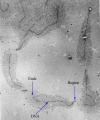
Electron micrograph of Ribosomal RNA transcription units of Chironomus thummi (Diptera). Magnification - 40.000x.

References
- ↑ What is a Genome? by the National Center for Biotechnology Information
- ↑ Messenger RNA (mRNA) Talking Glossary of Genetics Terms, National Human Genome Research Institute. Accessed September 25, 2010.
- ↑ Transfer RNA (tRNA) Talking Glossary of Genetics Terms, National Human Genome Research Institute. Accessed September 25, 2010.
- Molecular Biology more info
- Purves, William K. et al. Life: The Science of Biology. Gordensville, VA. 2004.
| ||||||||||||||


| |||||||||||||||||

