Battery

A battery consists of at least two electrochemical cells that are arranged so that the resulting chemical reaction produces usable electrical energy. There are many different types of batteries in common use today, but in one form or another they are a central component in almost all portable electronic devices.
Batteries are used for nearly all portable electrical devices, being a convenient and reliable source of electricity. Small battery cells are used to power wristwatches, both digital and analog, as well as hearing aids and LCD devices. The common AA and AAA sizes are used for a wide range of hand held devices, such as radios, voice recorders, and remote controls. Larger batteries are used in cars to power the electrical starting motor of the internal combustion engine. Some cars have been designed to rely solely on electrical energy, and in this instance the batteries are the exclusive source of energy.
Function
Batteries operate because of electrochemical reactions, which produce the electron imbalance needed to provide electromotive force. Every battery has two terminals which connect to the positive and negative sides of the battery. When operating batteries, the electrons run through the negative terminal through a device or load, to the positive terminal because of the imbalance of electrons created by the chemical reaction. Since the chemicals only continue to produce electrons when electrons pass from one terminal to the other, batteries kept in cool dry places may remain fully charged even if a number of years passes.[1]
In general batteries have an anode, a cathode, an anode charge carrier, a cathode charge carrier (often both carriers are in the form of liquids, pastes or thin layers), and some sort of bridge or porous wall that maintains the charge carriers separate but allows ions to pass back and forth. Batteries need an anode where electrons come out of the battery into the circuit (some remember this by the mnemonic ACID which represents: Anode Current Into the Device) [2] and a cathode where the electrons flow out of the circuit back into the battery (remembered by CCD, Cathode Current Departs) [3]. The charge carriers are usually chemical solutions, gels, or pastes that are moist enough to allow ions to flow. The bridge, or wall between the two charge carriers is usually something porous that allows the ions or their charge to pass back and forth from the two charge carriers. Sometimes, when an anode and cathode can be placed into the same electrolyte, a thin layer of solution on the anode and another on the cathode act as charge carriers while the electrolyte itself is the bridge.
For example, a Zinc–carbon has the same basic parts, including: the container, cathode, separator, anode, electrons, electrolyte, and collector. Battery containers often are made from steel to allow electrons to flow more easily to the device. The negative Cathode is a mixture of manganese dioxide and carbon, which absorbs positive ions in an electrochemical reaction. A Separator consists of a fibrous fabric which separates the two electrodes and lets ions pass without allowing the electrolyte chemicals to mix. Anodes, which absorb electrons from negative ions, are often made of powder. Electrochemical reactions occur at the anode and cathode electrodes. The Electrolyte is often a potassium hydroxide solution, which provides the ions which move from the anode to the cathode. The last part, the collector, is placed in the middle of the inside the battery with a brass pin which conducts electricity.
When making a battery, the factory starts with the empty steel container, then layers the cathode which is the manganese dioxide powders which make the positive electrical charge, over the inside wall of the container. Next, the separator, a thin paper, covers the cathode powders. the anode material which carries the negative charge, is spread over the separator layer. Finally, to form the negative current collector, the brass pin is inserted into the anode in the middle of the container. The chemical reactions will begin when the battery is inserted in any device. All batteries operate by a chemical reaction. The powdered zinc of the anode is oxidized by the electrolyte, and the cathode with its mixture of manganese dioxide and carbon reacts with the anode to produce electricity. When everything is in place, electric current will be conducted, and electric devices will start working.
Types of Batteries
Batteries can be categorized by size and composition. Researchers have found a very large group of chemical combinations that can produce or store electricity, so that the construction of a battery depends mainly on cost, safety, and shelf life. Depending on the chemicals used, the battery will be ready for use upon assembly and then becomes unusable upon exhausting its charge (called a primary cell), or will have to be charged and then be rechargeable (called a secondary cell)[4].
Rechargeable batteries and Alkaline Dry Cell Batteries are the most frequently used batteries among all types of batteries. Of them all, AA type batteries are most common batteries in use. Car batteries are another category of widely used batteries. Batteries were actually not used much in cars during the first wave of automobile construction after 1900, and in the 1930s, car batteries almost disappeared because they weren't essential. But as cars continued to be developed, most gasoline cars used batteries to operate the starter motor at ignition, and for accessories. Generator systems allow car batteries to be charged while the engine is operating.
History

The originator of the Battery is known as Alessandro Volta who is an Italian physicist, the word volt (V) comes from his name.[5] He created the first voltaic pile in 1800. A Voltaic pile is the combination of silver , zinc, and blotting paper soaked in salt water and alternating materials from the top to the bottom. The pile can be constructed in any size. You can make one by yourself quite simply, or you can either buy a kit for $10 to $20.

Voltaic Piles were first made by Volta who made a pile of alternating zinc and copper discs (sometimes silver and zinc discs). In between the disks he placed pieces of cloth or cardboard soaked in salt water which provided the charge carrier and the bridge. [6] These piles were the main source of electricity for experimenters for many years.
Dry Piles probably started when some of the voltaic piles dried out and were found to still produce electricity. Though “dry” they contain just enough water to serve as a charge carrier. [7]
The Zamboni Pile was invented by Giuseppe Zamboni in 1812. It is a dry pile that uses alternating discs of zinc foil, silver foil and paper (or paper with zinc backing in place of paper and zinc foil) with a paste of manganese oxide (sometimes honey was used instead) rubbed on each disc. With enough layers, large voltages (3000 volts) can easily be achieved. Oxford University owns a bell that is believed to be run on a Zamboni pile made before 1840 that has rung twice a second from 1840 until now, more than ten billion electrostatic movements. [8]
The Daniell Cell, was invented in 1836 by John Daniell. He used a zinc anode and a copper cathode, the zinc anode was immersed in a porous earthenware pot containing a zinc sulfate solution. This earthenware pot was placed in a copper can full of copper sulfate solution, so that the can became the cathode and the porous pot kept the copper sulfate from reaching the zinc anode which would neutralize the copper sulfate ions without generating any current. [9] The Daniell cell (also known as Crowfoot cell, Gravity cell, and Wet cell) was used for telegraphs and doorbells before 1870, which is before electrical generators had been invented. [10]
The Gravity Cell (also called the Crowfoot Cell) was invented in the 1860’s by Msr. Callaud of France. It was a modified Daniell cell where the zinc sulfate solution simply sat on top of the denser copper sulfate solution. The bridge was simply where the two solutions touched. If the cell became too hot, or was moved too much, the solutions mixed and ruined the battery. The anode and cathode were made to spread like fingers to provide more contact with their solutions, and looked like crow’s feet. The gravity cell was used to power telegraphs. [11]
The Grove Cell was produced by William Robert Grove of Wales, who taught Physics in London. In approximately 1839, he found that he could make a battery that produced twice the current of the Daniel cell by using a zinc electrode in sulfuric acid and a platinum electrode in concentrated nitric acid. He separated the acids with a porous pot. Telegraph companies used the batteries extensively until they too were found to produce a toxic gas. Grove is also known for inventing the first fuel cell. [12]
The Bunsen cell improved on the Grove cell by replacing the platinum with carbon. Robert Bunsen worked at the University of Marsburg in Germany and made many chemical discoveries. This cell still produced toxic gas. [13]
The Leclanché Cell, invented by Georges Leclanché of France, used carbon and zinc electrodes. Originally it was an improvement on the Bunsen cell because it used a much less toxic liquid electrolyte, but later the cells were closed and a damp paste took the place of the liquid. These became the carbon-zinc dry cells that were used before modern alkaline batteries appeared. [14]
The Earth Battery consisted of two different kinds of metal coils buried in damp ground. These were found to have good output and long term reliability. The construction of long telegraph lines brought about the discovery of underground electrical currents, which probably helped the efficiency of the Earth batteries. [15] Nathan Stubblefield of Kentucky holds a patent from 1898 for an earth battery which uses coils of copper and iron wires separated by a porous cloth insulation which would function simply by being buried in the ground [16].
| Period | Incident | Designation | |
|---|---|---|---|
| 200 B.C | Baghdad battery | Unknown | |
| 1791 | Frog leg experiment | Galvani | |
| 1792 | Voltaic piles | Volta | |
| 1802 | Mass produced battery | Cruickshank | |
| 1813 | Giant battery (2,000 cells) | Davy | |
| 1820 | Electricity from magnetism | Ampere | |
| 1827 | Ohm's law | Ohm | |
| 1833 | Ionic mobility in Ag2S | Faraday | |
| 1836 | Cu/CuSO4, ZnSO4/Zn | Daniell | |
| 1839 | Principle of the air cell | Grove | |
| 1859 | Lead acid battery | Planté | |
| 1868 | Zn/NH4Cl/C wet battery | Leclanché | |
| 1874 | Telegraph | Edison | |
| 1878 | Air Cell | Maiche | |
| 1880 | High capacity lead/acid | Faure | |
| 1881 | Zn/NH4Cl/C encapsulated | Thiebault | |
| 1885 | Zinc-bromine | Bradley | |
| 1887 | Zn/NH4Cl/C dry battery | Gassner | |
| 1891 | Thermodynamics of dry cells | Nernst | |
| 1899 | Nickel cadmium battery | Nernst | |
| 1900 | Ni Storage batteries | Edison | |
| 1905 | Ni iron batteries | Edison | |
| 1911 | Automobile self-starter | Kettering | |
| 1927 | Silver zinc | Andre | |
| 1930 | Nickel-zinc battery | Drumm | |
| 1943 | Cuprous chloride battery | Adams | |
| 1945 | Mercury cell | Ruben | |
| 1950 | Sealed mercury Cell | Ruben | |
| 1956 | Alkaline fuel cell | Bacon | |
| 1959 | Alkaline primary cell | Urry | |
| 1983 | Lithium metal rechargeable | Moli | |
| 1991 | Commercial lithium ion | Sony | |
| 1992 | Reusable alkaline | Kordesch | |
| 1995+ | Recent development | - |
Gallery
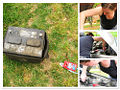
Car batteries widely used and recognized.
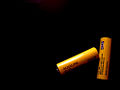
Rechargeable batteries and Alkaline Batteries are the most used batteries.
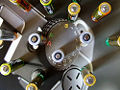
Of all battery types, AA batteries are most commonly used.
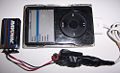
Batteries can even be attached to a computer USB port.
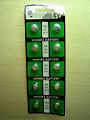
Small, round batteries are usually used for watches.
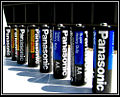
Row of batteries


References
- ↑ Howstuffworks, How Batteries Work by Marshall Brain and Charles W. Bryant. Accessed 3 July 2010.
- ↑ Wikipedia, Anode Accessed 3 July 2010
- ↑ Wikipedia, Cathode Accessed 3 July 2010
- ↑ http://en.wikipedia.org/wiki/Primary_battery Wikipedia, Primary battery]
- ↑ Corrosion Doctors, Alessandro Volta
- ↑ Wikipedia, Voltaic pile Accessed 3 July 2010
- ↑ Dry Pile Accessed 3 July 2010
- ↑ Oxford University, Clarendon Laboratory Exhibit Accessed 3 July 2010
- ↑ Wikipedia, Daniell cell Accessed 3 July 2010
- ↑ Howstuffworks, How Batteries Work by Marshall Brain and Charles W. Bryant. Accessed 3 July 2010.
- ↑ Wikipedia, Daniell cell
- ↑ Corrosion Doctors, Sir William Grove Accessed 3 July 2010
- ↑ Corrosion Doctors, Robert Willhelm Bunsen Accessed 3 July 2010
- ↑ PowerPedia, Electric battery history Accessed 3 July 2010
- ↑ PowerPedia Earth battery Accessed 3 July 2010
- ↑ Electrical Battery, United States Patent Office Patent 600,457. Accessed 3 July 2010
- Battery History Mary Bellis. About.
- How Batteries Work Marshall Brain and Charles W. Bryant. Howstuffworks.
- Battery (electricity) Wikipedia
- Re: who invented the battery? Dan Berger. MadSci.
- History of the battery Wikipedia
- Part One - Battery Basics Everyone Should Know Isidor Buchmann. Technick.
- Fascinating facts about the invention of the Electric Battery by Alessandro Volta in 1800. The Great Idea Finder. ideafinder.
- Battery History Corrosion-doctors
- The Battery: Using Chemistry to Make EnergyIeee-virtual-museum
- Electropedia
| ||||||||||||||


