Douglas-fir
| Douglas-fir |
|---|

|
| Scientific Classification |
|
| Species |
|

|
The Douglas-fir is any of the species of evergreen trees belonging to the taxonomic genus Pseudotsuga. Despite its name, it is not a true fir, nor a pine. This tree is a certain species named after Scottish physician Archibald Menzies who first discovered it. This tree's taxonomy has been changed many times until the current taxonomy which it is now. This tree ranges all over the [United States] and [Canada], and even down into Mexico. The Douglas-fir is a main tree for the softwood industry and is logged heavily, but strict laws prevent any unecessary logging to be stopped. The tree can grow up to 200 feet tall and produces seed cones to reproduce. This tree has many different common names and different types of species listed in the taxonomy to the right along with different locations. The only thing seperating these species are the cones which are very unique.
Anatomy
The Douglas-fir is a unique tree which can grow up to 200 feet tall in its natural location in the West. It has branches which are pendulous and whorled, which contain yellow-green to blue-green needles about 3/4 to 2 inches in length. This tree has very distinctive cones which are about 3-4 inches in length and have rounded scales which mature in late summer. Twigs coming off the branches are slim and brownish-red, which have long and pointed red-brown buds. This tree's bark is smooth and gray on young stems, but once the bark matures and the tree grows it becomes thick and rigid and changes color to red-brown[1]. This tree is used majorly in western states like Oregon in the lumber industry due to the sheer numbers of this tree. The softwood lumber produced by this tree makes Oregon the top softwood producing state in the country. There are very strict laws that have been made to protect this tree, and many new seedlings are planted every year to insure there is no risk of endangering them.[2]
Reproduction

The Douglas-fir reproduces in seed cones. These cones are unique to this tree due to the 3-pointed bracts, rounded scales and red-brown color of them. The full reproduction cycle takes 17 months to complete which usually begins in April. Both asexual and sexual reproduction take place during this time. To start, buds form. Once the buds are formed, pollen starts to form and it pollinates the flowering bud producing a seed cone. After this happens, the seed cones grow very rapidly. The next step is the seeds and embryo develop in the cone. After the cones grow a little more, they become mature and shed their seeds. This whole process takes over a year and a half and result in many new trees. The Douglas-fir starts this cycle when it is 12-15 years old, being the time when it can start producing cones. There are both male and female cones, the difference being the female cones are larger and a bit different in color. Trees can produce a different number of cones dependent on a number of variables like the number of primordia that develop into buds. Also, the older the tree is, the better the chance it has of producing more cones[3]. The Douglas-fir continues to grow in numbers due to the strict laws in the Northwest. Even those these trees are logged, the more of the older trees there are, the more they will reproduce resulting in many seedlings for the future. This tree continues to support the softwood industry, especially in the Northwest, and will continue to do such in the future as long as they successfully reproduce[4].
Ecology
The range of the Douglas-fir is the greatest of the commercial conifers in the west of North America. The orginal range of this tree is from central British Columbia, all the way down over 1,300 miles south along the coast. A longer arm of this ranges from central Mexico to up north over 2,700 miles into the Rocky Mountains. The range of the Douglas-fir is continuous through Idaho, western Montana and Wyoming. These trees are very abundant along the coast in Oregon and Washington, northern California and up into Canada[5]. The Douglas-fir is used widely for softwood timber, and produces the most out of any other tree in these areas. This tree grows faster then some other species of this tree like the Rocky Mountain Douglas-fir (Pseudotsuga menziesii glauca), and can grow up to 200 feet tall. This tree provides food for some animals through its seeds. Some animals like chipmunks, mice, voles, and shrews chew these seeds from the cones once they fall after maturing. Also many species of songbirds extract these seeds from the tree so they fall for these other animals to use as food. Other birds rely on the Douglas-fir for cover as they migrate across thousands of miles[6].
Gallery
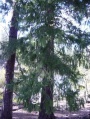
Coast Douglas-fir
Pseudotsuga menziesii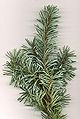
Rocky Mountain Douglas-fir
Pseudotsuga menziesii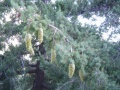
Bigcone Douglas-fir
Pseudotsuga macrocarpa


References
- Pseudotsuga (Douglas-fir) USDA, NRCS. 2010. The PLANTS Database (accessed 3 May 2010). National Plant Data Center, Baton Rouge, LA 70874-4490 USA.
- Anatomy Western Wood Products Association, 522 SW Fifth Ave. Suite 500, Portland, Oregon 97204-2122, 2007.
- Reproduction Morgan Cook, The Metamorphosis Design, 2008.
- Range of Douglas-fir The New York Times Company, About.com, 2010.
- Ecology Wikipedia, last modified on 15 May 2010 at 06:28.


