Coast Douglas-fir
| Coast Douglas-fir |
|---|

|
| Scientific Classification |
|
| Binomial Name |
|
Pseudotsuga menziesii |
 |
The Coast Douglas-fir is a species of gymnosperm found predominantly along the Pacific coast of USA. It is a member of the Douglas-fir genus (Pseudotsuga) with the species name Pseudotsuga menziesii.
History
The first time these plants were mentioned was in 1778, when British explorer James Cook came upon Nootka on Vancouver Island. The masts of his ships were rotting from the long voyage and he needed new ones. The Coast Douglas-fir was perfect due to its straightness, size, and strength. Never before had people been able to make a mast out of just one tree. Historically, to make a complete mast they had to splice two pieces together. The tree is named after a young adventurous Scotsman, David Douglas, who explored much of what is now Oregon, Washington, and British Columbia in the early 19th century. His remarks about the Coast Douglas-fir were: ”tree remarkably tall, unusually straight, having the pyramid form-one of the truly graceful objects in nature."(Lyons, page 19)
Anatomy
The Douglas-fir can grow to over 300 feet tall and 15 feet in diameter. The largest Douglas-fir in the country can be found in Oregon, it is 329 feet tall. The tallest Douglas-firs are estimated to be over 1000 years old. The Douglas-fir can often be free of branches for more than 1/3 of its length. When young, the tree will have a smooth texture and a grayish color. When the tree becomes older, the texture of the tree will break into plates running lengthwise, and the color of the tree will change from grayish to a reddish color. On some of the very old Douglas-firs, the bark can grow up to 12 inches thick.[1] The needles on the Douglas-fir are flat, yellow green and are 2-3 centimeters in length. The cones of the Douglas-fir are green, 5-10 centimeters long when they are young. As the cones mature they turn reddish-brown to grey. They have thin papery scales, with bracts that are usually 3 forked.[pojar. page 32]
Reproduction
The mature female cones are 5-11 centimeters long while the male cones are approximately 2-3 centimeters long. The male cones produce pollen in the spring. The tree will begin to produce a significant amount of seeds when it is 25-30 years old. The Douglas-fir has a irregular cycle of seed production. In the average cone, there are anywhere from 25-50 seeds. In a period of time that usually lasts 5-7 years, the tree usually has a few years with a small to medium crop of seeds, one very large crop and one complete crop failure.[2]
Ecology

The coastal Douglas-fir grows in nearly every forest in the pacific Northwest, and is the most dominant tree of the pacific Northwest.[3] It grows from British Columbia down to central California.[4] It grows in moist, mild climates and is a very fast growing tree. It grows much faster than its cousins the Grand Fir, Coast Redwood, Western Red cedar, California Incense-cedar, Lawson's Cypress, Tanoak, Bigleaf Maple, Sitka Spruce, Sugar Pine, Western White Pine, Ponderosa Pine, and many others. If the coast Douglas fir grows in a very moist environment, it is almost always covered in moss and lichen.[5]
Human Uses
The coast Douglas-Fir has many uses. It is a very strong and durable wood which is resistant to rot; it does not warp, and has the best strength to weight ratio of any tree in North America. Another advantage is that its great size allows very large boards or beams that do not have any major defects or knots. Because of its strength and beauty, coupled with the fact that it does not warp, it is often used in construction.[6]
In construction it is used for a large array of things. It is used for trusses on ceilings, and in structural-glued lumber products. It is used as stock for laminated beams because apart from being very strong, it is also very beautiful. Laminated beams of Douglas fir are often used for large structural beams in places such as church buildings. These beams are also found in stadiums and bridges. The lumber from the coast Douglas-fir works well in the construction of sub flooring and structural flooring. Contractors also use the wood for interior/exterior trim, and finish board materials.
The features that make the Douglas-fir so good for construction makes it perfect for casings in doorways and windows, as well as for millwork, mantles, stairs, and baseboards. Because of its amazing visual quality, it is perfect for paneling, cabinets and furniture.[7] The native Americans used these trees for firewood, spears, shafts for harpoons, and fish hooks. They used its pitch as a salve and to make their canoes watertight.
In more recent times, the Douglas-fir has been exported for plantation forestry in Europe, mostly in France and Germany, where now millions grow. [Lyons, page 19]
Gallery
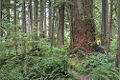
coastal douglas-fir
(Pseudotsuga menziesii)
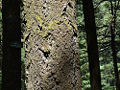
coastal douglas-fir
(Pseudotsuga menziesii)
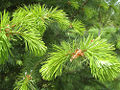
coastal douglas-fir
(Pseudotsuga menziesii)


References
- Lyons, Chess. Trees & Shrubs of Washington. Lone Pine publishing, 1999
- Pseudotsuga menziesii Floridata
- Coast Douglas-fir Wikipedia
- Douglas Fir & Western Larch Western Wood Products Association.


