Creation Evidence Museum of Texas

The Creation Evidence Museum of Texas is a non-profit creation museum located Glen Rose, Texas. Founded in 1986 by creationist Carl Baugh, the Creation Evidence Museum of Texas provides evidence for Creation and intelligent design. The museum is home to many different fossils and artifacts, including footprints of humans and dinosaurs together, and a twenty-five foot replica of Noah's Ark.[1] The museum has led many digs including the Paluxy river dig. The museum also houses a hyperbaric biosphere which, shows how plants and animals reacted to the pre-flood earth's atmosphere. [2]
|
Name: Creation Evidence Museum of Texas
|
Exhibits

The Creation Evidence Museum of Texas, also referred to as CEM, hosts many exhibits. This includes many fossils, including footprints of humans and dinosaurs, a fossilized human finger, and the London Artifact.[1] The museum also houses a detailed twenty-five foot replica of Noah's Ark. The model ark includes everything we know and everything we think was included in the ark, such as the door, separate sections for the animals, and windows running along the top for ventilation. [3]
One of the displays previously mentioned, including the London Artifact provides much evidence for creation and the global flood. The London Artifact is a hammer. It was found in 1932 by Max Hahn in Cretaceous rock in London, Texas. It has a wooden handle, which was detached when it was buried, and a hammerhead made of iron. Incredibly, there was no corrosion at the time of its discovery, and it remains without any corrosion today.[4] This, although it is claimed to be falsified or fake by evolutionists, still makes one question the age of the earth.[5]
Reseach

The Creation Evidence Museum of Texas has done much research in the name of Creation science. much of this research has been on dinosaurs, so as to prove they lived with humans. At the Paluxy River dig site, they have found over eighty human footprints in Cretaceous limestone. These footprints were found in the same area as dinosaur fossils.[6] Even more incredible is the Turnage Patton Trail. It is a trail of one hundred fifty-seven dinosaur tracks stretching about five hundred feet.[7]The primary trail contains one hundred thirty-six tracks, and the rest of the one hundred fifty-seven can be found after a gap. The trail is considered the longest in North America and one of the best in the world.[8] The Museum has also led a hunt for a living pterodactyl in Papa New Guinea.[9]
The Museum has also done much research as to what the earth might have been like before the flood. They have built what is called a hyperbaric biosphere, which subjects plants and animals to what they believe to be a pre-flood environment. [2] It is said that animals will become smarter when in the biosphere. It has also tripled the lifespan of fruit flies. [10] The museum is currently building a full size biosphere next to the museum. It will have cameras placed throughout with a twenty-four hour livestream.[2]
Carl Baugh
See also: Carl Baugh

Carl Baugh, the director of the Creation Evidence Museum, has also been involved in many other ministries. Born on October 21, 1936, Carl Baugh has had a full life defending creationism. He graduated from Pacific International University, an unaccredited Christian college of which he is currently the president.[11] He was the long time host of Creation in the 21st Century on the Trinity Broadcasting Network, or TBN. He also oversees the biosphere project at the Creation Evidence Museum of Texas.
Carl Baugh and his beliefs, some of which are strange, has been criticized greatly by both evolutionists and Creationists. Evolutionists claim things such as his education is unaccredited and therefore irrelevant, and his fossil findings are misdated, misidentified, or fake. This comes as no surprise, but what does is backlash from the Creationist community. He has made some outlandish claims, some of which include the following: the celestial bodies were closer to earth and that one could hear them sing, people could feel time before the flood, he claims that NASA did an experiment and proved eggs do not hatch outside of earth's magnetic field, and claims that because of higher oxygen pressure, people were smarter before the flood.[12] He also claims to have seen pterodactyls in Papa New Guinea, which are most likely flying fox bats.[13] Answers In Genesis, one of the largest Creation ministries, wrote an article titled What About Carl Baugh?, which criticized these strange views, stating, "It is sad that Carl Baugh will 'muddy the water' for many Christians and non-Christians."[12]
Gallery
Some Displays at the museum

The twenty-five foot model of Noah's ark.
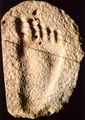
The Burdick track, a human footprint found in Cretaceous rock.
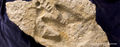
The Alvis Delk Cretaceous Footprint, a human and dinosaur footprint found in Cretaceous rock.
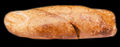
A fossilized human finger discovered in Cretaceous rock.
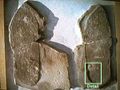
The Meister Sandal Track, the track of a sandal with a trilobite fossil on it.
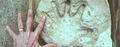
A human hand print found in the same layer of rock as dinosaur footprints.


Video
This video shows a 3D model of the future hyperbaric biosphere.
References
- ↑ 1.0 1.1 Creation Evidence Museum Displays Creation Evidence Museum of Texas. Web. Accessed on October 6, 2017. Author Unknown.
- ↑ 2.0 2.1 2.2 Hyperbaric Biosphere Creation Evidence Museum of Texas. Web. Accessed on October 8, 2017. Author Unknown.
- ↑ Noah's Ark Replica Creation Evidence Museum of Texas. Web. Accessed on October 6, 2017. Author Unknown.
- ↑ The London Artifact Creation Evidence Museum of Texas. Web. Accessed on October 6, 2017. Author Unknown.
- ↑ Anderi, Mihai. The 10 Most Amazing Unexplained Artifacts ZME Science. Web. Accessed on October 6, 2017.
- ↑ Dinosaur Escavations with the Creation Evidence Museum of Texas Creation Evidence Museum of Texas. Web. Accessed on October 7, 2017. Author Unknown.
- ↑ Trunage Patton Trail Creation Evidence Museum of Texas. Web. Accessed on October 7, 2017. Author Unknown.
- ↑ The Turnage-patton Trail The Ineractive Bible. Web. Accessed on October 7, 2017. Author Unknown.
- ↑ Powers, Ashley. Adam, Eve, and T. Rex The LA Times. Web. Written on August 27, 2005.
- ↑ Creation Evidence Museum of Texas Wikipedia - The Free Encyclopedia. Web. Last modified on September 22, 2017. Multiple Authors.
- ↑ Pacific International University Wikipedia. Web. Accessed on October 7, 2017. Author Unknown.
- ↑ 12.0 12.1 Batten, John and Kuban, Glen. What About Carl Baugh? Talk Origins. Web. Accessed on October 7, 2017.
- ↑ Other Veiws: Carl Baugh Institute for Biblical & Scientific Studies. Web. Edited on October 7, 2017. Author Unknown.
| ||||||||||||||

