Chimpanzee
| Chimpanzee |
|---|

|
| Scientific Classification |
|
| Species |
|
Chimpanzees (popularly called chimps) comprise a genus of ape that are considered by evolutionary science to be the animals most closely related to humans. Chimpanzees are classified in the genus Pan: Pan troglodytes is the common chimpanzee while Pan paniscus is the pygmy chimpanzee or bonobo.
Anatomy
A chimpanzee body is short and has arms which are longer than its legs. Their hands have four fingers and an opposable thumb that is kind of like ours. Their feet have four toes including an opposable big toe, this helps them grasp things with their hands and feet.[1]
| height | weight | |
|---|---|---|
| females | 2-3.5ft | 57-110 pounds |
| males | 3-4ft | 90-115 pounds |
Their bodies are mostly covered with black hair. A chimpanzee rump has a white tuft of hair, and the fingers, palms, armpits, and bottoms of their feet have bald spots showing a very pale skin. Their faces are bald except for a white beard that both males and females have. They have a slight, low brow ridge, elongated snout, large ears and small nostrils.
Chimpanzees move on the ground by knuckle-walking, a type of quadrupedal locomotion. They also move quadrupedally in the trees and they use a suspensor technique to move around in a feeding source. During dominance and aggression displays an chimpanzee will walk bipedally.[2]
Chimpanzees have similar senses to humans, such as hearing, sight, smell, taste, and touch.
Reproduction

A chimpanzee is able to produce young at about the age of 12-13. Pregnancy usually lasts 8.5-9 months and generally results in a single baby; twins are uncommon. Females nurture their young very carefully.
Babies are able to grab their mothers back hair at 6 months of age. The young chimpanzees move out of their mothers nests and make their own way once they are weaned.[1]
Chimps live about 60 years in captivity and 35-40 years in the wild.[1]
Ecology
Chimpanzees eat seeds, nuts, flowers, leaves, pith, honey, insects, eggs, and vertebrates (including monkeys). They consume 300 different plant species per year and 20 per day. They also use termite clay and rocks for the minerals in them. Males will usually form bands and hunt for antelope, pigs, duikers, and monkeys. Chimpanzees particularly like to hunt western red colobus monkeys. The chimpanzee who kills the prey gets to eat the prey while the rest sit there and beg for food and they usually get some. Chimpanzees use tools to extract insects and to break open nuts. They will use the hammer-anvil method to break open nuts. The females are able to break open coula nuts up in the trees without having to bring them down to an anvil. The hardest nut to break open is a panda nut and males usually don't have the patience to wait for it like the females do. Some eastern species don't break the nut open but eat off the skin instead. Chimpanzees also have a specific stick to put in termite and ant mounds to fish for termites and ants. The termites and ants will attack the stick and the chimpanzee will take it out and lick them off.[3]
They live in many habitats like tropical rain forests, woodlands, swamp forests and grasslands in western Africa. They live in 21 different African countries. Most of them are found north of the Congo, in the mountain forests and are rarely spotted in the flat savanna. When they are seen there, they are usually moving from one tree patch to another.[4]
Community
Chimpanzees are sociable animals and are diurnal. There are groups 40-60 chimpanzees and smaller subgroups of 6-7 chimpanzees. Cleaning the hair of one another is a major occupation of chimpanzees. Every night they will make a nest up in the trees and curl up and sleep in them. Nests are in the shape of a bowl and are made of leaves. They are only shared by mothers and their young. Young chimpanzees play often, learning the skills they will need as an adult.

Chimps use communication to teach the young skills that they will need and to convey information about food, social relationships, distress and mating. They have a complex system of communication. Their cries to warn other chimpanzees of danger can be heard 2 miles away. They also bark to let other chimpanzees know that there is a lot of food near by. They will indicate their needs and emotions with gestures. Approaching other chimps with open hands means that they want food. If they are friends they might even hold hands, hug and kiss. They pucker their lips to show that they are worried. When frightened, a chimp will show its teeth and a smile will tell you he is friendly but when his lips are tightly closed it means that he ready to attack.
Genetic similarity to humans

Evolutionary scientists have conducted many different genetic studies on chimps, and have claimed conclusive evidence that humans and chimps are closely connected to a relatively recent common ancestor. Depending on how the nucleotides are counted, chimps and humans are touted as having between a 95% and 98.5% similar DNA structure. Interestingly, evolutionists often claimed a mere two percent discrepancy between man and chimp before the human genome had even been fully mapped.[5]
It is important to note that even when there are similarities in the structure of two creatures' DNA, such does not necessitate a common ancestor. The so called evidence of a recent common ancestor of chimpanzees and humans only works within the philosophy of naturalism, and genetic similarity is easily explained within the creationist worldview as being the result of a common intelligent designer. Furthermore, using a percentage when explaining genetic similarity masks the fact that a mere 5% equates to a difference of 150,000,000 DNA base pairs. While chimps certainly look somewhat similar to humans in physical structure, they are obviously members of another created kind.[5]
Fossils
In the light of attempts to link the human race to the Chimpanzee, Darwinists fail to answer a critical question: where do Chimpanzees come from? Henry Gee, in an article published by Nature said:
"Fossil evidence of human evolutionary history is fragmentary and open to various interpretations. Fossil evidence of chimpanzee evolution is absent altogether".[6]
Gallery
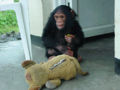
Chimpanzee - African Congo.

Vocalizing chimpanzee


References
- ↑ 1.0 1.1 1.2 All About Chimpanzees, Enchanted Learning
- ↑ Common Chimpanzee, Primate Info Net
- ↑ The Common Chimpanzee - ECOLOGY, The Primata, by Sean Flannery, 1999-2009
- ↑ Chimpanzee, The Honolulu Zoo
- ↑ 5.0 5.1 Greater than 98% Chimp/human DNA similarity? Not any more. by by David DeWitt. Journal of Creation 17(1):8–10. April 2003
- ↑ Henry Gee, "Return to the planet of the apes", Nature 412, 131-132 (12 July 2001)


