Viper
| Viper |
|---|

|
| Scientific Classification |
|
| Genera |
|
Subfamily Azemiopinae Subfamily Crotalinae (Pit vipers)
Subfamily Viperinae
|
Vipers are any of the species of venomous snakes that belong to the taxonomic family Viperidae. All have long fangs that deeply penetrate and inject venom in its prey.[1] Although land vertebrates were created on the fifth day of creation, many assume that legless serpents (snakes) were actually formed as a result of the curse imposed due to the fall of man.
Vipers are mainly classified into two groups, pit-viper and old world viper. The pit viper is in the subfamily Crotalinae and the old world viper is classified under the subfamily Viperinae.
Anatomy
Vipers tend to have broad, triangular heads. Most are heavy-bodied with short, slender tails. A lot of vipers have abundant and heavily keeled body scales. Long fangs allow them to penetrate and envenom their prey. A hinged-fang mechanism allows them to store their fangs against the roof of their mouth when they aren't using them. The configuration of this mechanism is very strange and unique. The lateral process of the palatine bone is missing, each one of the maxilla has one enlarged maxillary tooth and is cuboid in shape. The maxillary fang has a duct on its anterior face. A long ectopterygoid serves as a lever-type mechanism to raise and lower the fang. Some vipers can be as small as the Bitis schneideri, approximately 11 in. (28 cm), and some can be as large as 10 ft. (3 m), (Lachesis muta).[2]
Pit vipers are a very special viper. They have sensitive receptors called pit organs. These transmit high-resolution thermal data to the brain which is thought to be processed and integrated through the optic tectum (a part of the midbrain). This helps in finding and attacking its prey. The pit organ was originally studied as an infrared detector. Thorough physiological and theoretical studies showed that the organs responded to thermal, as opposed to light stimuli. However further studies of optical sensitivity and selectivity of the pit organ show that it responds to a wide range of radiation from infrared to ultraviolet.
The pit organ shows structural specialization indicating a high-resolution thermal detector. The temperature-sensing terminal nerve endings support the pit membrane, which is approximately 25 µm thick. The membrane is a heat-sensing surface, so it and the terminal nerve endings stay in the facial cavity, in front of an inner air space, so the pit organ has a very low thermal mass and can respond quickly to slight temperature changes. It also has a very rich capillary system, which may act as a rapid heat sink. This mixture of low thermal mass and rapid heat dissipation leads to quick and accurate location of thermal stimuli.[3]
First Aid

In past years snake bite victims have used slicing, freezing and squeezing to stop the poison from spreading before they got medical attention. Quite a few health-care professionals use a few basic first-aid techniques:
- .wash bite with soap and water
- .don't move the bitten area and keep it lower than the heart
- .Get medical attention
However, the best thing to do is to quickly get to a hospital, most bites do not happen in an isolated area. If a victim cannot get to a medical facility within 30 minutes after the bite occurred, they should wrap a bandage between two and four inches above the bite. This may help slow the flow of the venom. The bandage shouldn't cut off blood flow, it should be loose enough that a finger could fit under it. If you live in an area where snake bites are fairly common then you should probably buy a snakebite kit, which usually includes a suction cup to draw out poison.[4]
Venom
Viperid venoms are mainly proteolytic (protein dissolving), which means that they quickly destroy blood and tissue. This also helps in the snake's digestive process, because most vipers have a poor digestive system and need the venom to help partially digest its meal. The stomach fluid digests the meal from the outside and the venom digests it from the inside.
However there are always exceptions. Some viperid species secrete venoms that are somewhat or fully neurotoxic, which makes them very dangerous. Some vipers like this are the tropical rattlesnake, some Mojave rattlesnakes, and the rare mountain adder.
Because of the nature of proteolytic venom, a viper bite is a very painful experience, which, if not taken seriously, may become fatal. Even if you are bitten and immediately get medical attention it can still leave scars. The overall damage of the bite is determined by the size and potency of the poison.[5]
Reproduction
Vipers find their mate through the sense of smell. The males go through a ritual called "the dance of adders" when they compete for the same female. They look towards each other with the head and forepart of the body held up, and they try to push the other down. This dance can go on for hours, however they do not bite each other.
Several types of vipers are ovoviviparous, which means they produce eggs inside the body, so the young are born fully alive without placental attachment. Those that lay eggs stay and protect them until they hatch. The female holds the fertilized eggs in her body, where the baby snakes are held in a fibrous membrane "shell". When the baby snakes are completely developed, they hatch out of the egg inside the oviduct or else hatch after the eggs are laid.[6] Many snakes are live-bearers (ovoviviparous), but most are oviparous where eggs are laid with little development of the embryo inside the mother's body. The types of vipers that are ovoviviparous include Bitis, Echis carinatus, and most Vipera. The types of vipers that are oviparous include, Calloselasma, some Trimeresurus, Lachesis, Causus, and Echis coloratus.[7]
Ecology
Vipers can be found on all continents except Australia. Vipers can be found in most habitats from tropical rain forests, to deserts, some even being found on high mountains. Crotalines have arboreal, terrestrial, and aquatic species. Most vipers eat small animals like birds, rats, mice, etc.[8]
Vipers in the Bible
There are several poisonous snakes of Jordan and Israel which are probably like the vipers mentioned in the Bible. Five species are considered the most poisonous snakes of the region: Echis coloratus, Pseudocerastes fieldi, Cerastes cerastes, Walterinnesia aegyptia, and Atractaspis engaddensis[9]. The Atractaspis is known as the burrowing asp [10], the Cerastes cerastes is known as the horned viper[11][12], the Walterinnesia aegyptia [13] is known as the Desert Cobra, though it is thought to be from the family Elapidae [14], and the Pseudocerastes fieldi [15] is called the false horned viper [16]. Human deaths have been reported from all of them.
1 Rescue me, O LORD, from evil men; Preserve me from violent men 2 Who devise evil things in their hearts; They continually stir up wars. 3 They sharpen their tongues as a serpent; Poison of a viper is under their lips. Psalm 140:1-4
31 Do not look on the wine when it is red, When it sparkles in the cup, When it goes down smoothly; 32 At the last it bites like a serpent And stings like a viper. Proverbs 23:31-32
The oracle concerning the beasts of the Negev. Through a land of distress and anguish, From where come lioness and lion, viper and flying serpent, Isaiah 30:6
“Either make the tree good and its fruit good, or make the tree bad and its fruit bad; for the tree is known by its fruit. 34 You brood of vipers, how can you, being evil, speak what is good? For the mouth speaks out of that which fills the heart. Matthew 12:33-34
1 When they had been brought safely through, then we found out that the island was called Malta. 2 The natives showed us extraordinary kindness; for because of the rain that had set in and because of the cold, they kindled a fire and received us all. 3 But when Paul had gathered a bundle of sticks and laid them on the fire, a viper came out because of the heat and fastened itself on his hand. 4 When the natives saw the creature hanging from his hand, they began saying to one another, “Undoubtedly this man is a murderer, and though he has been saved from the sea, justice has not allowed him to live.” 5 However he shook the creature off into the fire and suffered no harm. 6 But they were expecting that he was about to swell up or suddenly fall down dead. But after they had waited a long time and had seen nothing unusual happen to him, they changed their minds and began to say that he was a god. Acts 28:1-6
Crotalinae (pit vipers)
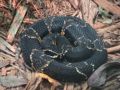
Ornate Cantil
(Agkistrodon bilineatus)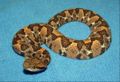
Picado's pit viper
(Atropoides picadoi)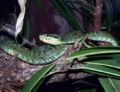
black-speckled palm viper
(Bothriechis nigroviridis)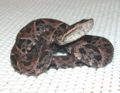
Terciopelo
(Bothrops asper)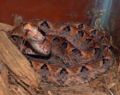
Malayan pit viper
(Calloselasma rhodostoma)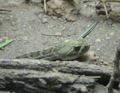
Mojave rattlesnake
(Crotalus scutulatus)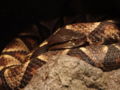
Sharp nosed viper
(Deinagkistrodon acutus)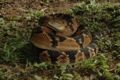
Bushmaster
(Lachesis muta muta)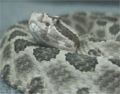
Western Massasuaga
(Sistrurus catetanus tergeminus)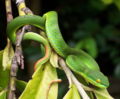
White-lipped tree viper
(Trimeresurus albolabris)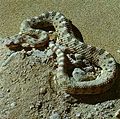
Sidewinder rattlesnake
(Crotalus cerastes)


Viperinae (old world viper)
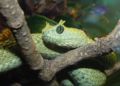
Horned bush viper
(Atheris ceratophora)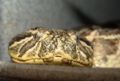
Puff adder
(Bitis arietans)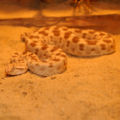
Desert horned viper
(Cerastes cerastes)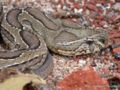
Russell's viper
(Daboia russelii russelii)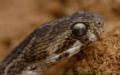
Saw-scaled viper
(Echis Carinatus)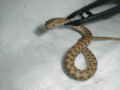
Blunt-nosed viper
(Macrovipera lebetina)
Lowland viper
(Proatheris superciliaris)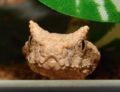
False horned viper
(Pseudocerastes persicus fieldi)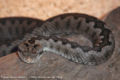
Lataste's viper
(Vipera latastei latastei)


References
- Armed Forces Pest Management Board, U.S.A. Department of Defense.
- Family Viperidae (Vipers and Pit Vipers) by Peter Uetz
- Unique temperature-activated neurons from pit viper thermosensors by Todd C. Pappas, Massoud Motamedi, and Burgess N. Christensen. Am J Physiol Cell Physiol 287: C1219-C1228, 2004.
- For Goodness Snakes!: Treating and Preventing Venomous Bites. by John Henkel. FDA Consumer magazine
- Eyelash Palm Pit Viper by the Smithsonian National Zoological Park
- Viperidae Wikipedia
- Venomous snakes of Israel: ecology and snakebite Kochva E., Tel Aviv University, PubMed abstract. Accessed 13 June 2010.


![[11]](http://www.afpmb.org/pubs/living_hazards/407-Animals-Snakes-Desert%20Horned%20Viper%20Egypt%203.jpg)
![[13]](http://www.afpmb.org/pubs/living_hazards/W1AEGYPT.jpg)
![[15]](http://www.afpmb.org/pubs/living_hazards/snake6.jpg)