Snake
| Snake |
|---|

|
| Scientific Classification |
|
| Families |
 |
| Image Description |
Snakes are any of the species of legless reptiles belonging to the taxonomic suborder Serpentes. They are also known as ophidians. They are carnivorous vertebrates and reproductively eclectic, being viviparous (live birth), ovoviviparous (eggs are formed, but born live), or oviparous (egg laying). They are perhaps best known for the fear they cause in people, known as ophidiophobia.
Body Design


Snakes are tubular shaped and are legless. Snakes can be as small as 4 inches or as large as 30 feet.[3]One of the snakes notable features is its scales. They can be shiny and smooth or rough and dull depending on the species. The epidermis has to be shed regularly but the dermis is more developed. The dermis contains chromatophores which gives the snakes it's color. The scales are also made of keratin.
On the snake's head they have nostrils, eyes, and a mouth. The snake however has no eyelids. The snake also has a Jacobson's organ which helps them smell. They wave their tongue in the air and then touch the tongue to this organ. The snake's jaw is connected by a quadrate bone which allows the snake to open their jaws wide enough to eat their prey whole. Snakes have recurved teeth so the prey can only go into the stomach and not back out of the mouth.[4]
Movement
Snakes use many different types of movement to achieve locomotion despite their legless condition. There are four basic ways snakes move, which are known as sidewinding, rectilinear, and concertina. Snakes will use these depending on the types of surfaces found in their specific environment.
Serpentine
Serpentine is an S-shaped movement and it is the most common for both terrestrial and sea snakes. This type of motion is also called undulatory locomotion. Starting from the head the snake thrusts its body from side to side hitting resistance points propelling the snake forward.[5]
Sidewinding
This is used on surfaces with few resistance points like sand. They make a S-shape that only has two resistance points on the ground, and when they push off it looks like the snake is traveling sideways.[5]
Rectilinear Rectilinear Locomotion, where the snake lies straight and uses it's ventral side (belly) to accomplish locomotion. This mode is usually only used by very large, heavy snakes, such as large pythons and vipers.[6] It is a much slower method and it looks very similar to a caterpillar. The snake contracts its body into curves but instead of side to side it is up and down. Every time a section of the snake's body hits the ground the ventral scales push against the ground causing the snake to move forward.[5]
Concertina
This method is used for climbing objects, used to both climb trees and move through small tunnels. In the case of tunnels, the body loops are pressed against the tunnel walls to attain traction.[6] When gripping an object, they grip with the scales on its head and then bunches up the lower body and brings it to the head. After that the lower body grips the object and the upper body extends forward to repeat the process.[5]
Life Cycle

Snakes reproduce either by either viviparous methods (live birth), ovoviviparous (eggs are formed, but kept in the mothers until they hatch), and oviparous (laying eggs) techniques. Recently, it has been confirmed that several species of snake are indeed fully viviparous, such as the green anaconda, nourishing their young through a placenta as well as a yolk sac, highly unusual among reptiles, or indeed anything else outside of placental mammals. All snakes undergo internal fertilization, using paired, forked hemipenes, which are stored, inverted, in the male's tail.[6]
The mating process can be different across all the species of snakes. Snakes that live in colder climates will mate in late spring and early summer, however snakes that live in tropical climates can mate all year long. In many species the male leaves after mating. When the snakes are born the mother will usually leave them to fend for themselves, but some species of snakes will protect their young for a short period of time.[7]
Snakes have to shed the outer portion of their skin in order to grow and this process is called ecdysis. This process is also controlled by hormones. A typical adult snake will shed their skin 4 to 8 times a year. This number may vary based on temperature, amount of food, and activity level. Young snakes however will shed every couple weeks because of their rapid growth. A snake will never stop shedding and growing in their life but their growth will slow down.
The shedding process usually lasts about one to two weeks. The snake starts shedding from head down. The snake's vision is impaired during this process and the snake can become more hostile and can be scared off easily because of their lack of vision. The new skin can be very soft and can be damaged and cut easily.[8]
Ecology

Snakes are found on every continent except for Antarctica. They can live in almost any climate but because they are cold blooded they thrive in warmer environments like tropical areas. They can be found in forests, deserts, or even in bodies of water, but they are most likely to be found where food is an ample supply. When snakes live in a cold climate they often have to undergo a hibernation called brumation. It is not a true hibernation because the snake can be woken up.[9]
Most sea snakes are confined to coastal areas in the Indian and Pacific oceans but the yellow-bellied sea snake can be found in open ocean. Most sea snakes can only live in water that is 100 feet deep because they have to go to the seafloor to find food. Some species prefer to live in coral reefs but there are others that will live in sandy and rocky areas. They can stay submerged under the water for several hours because of their ability to breath through their skin.[10]
Poisonous Snakes
Most venomous snakes are classified by four major groups:
- Elapids - cobras, king cobras, kraits, mambas, Australian copperheads, and coral snakes.
- Viperids - vipers, rattlesnakes, copperheads/cottonmouths, adders and bushmasters.
- Colubrids - boomslangs, tree snakes, vine snakes, mangrove snakes, and many others, though not all colubrids are venomous.
- Hydrophiidae - sea snakes
Most Snakes are classified into two major, broad groups:
- Short, fixed-fanged snakes, which include the coral snake, cobras, and sea snakes.
- Long, retractable-fanged snakes, which include vipers and pit vipers.
Evolution
Tom Hennigan has done a preliminary study about the baraminology of snakes. He believes that the snakes are so much like each other and so different from other lizards and reptiles that they may be termed an apobaramin, a "group unrelated to all other groups". He notes, among other characteristics, that snakes have "120 to over 400 precloacal vertebrae", and a "left arterial arch larger than the right". Also, all snakes are carnivorous, but their stomach and liver is long and tapered at both ends, while other reptile stomachs and livers are S-shaped.[11]
Though he believes that snakes as a group of animals are not descended from other animals (an apobaramin), that does not show that they are necessarily related to each other. Hennigan searched for evidence that different species of snakes can interbreed which would be good evidence that they are related or recently descended from a common ancestor. Hennigan notes that at present there are 20 definitions of species, and so prefers classification by baramins instead. Some species that are far apart geographically can still interbreed when placed together in captivity.
| “ | Interestingly, the Borneo python (Python breitensteini) and ball python (Python regius) have produced hybrids in captivity. This is surprising for many because these two species are reproductively isolated in the wild. The Borneo python is native to Sumatra and Malaysia, while the ball python is indigenous to Western and West Central Africa. | ” |
In the Boidae family he found four genera whose species were definitely related inside each genus. The Colubridae family had six groupings that interbred, one across three genera. In the family Viperidae, or Pit Vipers, he found three groupings that could be termed monobaramins.
| “ | Within Boidae, Morelia/Liasis, Python, and Antaresia were identified as three separate monobaramins. Nerodia, Pantherophis/Lampropeltis/Pituophis, Diadophis, Thamnophis, Toluca/Conopsis, and Chilomeniscus were identified as six monobaramins within the colubrid taxon and in the viper family the three monobaramins were Crotalus/Sistrurus, Agkistrodon, and Bitis. | ” |
Hennigan hopes that future development of snake baraminology will be able to show conclusively whether all snakes are descended from one original pair, or from several pairs.
Snakes In Modern Culture
Snakes are one of the biggest fear producers in the world, ranking only third in most studies to public speaking and spiders. The fear of snakes is called ophidiophobia. A love of snakes is called ophiophilia, and a snake specialist is an ophiologist.
Snakes are found very commonly in the world, not just as animals, but in pictures, toys, movies, and religion. In the Chinese Zodiac, it's a celestial animal, and in Greek Mythology snakes are often portrayed as symbolic of evil, such as Medusa's hair made of snakes, or the nine-headed Hydra that Hercules defeated. And, of course, a snake is involved in the infamous appearance of Satan in the Bible when Satan is portrayed as a serpent, who tempts Adam and Eve, and causes the fall of man. Snakes are often used in movies, one example being the picture shown to the left.
Video
Video on snake movement.
Gallery
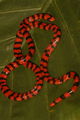
False coral snake
(Anilius scytale)
Family: Aniliidae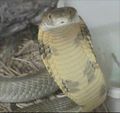
King cobra
(Ophiophagus hannah)
Family: Elapidae
Mexican burrowing snake
(Loxocemus bicolor)
Family: Loxocemidae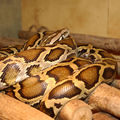
Indian python
(Python molurus)
Family: Pythonidae


References
- ↑ Thorpe, Stephen. Serpentes Wikispecies. Web. last modified on December 27, 2014
- ↑ List of Serpentes families wikipedia. Web. last modified on December 3, 2014 Unknown Author.
- ↑ BASIC FACTS ABOUT SNAKES Defenders of Wildlife. Web. accessed on January 10, 2015 Unknown Author.
- ↑ Mader, Douglas. Snake Anatomy Reptile Magazine. Web. accessed on January 10, 2015 .
- ↑ 5.0 5.1 5.2 5.3 Perry, Lacy. Snake Movement How Stuff Works. Web. accessed on January 25, 2015.
- ↑ 6.0 6.1 6.2 Snake Wikipedia.
- ↑ Snake Reproduction Fusion Theme. Web. accessed on January 25, 2015 Unknown Author.
- ↑ Snake Shedding Animal Hospitals USA. Web. accessed on January 25, 2015 Unknown Author.
- ↑ Where do Snakes Live? WiseGeek. Web. Accessed on January 11, 2015 Unknown Author.
- ↑ Sea snake Encyclopedia Britannica. Web. Last update on August 11, 2013 Unknown Author.
- ↑ An Initial Investigation into the Baraminology of Snakes: Order—Squamata, Suborder Serpentes by Tom Hennigan. CRSQ 42(3):153-160. December 2005.


