Sugarcane
| Sugarcane |
|---|

|
| Scientific Classification |
|
| Species |
|
 |
| Image Description |
Sugarcane is the common name for a number of species belonging to the taxonomic genus Saccharum. They are tall tropical southeast Asian grasses (i.e. Saccharum officinarum) which have thick, solid, tough stems that are the chief commercial source of sugar. Sugar comes from this plant after several steps of processing. It's known as Sugarcane or Sugar cane. Sugarcane is one of the most wide-spread plants in the world, found especially in warm temperate areas. Also, for some countries, sugarcane is one of the most important and famous export products. This product once required hard work to harvest, but after mechanization, it became easier.
Anatomy

The main parts of sugarcane are stalk, root system, and leaf. The stalk consists of segments called joints. It has nodes and internodes, where a node is the point where the leaf is attached and where the bud can be found. When the leaf drops off the plant, the leaf scar can be found on the node. The length of joints (usually thought to be one node and the internode space to the next node) vary with different growing conditions. However, the length of joints at the base is short and internode length increases along the stem. The small outer leaves form a scale. The outermost bud scale has the form of a hood. Normally, each node has one bud, and they alternate from one side of the stalk to the other. [1]
Sugarcane grows to 2 to 6 meters tall. When seed-cane is planted, each bud will form a main shoot. The secondary shoots, called "illers", form from the underground buds on the main shoot. The colors of the stalk vary with the environment. For example, exposure of the internodes to the sun might change the color of stalk completely.[2] The same variety grown in different climates may show different colors. All stalk colors arise from two basic pigments which are the red color of anthocyanin and the green color of chlorophyll. The surface of the internode is more or less covered by wax. The leaf of sugarcane is divided into two parts, sheath and blade. The leaves are usually attached to the nodes.
The function of the root system is twofold. First, it enables the intake of nutrients from the soil, and second it serves to anchor the plant.
Reproduction
Sugarcane is propagated by planting of cuttings rather than using seeds though some of them still produce with seeds. Cutting the stem became the most common method of reproduction. The cut stem must have at least one bud, and the cuttings are usually planted by hand. Once sugarcane is planted, it can be harvested several times. After each harvest, new stalks grow up, called ratoons. Usually, after every harvest, the sugar production is a little less until finally, people will have to replant it. Every sugarcane plant has a different period for replanting. One plant can be harvested more than 10 times and others may not last more than 2 times. These plants once were harvested by hand, but presently it's done mechanically. Each stalk is very heavy and 5 short stalks are often the limit of what a grown man can carry. Long, thin knives called machetes are used to slice through the tough stem, and several blows are required. Sugar cane is exhausting to harvest by hand, and people who work long hours at it are weakened by the labor. When people harvest sugarcane, they first burn it to kill any venomous snakes hiding in the field, but the stalks and roots are not harmed. This plant requires strong sunlight and abundant water for satisfactory growth. Once cut, the plant starts to lose sugar content. Sugarcane plant produces stalks that can reach up to 10 to 24 feet high with sword-shaped, long sleeves.[3]
Ecology

Sugarcane originated mostly from South Asia and Southeast Asia. The sugarcane was and is, extensively grown in the Caribbean]]. Sugarcane was first brought by Christopher Columbus and is now grown in most warm tropical regions. Several species of Saccharum are found in Southeast Asia and neighboring islands.[4] The sweet juice and crystallized sugar are known from China and India about 2500 years ago. Sugarcane reached Americas in early colonial times. They are planted in late summer or early fall and harvested after one year. Over 592,000 acres of Sugarcane is grown in Hawaii, Florida and Louisiana. At present the largest producer of sugarcane is Brazil followed by India. In the eighth century A.D, Arabs introduced their sugar to Egypt, Spain, North Africa, and many other countries. By the tenth century, there were no towns in Mesopotamia that didn't grow Sugarcane. "Boiling houses" were used in the 17th through 19th centuries to make sugar from sugarcane juice.
Other
Photosynthesis of plants makes sugar.
12 CO2 + 11 H2O = C12H22O11 + 12 O2
12 x carbon dioxide + 11 x water = 1 sucrose + 12 x oxygen
In a sugar mill, sugarcane is washed and shredded by revolving knives. After that it is mixed with water and crushed between rollers. The collected juice contains 10–15 percent of sucrose, and the fibrous solids, which remain in it is called bagasse. It can be used in many ways, as animal feed, in paper manufacture, and many other ways.
The essential elements for sugarcane are carbon, hydrogen, oxygen, nitrogen, phosphorus, potassium, calcium, magnesium, boron, chlorine, copper, iron, manganese, molybdenum, sulfur, zinc and silicon. Some of them might not be strictly needed for sugarcane to grow.
Gallery
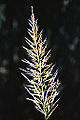
Wild sugarcane
(Saccharum spontaneum)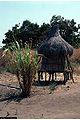
Sugarcane
(Saccharum officinarum)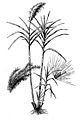
Sugarcane
(Saccharum officinarum)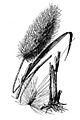
Sugarcane plumegrass
(Saccharum giganteum)


References
- University of Florida J. D. Miller and R. A. Gilbert2. EDIS. Unknown
- CANE SUGAR - WHAT IT IS AND HOW IT IS MADE Author Unknown. Publisher Unknown. Last Updated 16th Jan 1998
- britannica Takeo Yamane. Publisher unknown. Date unknown
- How Sugar is Made by SKIL


