Viceroy butterfly
| Viceroy butterfly |
|---|

|
| Scientific Classification |
|
| Binomial Name |
|
Limenitis archippus |
 |
The Viceroy Butterfly (Limenitis Archippus) is a beautiful butterfly that mimics the Monarch butterfly and ranges from central Canada through the eastern United States, into the Cascade Mountains and northern Mexico.[1] Its wingspan sizes about 3 inches (7cm). They are herbivores though they can feed on decaying matters.[2]The Latin name tells us where it can be found, “Limenitis” in Latin, means marshes, where viceroy butterfly prefers to inhabit. The common name originates from the resemblance to two other butterflies; the Queen and the Monarch. There are nearly three thousand species worldwide, of which hundred and fifty to hundred and sixty in North America. They favor moist areas around lakes, swamps, thickets, wet meadows and rural areas since the female lays eggs in these areas.[3] However, due to loss of habitats, it is in danger of extinction in certain areas.[4] Though they mimic and share fascinating relationships to monarch butterfly, they do not migrate.[5]
- God created the viceroy butterfly on the sixth day (however, it could be on fifth day, depending on whether you consider it as a flying creature or a land creature), on the same day as the humans were created, according to Genesis 1:31. God saw all that He had made, and it was very good.[6]
Anatomy

The viceroy butterfly possesses orange wings (two fore and hind wings) with black veins and white spots edging the wings. In each segment of both wings, there are also white specks in the outer black border. They mimic the monarch butterfly, however, they can be distinguished by a black stripe that runs horizontally in their hind wings. The undersides of the viceroy’s wings are fairly comparable to the uppermost side while the Monarch’s underside is much paler. The viceroy has a plenty of wing power, having a wingspan ranging from 2.75 to 3 inches (7 to 7.5 cm).[7]
They engage in several characteristics as the other animals in Class Insecta, that the viceroy has three pairs of walking legs, their body is separated into three segments: head, thorax, abdomen, and they own one pair of antennae. Its segmented exoskeleton is black and fuzzy with slender and feathery antennae on top of the head. When it is in flight, its wings are completely stretched out while the Monarch’s are at a definite angle. Thus, it is easy to make a distinction between them in flight.[8]
This invertebrate is ectothermic, meaning that they have body temperature that varies with the environment and they exhibit bilateral symmetry. Bilateral symmetry is when an organism or a body part, along a central axis can be divided into equivalent right and left halves by only one plane.[9]
In adult butterflies, there is a tube-like organ that siphons off liquid called proboscis. The food is then carried into the thorax, and into the abdomen. Their body is also capable of storing the food particle in the crop until it is required. Lastly, the nutrients are broken down in the midgut, absorbed by blood or stored as fat. The residuals are delivered into the hindgut and rectum.
In larval and adult stages, butterflies have spiracles on the abdomen. Spiracles are small pores that function in breathing. Addition to the spiracles, they enjoy their respiratory system with tracheae that transports oxygen throughout the body without using circulatory system.[10]
Groups of nerve cells develop into ganglia. In the brain, one of the ganglias connects to a nerve cord that runs in length. In the thorax, there are two extra ganglia and four in the abdomen. Smaller nerve cells extend throughout the body, where they organize motion, circulation, digestion, and reproduction. The antennae, consisting of over 16000 olfactory sensors (sense of smell), can also detect sexual pheromones, and location of the nectar. Furthermore, the antennae allow them to communicate physically and chemically, and for their courtship. They observe with compound eyes (contain thousands of individual lenses, up to 17000 ommatidia). Though some insects have the ability to hear, butterflies are deaf as most of the insects. Antenna dipping is a common way used by butterflies in which they gently dab the tips of their antennae onto soil or leaves to check its chemical qualities. This method is enjoyed by males frequently to verify whether the soil or the leave has vital nutrients (usually to swallow mineralized moisture to absorb sodium). Females practice the same skill to confirm if the plant is favorable for egg-laying. The Johnston’s organ is placed at the base of antennae that is responsible for their balance and orientation, especially during flight. Moreover, on each side of the proboscis are labial palps. These palps are sensitive to pheromones, chemicals, and some possibilities of ensuring if something is food or not.[11]
Butterflies, like insects do not attain closed circulatory system, rather, open circulatory. However, they manage circulatory system throughout the entire body with a long tubular organ called tubular heart that progresses the blood wholly. Instead of red pigmented blood, they prefer clear, yellowish fluid called hemolymph that flow over within the body cavity.
Malpighian tubes that float in their body and eliminate waste from the blood and as well as transferring the waste to the digestive system (midgut and hindgut) is the main excretory organs. After that, the waste is removed through the anus. The main waste product is uric acid, which disposes of nitrogenous wastes.[12]
Reproduction

Viceroy butterfly accomplishes complete metamorphosis, involving four stages of egg, larva, pupa, and adult. Mating regularly occurs from April to September. They practice fertilization in the afternoon.
During most of the day, males settle on vegetation or patrol around the host plants (cottonwood, etc) to find females. The female deposits nearly three pale green to yellow-colored oval eggs per sapling (an obvious method of assuring the maximum survival of her offspring) mostly onto the tip of a willow tree, poplars or cottonwood leaves (rarely lay eggs on plums, apples, and cherries)[13] and interestingly selects only leaves that have not been harmed by other insects. The eggs of viceroy bear resemblance to insect galls that influence the host plants.[14] The eggs of butterflies have as many as 14,000 tiny water-proof pores on their surface, which are so complete that the eggs can survive in the water.[15] They approximately reproduce three generations per year. Predators typically undergo hard time finding the eggs.[16]
As the caterpillar appears, it eats its eggshells. Afterward it feeds on willow, cottonwood, or poplar leaves at night. The precise camouflage can additionally be observed in caterpillars; they are brownish or olive green with a white spot on the back, imitating bird’s droppings, that provides them protection from predators. They also possess branched, spiny tubercles that are similar to antennae on the head. During winter, caterpillars wrap themselves within a leaf fastened with silk for winter protection and camouflage. The caterpillar becomes active again in spring, then turning into a pupa, known as chrysalis.[17]
The chrysalis is brownish with silver or cream color. It is again possible for predators to mistake the chrysalis for bird's droppings. As soon as the young adult viceroy emerges from the chrysalis and its wings dry, they seek food, such as nectar of butterfly bush, asters, goldenrods, overripe fruit, and sap, aphid honeydew, carrion dung, decaying fruit and fungi, etc. It takes about 30 to 40 days (6 weeks) to complete this metamorphosisThe adults fly from May to October, but all year in Florida.[18] Despite the fact that most butterflies survive for almost a week to 4 weeks, viceroy and monarchs are speculated to live for several months.[19]
Ecology

The viceroy butterfly extends from central Canada through the eastern United States, into the Cascade Mountains and northern Mexico. The preferred habitats of this invertebrate are open or somewhat shrubby areas that are wet or near water. They inhabit places such as wet meadows, marshes (Limenitis means marshes, explains where it lives), ponds, lakes, railroad tracks, and roadsides. Males rest on vegetation or patrol their territories for females. Males reiterate this behavior. However, if two males encounter, they will rapidly ascend up and down around 50 m or more high up in the air.
Even though caterpillars of viceroy are mainly herbivorous, eating willow and poplar leaves, it is additionally observable for the adults to feed on manure, carrion, and the nectar of the flowers, especially golden rod, thistles asters, and the others. Therefore, the adults display detritivore and herbivore.[20]
To detect food, viceroys use their antennae that are covered in over 16000 scent detecting sensors. They are sensitive to pheromones, and the sources of nectar. They are also capable of using a remarkable technique named antenna dipping in which they pat the tips of antennae to verify if the food source, such as soil or leaves contain essential nutrients. Females carry out this process to find the favorable leaves for egg-laying.
Labial palpi, also covered with olfactory sensors, are located on the antennae, thorax, abdomen and legs. These palpi are able to sense pheromones, chemicals, and food sources in addition to their antennae.[21]
Birds are main predators to the viceroy butterfly. Since the eggs of viceroy are laid at the tip of the leaves, the predators have hard time finding them. Caterpillars, as well as chrysalis, begin to resemble bird’s dropping, which gives them protection. As they grow mature, they bear a resemblance to the monarch butterfly, known as poisonous butterfly. Thus, the birds avoid eating both of them.[22]
Mimicry

The mimicry of viceroy butterfly (nonpoisonous) seized biologists’ attentions widely because in all metamorphosis stages of viceroy mimic something.
- Second, the caterpillar stages look similar to bird droppings. The older caterpillar looks frightening with its tubercles. During winter, the caterpillar wraps itself within a leaf for additional protection from predators.
- Third, the chrysalis also resembles bird’s droppings except the fact that it hangs upside down on a tree branch.[23]
- Lastly, the adult viceroy mimics the monarch butterfly. The milkweed that the monarch butterfly feeds on as larva contains cardiac glycosids, meaning heart poisons, causing the adult to be unpalatable. Birds avoid both of viceroy and monarch because they look so much alike. Female monarchs are considered to have more glycosids than males.[24] However, recent studies indicate that the viceroy is also inedible, giving each butterfly twice the protection from predators.[25]
This type of mimicry relationship is called Mullerian mimicry (It is a natural phenomenon when two or more harmful species share one or more common predators, have come to mimic each other’s warning signals. It was first claimed Fritz Muller, a German naturalist).[26]
Viceroy Butterfly: Media
Brief summary of viceroy butterfly
Gallery
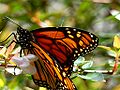
Viceroy Butterfly
(Limenitis Archippus)
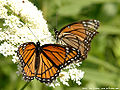
Viceroy Butterfly
(Limenitis Archippus)
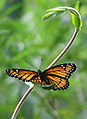
Viceroy Butterfly
(Limenitis Archippus)
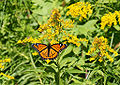
Viceroy Butterfly
(Limenitis Archippus)


 Browse |
References
- Limenitis archippus viceroy Opler, Paul A. and Krizek, George O. Butterflies, he John Hopkins University Press, 1984.
- Viceroy Butterfly Enchanted Learning, Enchanted Learning, 2000.
- The Viceroy Butterfly Kentucky State Butterfly, DesetUSA, 1990.
- Viceroy Butterfly ButterfliesSite, ButterfliesSite, 2008.
- Viceroy Butterfly THE GARDEN CLUB OF KENTUCKY, THE GARDEN CLUB OF KENTUCKY, 2004.
- The Viceroy Butterfly - One of God's of Little Folk Frank L. Hoffman, Northern Prairie Wildlife Research Center, 11 Feb 2009.
- Viceroy butterfly facts group of bug enthusiasts, Bay Park Studios, 2006.
- Excretory System Watt, Ward B., Brusel, E., An Introduction to Insect Physiology, 1970.
- The Butterfly Lab The Peggy Notebaert Nature Museum, The Peggy Notebaert Nature Museum, date.
- Butterfly Anatomy Just Host, Adrian Hoskins, date.
- The Monarch Butterfly West Virginia Division of Natural Resources, West Virginia Division of Natural Resources, 2003.
- Mullerian mimicry wikipedia, wikipedia, 6 November 2009.
External Link
- Viceroy Butterfly backyardbugs, youtube, February 20, 2009.
- Species Limenitis archippus - Viceroy Troy Bartlett, Iowa State University Entomology, 16 February, 2004.
- Viceroy butterfly wikipedia, wikipedia, 29 November 2009.


