Alternation of generations

Alternation of generations is the mode of reproduction used by all plants, but most notably in ferns, mosses, liverworts, and hornworts. The unique life cycle is characterized by two distinct stages and involves both sexual and asexual reproduction. The Gametophyte stage creates male and female gametes, which then unite to form a sporophyte. The sporophyte then uses asexual reproduction to create spores which in turn germinate into the gametophyte. [1]
Reproductive structures
Gametophyte
A gametophyte is a gamete-producing plant. Gametophytes develop from a spore which is produced in the sporophyte stage. A gametophyte begins as a diploid spore cell. As it progresses through its life it goes through a process of meiosis. Meiosis is the splitting of the cell. It splits the diploid cell into two separate halves. Since a diploid cell has two sets of each chromosome. The result of this is a gamete which has only half of the DNA structure. [1] This process is critical for sexual reproduction, so that the new organism is not a clone.[2] When the spore goes through mitosis it begins to germinate. When this spore has been germinated it grows into a mature gametophyte. In the case of a mature gametophyte fern, the plant only grows to .5cm wide.[3] (Purves 586)
The gametophyte has two major parts. There is the Antheridium, which is the male reproductive organ, and there is also the Archegonium, which is the female reproductive organ
Antheridium
Antheridium are the male reproductive organs of a mature gametophyte.(Purves 586) This organ is where the male gametes or spermatids are produced. When the gametophyte is ready to reproduce the capsul shaped antheridium burst open sending the spermatids/male gametes into the archegonium, female reproductive organ.[4]
Archegonium
Archegonium are the female reproductive organs of a fully mature gametophyte. This is a multi cellular structure that produces and contains the ovum, or the female gamete. The ovum is the females reproductive cells. The archegonium shape is long and thin at the top, and has a swollen base where the egg is positioned. One the gametophyte is ready to reproduce, the antheridium shoots its spermatid cells into the archegonium entering the long narrow neck. After this happens the egg is fertilized and the sporophyte stage of the life cycle begins. [5]
Sporophyte
A sporophyte is a spore-producing plant. It is one of the two phases in alternation of generations plant reproductive lifecycle. They develop from the fertilized egg during the gametophyte stage. The ultimate job of the sporophyte is to produce spores that germinate into gametophytes. The spores are produced through a cell division process called meiosis. A mature sporophyte can grow up to around 1m. In the case of the fern the spores are located on the underneath side of the leaf. Spores are created in clusters of sporangia called Sori.(Purves 584-6)
Plant types
Alternation of generations occurs in all plants, but there are three major plant groups wherein this process is most notable. Those plants consist of the fern, moss, liverworts, and hornworts.
Fern
The ferns alternation of generation life cycle goes from Sporophyte to Gametophyte. It starts out as a spore. The spore goes through meiosis, and germinates into a mature gametophyte. After this has happened the antheridium and archegonium perform sexual reproduction creating fertilizing an egg. The egg grows in to a sporophyte which grows clusters of sporangia on the underside of its leaves. The sporangia burst sending the spores cells into the surroundings and the process duplicates itself. (Purves 559)
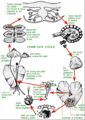
Fern life cycle

Moss
The lifecycle of moss is very similar to that of the fern. Its gametophyte stage is however longer than that of the ferns. After the spore has landed in the soil it begins to germinate through meiosis. It starts to grow photosynthetic sprouts that help supply the plant with energy as it gets ready to perform sexual reproduction. Moss has to be in a moist location in order to perform reproduction.
In order for the sperm cells to reach the archegonium from the antheridium water must be present so that the cells cam swim through to the female reproductive organ. Once this has been accomplished the egg is fertilized and a new plant begins to grow. It grows into a new gametophyte, however it has a sporophyte is attached, because it is nutritionally dependent on the gametophyte. The sporophyte develops a capsule, which when ready bursts sending new spores all over its surroundings, each in turn creating new gametophytes, without the sporophyte addition. (Purves 574)
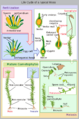
Moss life cycle

Moss showing sporophyte growing from the leafy gametophyte.
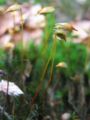
Sporophyte of a moss (Polytrichum formosum)


Liverwort
The alternation of generations in liverworts is virtually identical to that of mosses and ferns. The only major difference is the fact that liverworts live in the water. They have rhizoids on their underneath side to anchor themselves down so that they do not float away.
Already being in water helps the liverwort in the process of sexual reproduction because it does not need to wait for moisture to develop for the sperm cells to be able to move and fertilize. Other than those few differences the cycle of alternation of generations is identical.


References
- ↑ Alternation of generation Wikipedia
- Purves, William. Life the Science of Biology. 2005. Couriers Company Inc.
- Alternation of Generation Alt. of Gen.
- Meiosis Wikipedia
- Archegonium Wikipedia
- Antheridium Wikipedia
- Sporophyte Wikipedia


