Tetraodontiformes
| Tetraodontiformes |
|---|

|
| Scientific Classification |
|
| Families |
|
Tetraodontiformes is the name of a taxonomic order of bony, ray-finned fish (class Actinopterygii). The group includes a number of unique forms with two basic body types – compressed and spheroid. Their scale-structure is also unique with skin that appears like hard plates with retractable spines, or tough leathery skin. And they usually possess a relatively small mouth. The order includes 10 families and approximately 360 species. Most species are marine organisms distributed in tropical and subtropical coral reefs. [1]
Anatomy

Tetraodonts do not possess a streamlined shape typical of most fish, and their bodies are relatively inflexible. Some Tetraodonts are square or triangular (boxfishes), others are spherical (pufferfishes), and the filefishes are laterally compressed. In most species, the fins are simple, small, and rounded. They also have a tough outer surface with scales modified into strong plates or spines for protection.
Instead of propelling themselves through the water by an undulation of their body, they are slow-moving and rely on their pectoral and caudal fins for propulsion. They are nevertheless quite precise in their maneuvering, using both dorsal and anal fins in stabilizing.[2]
- Family Tetraodontidae
This family might be the most famous family in Order Tetraodontiformes. The representative organism is Arothron meleagris (Common name: Puffer). These organisms have spherical body form. Their bodies are inflatable. When they take water into their stomach and discharge, they become bigger and rounder. Some species have super serious toxins that can kill even human. Toxins are usually put on skins, intestines, and liver. Maximum size of these organisms can approach 1m.[3]
- Family Molidae
These organisms can grow up to huge size like 3m in diameter and 1.5tons weight. The most famous organism is Mola Mola (Common name: Ocean Sunfish). Body shape seems disc. They possess extremely thick, tough, leathery skin.[4]
- Family Balistidae
The most well-known species in this family is Sufflamen Bursa (Common name: Triggerfish). They are very large species that have compressed body form and small mouths. Every organism in this family has a trigger mechanism.[5]
Reproduction
Tetraodontiformes have two separated sexes. Fertilization type is external fertilization. When a male slowly pushes a female to the surface, spawning occurs. The eggs can buoy themselves, and are hatching after a few days later. During larvae stage, they are developed with eyes, a swim bladder, and a mouth. [6]
Ecology

Most species are marine, and usually live in tropical and subtropical coral reefs. Commonly, they are carnivorous and feed predominantly upon plankton and small crustaceans. Strategies of predation are different depending upon the characteristic possessed by each Family. Molidae, such as Mola Mola, are extremely slow moving. So they just take small pieces of fishes, zooplankton, jellyfish and so on by waiting until foods come to their mouth. [7]
As Nutriment
Tetraodontiformes are also a very good food source. Specifically, Family Diodontidae and Family Molidae have been used as food source in the East Asia. Today, American also eat them. They are solved in market. Some species have toxin, and part of them could be seriously dangerous. So you need special license for toxin-species processing. [8]
Gallery
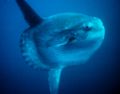
Ocean sunfish
(M. mola)
Family: Molidae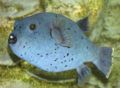
Black spotted puffer
(A. nigropunctatus)
Family: Tetraodontidae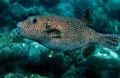
Puffer
(A. meleagris)
Family: Tetraodontidae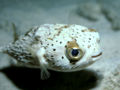
Balloonfish
(D. holocanthus)
Family: Diodontidae
Trigger fish
(S. bursa)
Family: Balistidae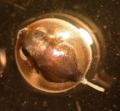
Puffer larvae
Family: Tetraodontidae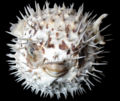
Poisson lune
(M. mola)
Family: Molidae


Related References
- WikipediaWikipedia Tetraodontiformes
- Solaster-mbOrder Tetraodontiformes
- New Jersey Scuba DiverSome species in Order Tetraodontiformes
- Planet-petsTriggerfishes
- SeaworldTetraodontiformes
- MarinebioFamily Diodontidae
- MarinebioFamily Tetraodontidae
- San Francisco State University Department of GeographyMola Mola


