Clubmoss
| Clubmoss |
|---|

|
| Scientific Classification |
|
| Classes |
|
 |
| Drawing of the plant |
Clubmosses are species of plants belonging to the taxonomic division Lycopodiophyta. Although called a "clubmoss", they are not true mosses, but a small vascular plant (having veins). However, their leaves only have one vein, unlike ferns and plants with seeds. Clubmosses also reproduce by spreading spore like true mosses. Clubmosses includes over a thousand species and are separated into 3 classes.[2]
Body Design

The type genus of Lycopodiophyta is lycopodium, which has around two hundred species. The sporangium (spore producing structure) is short and kinda looks like a capsule and also includes many haploid spores. All the sporangium have many tiny spores on the surface. The stabiles is global and the sporophytes are arranged in a spiral and closed fashion.
They have slender rhizomes that give it aerial branches with many small leaves. The stem is fragile and slim. The leaves would be describes as sessile and mircophyllous. The leaves are also arranged on the open spirally. [3] The branch of the stem is part [monopodial]] and part dichotomous.[4]
The leaves are arranged in opposite pairs or arranged randomly. The leaves are usually narrow and oval shaped. In only a few species, they leaves are not the same in size and shape. Other than that they are all the same size and shape.
The roots are short at first but grow later. The stem consists of the epidermis, which is one cell thick, and it also includes the stomata. The stomata looks like the structure of the leaf itself. The cortex is large compared to other species. It has three zones, the peripheral, central, and middle zone. The peripheral and central zone is thick sclerotic cells and the middle zone has large and thin cells with little chloroplast. [5]
Life Cycle

Alternation of generation occurs in lycopods. [3] Alternation of generation occurs when plants alternate between a sex cell producing phase and spore-producing phase. The members of the Lycopodiopsida are homosporous, which means it only one kind of spore. [6] The dominant body form of this plant is a sporophyte. The tsrobilus, spore bearing cone, undergoes meiosis which forms haploid a spores. The spores germinate in order to form the gametophyte, also known as the prothallus.
The gametophyte is small and develops underground. It also relies on the microhyizal fungus for water and nutrients. Sometimes the gametophyte wait up to fifteen years to release their sperm or to produce sporophyte. [7]
After this occurs, the antheridium ,which is the male, produces sperm calledmultiflagellate. Then the archegonium, female structure, produces the egg. The fertilization occurs in a structure called the oogamous. Finally the zygote divides to make an embryonic spurophyte which eventually grows in to an adult plant. [8] This life cycle can take up to several weeks or even several years to develop. They also produce above ground when they release the spores. [9]
Ecology

These species can survive harsh and dry environments with little to no moisture. They live in dry and rocky places located in the southwest of the United States. The live on the sides of slopes and on edges. One of its species doesn't dry out and because of this it has been given the name “resurrection plant”. The plant can restore itself from being dried out for many months and this is not natural for a vascular plant. [10] When there is no moisture their aerial stems roll up into balls and look like they are dead. When there is moisture, they uncurl and point their leaves to the sun. They do this to store photosynthesis for the next period without moisture.
They can also grow in tropic regions, the arctic, and on the forest floor of conifers forests. [11] Most of them live in places with low of mid-range rainforests. These rainforests are in places such as South America, Africa , and Southeast Asia. They also live on the ground in open places or in upper areas with higher altitude.
Medicine
Lycopodium would be considered a natural substance and are prescribed byhomeopaths. Homeopaths are people who study homeopathy, which is natural medicine. It is prescribed for small illnesses such as an earache, sore throat, digestive disorders, urinary tract difficulties, hepatitis, prostatitis, and eye situations. It also works on things such as soft tissue, blood vessels, bones, joints, liver, and heart. This plant is for helpful for both the internal and external illnesses. It also helps with back pain, coughs, fevers, food posioning, and more.
While this plant is very useful it also has many side effects. Taking this plant as a medicine can result in anger, disappointment, overheating, or the increase of alcohol consumption. The adult patients that are alcoholic and tend to get scared. Unfortunately the children get bad-tempered because body is weak. Towards the end of taking the medicine, the patients look older. The children are likely to have tonsillitis and bronchitis. If a meal is missed, they can a get a headache because of their digestive disorders. The joint pain leads to terrible pain which starts at the right side of the knee and continues to the left. Fevers worsen the pain. The patient would be described as pale and covered with skin defects.
While taking the medicine, peppermint, coffee, and alcohol should be avoided. Taking these products will cause the medication to not work. [12]
Video
Facts about the Lycopod.
Gallery
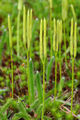
Club Mosses
(Lycopodium clavatum)
Class:Lycopodiopsida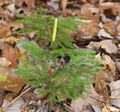
Club Mosses
(Lycopodium dendroideum )
Class:Lycopodiopsida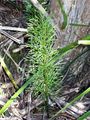
Club Mosses
(Lycopodium deuterodensum)
Class:Lycopodiopsida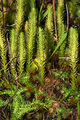
Club Mosses
(Lycopodiella Inundata)
Class:Lycopodiopsida


References
- ↑ [1] Lycopodium L. Web. January 31, 2018. Author Unknown.
- ↑ [2] Lycopod. Web. last changed on 24 September 2013. Author Unknown.
- ↑ 3.0 3.1 lycopodium-plant-body Publisher site name. Web. Last Accessed January 18,2018. Unknown Author.
- ↑ Sinha,Aunushree [www.biologydiscussion.com/botany/pteridophyta/features-of-lycopodium-with-diagram/54506] Features of Lycopodium (With Diagram). Web. Last Accessed January 18, 2018.
- ↑ S,Samisha[3] Lycopodium: Useful Notes on Lycopodium. Web. Last Accessed January 18, 2018.
- ↑ Mickel T,John,Wagner H.,Warren,Gillford M,Ernest[4]Lycophyte PLANT DIVISION. Web. Last Accessed January 17, 2018.
- ↑ Speer,Brian.[5] Lycophyta:Life History and Ecology. Web. Last Accessed January 10,2018.
- ↑ [6]Life Cycle of Lycopodium. Web. Last Accessed. January 18,2018.
- ↑ "lycopodium-life-cycle". Web. January 7, 2018. Author Unknown.
- ↑ Spear,Brian[7]Lycophyta: Life History and Ecology. Web. Last Accessed. January 14,2018.
- ↑ [8]Phylum Lycophyta: Club Mosses and More. Web. Last Accessed January 16,2018. Author Unknown.
- ↑ [9] Lycopodium. Web. Last Accessed January 18,2017. Author Unknown.


