Woodlouse
| Woodlouse |
|---|

|
| Scientific Classification |
|
| Families |
|
Infraorder Tylomorpha
Infraorder Ligiamorpha
Superfamily Trichoniscoidea
Superfamily Styloniscoidea
Superfamily Oniscoidea
Superfamily Armadilloidea
incertae sedis
|
The woodlouse are isopods assigned to the suborder Oniscidea. There are over 3000 known species known by such names as the "roly-poly", "armadillo bug", "cheeselog", "doodlebug", "monkeypea", "pill bug", "potato bug", "roll up bug", "slater", and "sow bug".
The woodlouse is the only crustacean to occupy an inland habitat. Woodlouse body length is 11mm, which is rather small, never reaching more than three-quarters of an inch long, with oval shaped bodies, convex above, and empty beneath.
The two most common European woodlouses are Oniscus asellis, which has a brown body and yellow marks on its back, and Porcellio scaber that has mix blue and grey body. Both are rather flat.
Anatomy

The woodlouse has a flat body. The head part and abdomen are tiny, but the thorax is large(compared to other parts), and also composed of seven hard individual overlapping plates. The woodlouse breast consists of 7 joints. The woodlouse has a stomach which consists of 6 tiny joints. The woodlouse has 7 pairs of legs, and each leg has a round shape. The end of the tail woodlouse has 2 antennas. The first antenna is small, and second antenna is similar to the broken ruler and it’s huge. The second antenna has with several joints. The woodlouse is similar to the sow bug; if one touches the sow bug it changes to a ball shape which protects itself but woodlouse doesn’t change to a ball shape. That is the difference between a sow bug and a woodlouse. [1]
Reproduction
The Woodlouse has separate males and females. After mating the female puts down her eggs, and brings them around with her inside a brood pouch on her outside. She maintains carrying them for a while after they incubate so that she can protect them.[2] As woodlouse grows, they moult. They do this several times before they are completely grown. They can take up to 3 years to mature. [3]
Ecology

The woodlouse likes moisture because it has gill-like structures on their underbellies which they breathe through. These gills are important in the life of woodlouse, if they dry out the woodlouse will die. Hence, the woodlouse lives in dark places, such as under garden’s rocks, fallen tree limbs, or around the garbage. The woodlouse is usually nocturnal and is a detritivores; as it feeds specifically on dead plant matter (detritus). The woodlouse can do minor damage to plants by eating roots and decaying vegetation which lays on the ground; but they are not considered a pest as it does not do any significant damage to live plantlife. [4]
Gallery
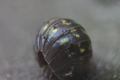
Woodlouse form toliet roll.
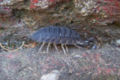
Woodlouse Scurrying around backyard.
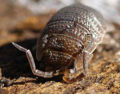
Woodlouse own place.
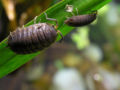
The big woodlouse has a tiny passenger.
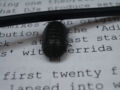
Woodlouse and text.
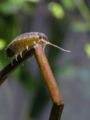
Woodlouse on the bridge.
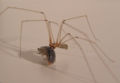
Daddy long-legs spider (Pholcus phalangioides)with a captured woodlouse.


Related References
- Woodlouse Information by wikipedia
- Woodlouse Information by britishlibrary
- Woodlouse Information by Pubmed


