Diatom
| Diatoms |
|---|

|
| Scientific Classification |
|
| Orders |
Diatoms are unicellular organisms that are well known and make up a large proportion of phytoplankton. Plankton is a general term for sea creatures that only float with sea currents.[1] Phytoplankton are plankton that live close to the surface and use photosynthesis to make their own food.
Diatoms are distributed all over the watery areas of our planet and influence the world in many ways. They are responsible for 23% of the primary photosynthetic productivity of the world, nearly one-quarter of Earth's photosynthesis. As a result, they play an important role for the food web. [2] Although diatoms can reproduce either sexually or asexually, they usually reproduce asexually, but when they reproduce asexually, each generation gets smaller until auxospores are formed by sexual reproduction that help return the organism to the correct size. Diatoms are divided into two orders: centric diatoms (Centrales) that are round with radial symmetry, and pennate diatoms (Pennales) that are long, thin ellipses. Diatoms are one of the most beautiful organisms to look at under the microscope; the pattern of areolae, holes that are needed to obtain nutrient and gases, is especially amazing. [3]
Classification
The opinion over classification of heterokonts that include algae, kelp, and diatoms is still debated. They can be either considered as a phylum, or kingdom, or some where between. Consequently, diatoms may be arranged anywhere from class (Bacillariophyceae) to a phylum (Bacillariophyta). Diatoms are also sometimes called Class Diatomophyceae.
There has been a recent revision for the classification of the diatom. According to the recent classification, diatoms are divided into three classes: centric diatoms (Coscinodiscophyceae), pennate diatoms without a raphe (Fragilariophyceae), and pennate diatoms with a raphe (Bacillariophyceae). A raphe is a ridge where two halves of the diatoms join. The classification of diatom is likely to be revised in the future. [4]
Anatomy

Diatoms are encased in two distinct valves, which are made of silica. The larger, older valve that cover the other one is called the epivalve, and the smaller, younger valve that is covered by the epivalve is called the hypovalve. The two valves are joined by a girdle region. Diatoms often carry one or more spines that are known as setae. The setae are a quite unique part of diatoms since they may be many times longer than the diameter of the cell. These spines help diatoms to move vertically.
Diatom valves are equipped with areolae, numerous 0.1 ~ 0.6 micron hexagonal holes. Areolae are necessary for the diatom to obtain nutrients and dissolved gases such as CO2 from the seawater, because no molecules or ions can go through the solid silica sheet which covers the diatom. Areolae are arranged in alluring, regular patterns. [5]
The appearance of the diatom, especially the patterns of areolae, has appealed to microscopist for more than twenty years. Diatoms are one of the organisms that make people willing to look under the microscope. [6]
Reproduction
Diatoms can reproduce in two different ways.
First of all, diatoms can reproduce asexually. Reproducing asexually is the basic method of how diatoms reproduce. Diatoms have a distinctive mode of reproduction called “shrinking division,” which is used in asexual reproduction. After cell division, the two valves that encase the diatom separate. Each valve becomes the epivalve of a daughter cell, and new hypovalve is secreted to encase the daughter cell. As a result of the cell division, one daughter cell becomes the same size as the original mother cell, and another daughter cell becomes a little bit smaller. Consequently, the average size of diatom gets smaller as asexual reproduction proceeds.
When diatoms get too small as a result of asexual reproduction (about 30% of their original size), they switch to sexual reproduction. Meiotic cell division, which occurs in a parent cell, makes eggs or sperm. An Auxospore that is formed when a sperm cell finds an egg splits the two valves of the diatom and starts to grow. When the process of growing is almost complete,new cell wall secretion occurs, the cell walls being called tests or frustules[7]. If they think they’ve grown enough, they change to asexual reproduction.[8]
Ecology
Diatoms are one of the organisms that influence the world very much. Diatoms are responsible for 23% of the photosynthesis in the world. As we can see from the proportion of the diatom’s photosynthesis, we can predict that there are many diatoms in the world. Since they are primary producers, they play a core role in marine food webs.[9]
Diatoms live in freshwater streams and lakes as well as in the light zone of every ocean. Diatoms live in almost any body of water relying on its lifestyle known as boom and bust. When the conditions in the upper layer such as nutrients, silica, or sunlight are favorable, they boom by reproducing quickly and dominating phytoplankton communities. When conditions in the upper layer are not favorable, especially by lack of nutrients, they bust and sink, either by losing buoyancy control, or by producing heavy resting spores. Because of their ‘boom and bust’ lifestyle, diatoms play a considerable role in transferring carbon from oceanic surface waters to deep waters.[10]
Gallery
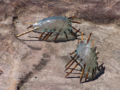
A model of diatom
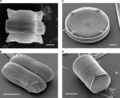
Scanning Electron Micrographs of Diatoms. (A) Biddulphia reticulata. Order: Centrales (B) Diploneis sp. Order: Pennales (C) Eupodiscus radiatus. Order: Centrales (D) Melosira varians. Order: Centrales

An assortment of Diatomea from Ernst Haeckel's 1904 Kunstformen der Natur (Artforms of Nature)
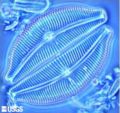
Cymbella tumida
Order: Pennales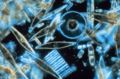


Related References
- How Diatoms Reproduce by John Becker. MBARI.
- Diatoms Ecology by John Becker. MBARI.
- Diatom by many people. Wikipedia.
- Diatoms Morphologyby John Becker. MBARI.
- Phytoplanktonby Caren E. Braby. MBARI.


