Crown-of-thorns starfish
| Crown-of-thorns starfish |
|---|

|
| Scientific Classification |
|
| Binomial name |
|
Acanthaster planci |
The crown-of-thorns starfish is a species of starfish with the scientific name Acanthaster planci. They can have up to 20 arms extending from the central disk and has thorn-like spines all over its body. This is one of the few sea animals that feed off of living coral. The crown of thorns starfish is usually found in the Pacific and Indian Ocean. Starfish are members of the Phylum Echinodermata, which also includes the Sea Urchin, Sea Cucumber, and Sand Dollar.[1]
Anatomy

The crown-of-thorns starfish can be multi-colored and has a large number of pointy thorn-like spines (4-5cm in length) sticking out all over its body. The crown-of-thorns starfish can grow up to 40cm in diameter.[2] Unlike other starfish, which only have 5 arms, the crown-of-thorns can have anywhere from 10-20 arms. The crown-of-thorns starfish(COTs)should be handled carefully because they have pointy spines and are venomous. [3] If poked by the crown-of-thorns starfish the wound will eventually turn blue and will sting and cause swelling that may last for a couple of days. [4]
Reproduction
Spawning is the name used for reproduction of the crown of thorns starfish. Spawning can happen anytime during the summer, unless the water temperature isn’t right. The crown of thorns starfish stands on its tiptoes on top of rocks and releases its eggs or sperm into the water and at this time they meet with the opposite and are fertilized. Up to one-hundred million eggs can be produced by the female each year.[5]
Ecology

Usually the crown-of-thorns starfish live in the Great Barrier Reef, which gives this animal shelter and protection. The starfish will climb onto the coral polyps by putting its entire stomach over them. These starfish love coral and prefer to eat the more common species of hard corals, but when they run out they will settle for soft coral, algae, clams, and other assorted animals. When many COT starfish are near each other they can eat up coral faster than it can grow and reproduce. This isn't very good for the corals population.[6] Many sea creatures will prey on the crown of thorns starfish but few will actually attack it. The Giant Triton is one of those very few and is one of the crown of thorns starfish’s worst enemy.[7] The crown of thorns starfish is a very influential species and the most important member in the tropical coral reefs.[8]
Gallery
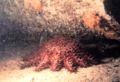
a red crown-of-thorns starfish

 Browse |
Related References
- Crown-of-thorns starfish Wikipedia
- Crown-of-thorns ReefED
- Crown-of-thorns CRC Reef
- Acanthaster planci by: dr. A. Goldschmid


