California sea lion
| California sea lion |
|---|

|
| Scientific Classification |
|
| Binomial name |
|
Zalophus califonianus |
| Image Description |

|
California sea lion is a species of sea lion known by the scientific Zalophus califonianus. They are large predatory eared seals that lives in the Northern Pacific Ocean. There are about 200,000 California sea lions living in waters from British Columbia to northern Mexico. They are abundant today, living in large colonies ranging in the thousands. They are considered quite intelligent, adapt rapidly to man-made habits, and are easy to train. California sea lions have been trained to perform tricks in circuses such as catching balls or clapping with their flappers.[1]
The sea lions were once found in a few islands in Japan, but unfortunately, most researchers believe they all became extinct during World War II. Some believe a few individuals still live in Dokdo Island (claimed by South Korea right now) [2]
Anatomy
California sea lions have a large range in size and weight because of the difference between males and females. Usually males have darker skins and are bigger than females. The male is 6.5 to 8.0 feet long (2 m to 2.4 m), and weighs about 441 to 882 pounds (200 to 400 kilos), while the female ranges from 5 to 6.5 feet (1.5 to 2 m) and weighs about 110 to 243 pounds(50 to 100 kilos). [3] Their life span is about 15 to 25 years. Their body is torpedo shaped to swim faster in the water. They also have four flappers rather than legs, that help them to swim better (they can swim up to 25 mph). They are quite fast on land using their flappers as legs. They have a thick layer of blubber (fat) and thick fur which keep their body temperatures stable even in cold water and they store the fat so they can use it when they really need food. Males also have a thick and furry mane around their neck. They have vibrissae, usually called whiskers, on their mouth which help the sea lion’s sense of touch. They have nostrils to breathe and they are able to close their nostrils. Sea lions have a pair of external ears to hear, and also have sharp eyesight but don’t have color vision. [4]
Reproduction

The California sea lion mates from May to August. They breed in the same area of beach year after year. The males establish their territories on the beach, and they fast and try to stay for as long as they can. Size is the critical thing in winning fights among the males. The reason why their size is important is that they use their blubber (fat) to survive longer without eating, and the larger sea lion can store more blubber and can wait longer.
Females can mate again about 20 to 30 days after giving birth. The female begins the mating ritual by presenting submissive postures in front of the males. Mating is usually on the land, but sometimes in shallow and deep water also. The male meets 16 females in average in one season and the females bear one pup each season [5] Gestation, the time that females carry embryos, lasts about 50 weeks and then lactation, production of milk by female mammals, lasts about half a year to a year.[6] Young babies are very small; being about 30 inches long (75cm) and weighing about 20 pounds (9 kilos).[7]
Ecology
California sea lions usually live in the water. When they come out of the water, they usually stay on shore near the water. They like warm weather. They live between British Columbia and Northern Mexico but don't migrate to other lands because the weather where they live is generally warm every day.
They are carnivorous, which means that they consume other animals as food. They usually eat fish, squid, octopus, crabs, and lobsters. One interesting thing about these animals is that they don’t chew their food; they just swallow it in chunks. When they eat crustaceans and mollusks, they crush the hard shells with their back teeth. [8]
They are very powerful animals, but they have predators such as the killer whales and the white sharks. When they are attacked or troubled by predators, they swim fast enough to get away or they take refuge on land while the predators stay in the water. [9]
Hybrids
A hybrid between the California sea lion and the south American sea lion was reported in the 2002 issue of the Journal of Mammology. [10]
Gallery

Adult male California sea lions (Zalophus californianus) are around 200 to 250 cm in length and can weigh 200 to 300 kg.

A sea lion shares his intimate knowledge of the ocean with researchers via an electronic tag.

Sea lions have strong front flippers that they can use to walk on. They are also capable of using their hind flippers for walking.

California sea lion showing its close encounter with a white shark.
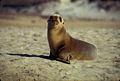
Young baby of the California sea lion


References
- Marine Mammal Information Unknown author, The Marine Mammal center, Copyright 2008 .
- California Sea lion's habitat & distribution Sea World Adventure Parks, Sea World Adventure Parks, No Copyright date.
- Scienstific classifications of California sea lion many authors, Sea World Adventure Parks, No Copyright date.
- Enchanted Learning California Sea Lion many authors, Enchanted Learning , copyright 2008.
- California Sea lion's Reproduction Sea World Adventure Parks, Sea World Adventure Parks, No Copyright date.
- California Sea lion Jaap van der Toorn, compuserve.com, Lastly modified in Thursday September 24th, 1999.
- California sea lion's Birth & Care of Young Sea World Adventure Parks, Sea World Adventure Parks, No Copyright date.
- Sea lion hybrid Many authors, Wikipedia


