Brazilian salmon pink birdeater
| Brazilian salmon pink birdeater |
|---|

|
| Scientific Classification |
|
| Binomial Name |
|
Lasiodora parahybana |
| Image Description |
 |
The Brazilian Salmon Pink Birdeater is famously known for being the perfect pet for tarantula collectors. Found in few bizarre and exotic places in the world their attributes are much like a normal tarantula except for their looks. They are easily recognized by their massive size and their bright pink color when they are young. Feasting on insects and sometimes small birds, the Brazilian Birdeater helps keep careful balance in the ecosystem. Ranking among the world's biggest spiders, the Brazilian Birdeater is a truly unique and wondrous spider made by the Creator for us.
Anatomy

Tarantulas' body length can range anywhere from two to five cm. ( 1-2’’) with a leg span of anywhere between eight and thirty centimeters(3-12’’) The greatest species of tarantulas can weigh up over nine point one-tenth of a gram (0.3 ounces) the Bird eater along with Lasiodora klugi and others rival the size of the largest tarantula. The bird eater may reach seven and a half to ten inches. When they are young their body is covered by pink hair but while the abdomen is a slightly darker pink. When it reaches an adult, the color changes to brown-black with tibiae and patellae lateral strips, which is reddish brown, of curly hairs on the abdomen and legs.
The Brazilian Salmon Pink Bird Eater is a member of the Phylum arthropods. Therefore it must rely on exoskeleton support, much like all invertebrates. The Bird Eaters body is formed of two parts, a Prosomn and an abdomen. The prosoma is also known as the cephalthoray, while the abdomen is known as the opisthosoma. These two main body parts are connected together by a pregenital somite, the pregenital somite is also known as a peclide. The peclide is what allows the two bodies to move, it is attached to the prosoma and allows the opisthosoma to twist in a waist like motion.[1]
Attached to the prosoma are the bird eater’s eight legs, their pedipalps and two chelicerae’s. A tarantula has four pairs of legs, but for every leg there are seven segments: The coax, Trochanter, Femur, Patella, Tibia, Tarsus and the pertarsus. These seven segments all form a function of a leg. At the end of each leg there are two to three claws that are able to retract back into the body. The claws are used for climbing, or gripping when hanging upside down. Surrounding each claw are scopulas, tiny hairs that assist the spider with climbing. When the tarantula walks the first and third leg on one side of the body move simotaniously with the second and forth legs on the opposing side if the body. A tarantula’s leg muscles cause bending at the joints, but to extend the leg out when walking or running blood is pumped into the leg to raise blood pressure in the leg causing it o extend. The tarantula is also equipped with two pairs of appendages. The first are the pedipulps that are used for feeling grabbing and in mating. The second pair of appendages are the cheliceraes that are appendages that the fangs are attached to.[2]
Body Systems
When the tarantula eats it must transform its prey into liquid form. This is a result of the tarantula’s mouth, located under the chelicerae on the front lower part of the spiders prosoma, is just a short straw tube that can only pass liquid through. Therefore when the tarantula injects a prey that has large amounts of solid parts with it also coats it with a digestive juice that is secreted from openings in the chelicerae. Then the liquefied prey is sucked down by the powerful muscular contraction by what is called the sucking stomach. Then the liquefied food runs the length of the spiders’ body through the digestive organs where it enters the intestines. Once in the intestines it is broken down to sizes small enough to pass through the walls of the intestinal walls. From there it enters the hemolymph (bloodstream) and the protein is transported to the whole body by the bloodstream.
The circulatory system of the Bird eater is unlike most other invertebrates. For one instead of a four-chambered heart it has a heart that is a long slender tube, it is located along the top of the opisthosma. Also, instead of the heart being coordinated by muscle contractions it is controlled by nerve cell impulses. The heart pumps the blood through sinuses that are open passages to all the body. Also because there are no blood vessels to protect the flow of blood, if the exoskeleton was sliced stabbed or broken, the spider would most likely bleed to death unless the wound was small in so enabling to wound to dry and heal. Also making the bird eater, along with tarantulas, circulatory system different is the blood its self. It is a liquid called naemolmph or hemolymph. There are four types of hemolymph cells; also there is a oxygenated protein which is a copper based called hemocyanin.[3]
Reproduction
Once the bird eater reaches maturity it will be consumed with mating urges. The male spider will find a safe place and weave a web mat on the surface. Then the spider will rub his abdomen on the mat releasing sperm. The sperm is collected in the mat. Then the male will insert its pedipalps into the web mat and suck up the sperm where it will remain safe in the pedipalps until a mate is found. The male spider will go in search of a female mate. Once he has spotted one the two will exchange signals indicating they are the same species. If so then the receptive female will insert his pedipalps into the lower abdomen of the female called the opithosoma. Once the male has injected his semen into the female he will flee fearing the female and her aggressive state, if he does not the female will some times consume to male. Once the egg is fertilized in the female she will guard the silken egg sac that may contain up to fifty to two thousand eggs for about six to seven weeks. During that time she will brood (turning of the eggs) her eggs so they young’s do not deform from staying on one side of the body for two long. Once hatched, they will remain in the nest where they will feed of the protein from their yolk sac.[4]
Ecology

The home of the Brazilian bird eater is the lush tropic jungles in eastern Brazil North America. They can be found in regions of temperatures 75F-80F and a humidity of 65-80. Although some tarantulas live in trees, the Brazilian Birdeater can be found coming out of burrows from the ground to hunt or to hunt. The Brazilian Birdeater is often captured to be made pets but they must be kept in a heated jungle like environment much like their natural habitat. [5]
Other
the Brazilian Pink Salmon Birdeater makes the perfect pet for any spider lover. They are rarely aggressive and they are easily tamed. they are also easy to care for and their diets are easy to for fill. Thousands of people already own Spider Eaters and there are web sites where owners talk and discuss activities and habits there spiders are having. these sites are abundant and reliable. a lot of them include
- http://www.arachnoboards.com/ab/archive/index.php/t-101718-p-2.html
- http://www.rightpet.com/InvertebrateDetail/brazilian-white-knee-tarantula
- http://www.exotic-pets.co.uk/products.php
- http://www.arachnoboards.com/ab/archive/index.php/t-101718-p-2.html
Gallery
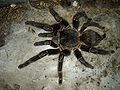
Brazilian Birdeater
(Lasiodora parahybana body span)

Brazilian Birdeater
(Lasiodoraparahybana in captivity)
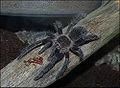
Brazilian Birdeater
(Lasiodoraparahybana size perspective)

Brazilian Birdeater
(Lasiodoraparahybana as a pet )


 Browse |
References
- Lasiodora_parahybana multiple authors, wikipedia, 2009.
- Brazilian Salmon Pink Eater unknown, Exotic pets,2005-2009 .
- FINAL LAB PACKET: Tarantulas & Climate Allison Mouch, Audrey MacWood, Kelly Alter, Nick Anderson , Michigan State University, 12:39 pm 12/7/01
- Brazilian Salmon Pink Birdeater by the Saint louis Zoo, Unknown author.


