Blood-foot mushroom
| Blood-foot mushroom |
|---|

|
| Scientific Classification |
|
| Binomial Name |
|
Mycena haematopus |

|
The Blood-Foot Mushroom is a species of fungi known by the scientific name Mycena haematopus. Its common name (Blood-Foot) is derived from the purple-red 'blood' that comes out of its stem when it is cut or crushed.
Anatomy
The Mycena haematopus is small in size. Since they haven't been tested for toxins yet, it is not recommended to eat them, though, due to their size, they wouldn't add much to the table. A good way to tell if you have found a Blood-Foot Mushroom is by their color and 'bleeding' capabilities.[1] When the mushroom's stem is crushed a purple-colored 'blood' will drip out. [2] How old the mushroom is when it is cut controls how much 'blood' will flow out. The mushrooms can be found in the colors red, pink, brown, grey, with even some in beige.[3]
As mentioned, the Mycena haematopus is very small, their stem will grow to only about eight cm. with the shortest reaching four cm. The stem is only one-two mm. thick and hollow. The stem is usually a smooth red, but sometimes it will have a few pale red hairs. The cap of the mushroom will grow to be only one cm. to three cm. in diameter, in the shape of an oval.[4]
Reproduction
The Mycena haematopus reproduce asexually, by spores. The spores are white in color and are usually between 8-11 x 5-7 µ when placed under a microscope. [5]
Ecology

The Mycena haematopus are found on logs, usually ones that are decaying. Like most other plants and fungi, the Mycena haematopus will grow in clusters close together, but every now and then you can find a loner here and there. Mycena haematopus are found in North America in the spring, summer and fall,[6] although some have been seen growing from mid to late winter. [7]
The Name's Origin
The Mycenean civilization is thought to be named after the mushroom. The story told is that three and one-half millennia ago Perseus, a Greek hero, accidentally killed Acrisius, his grandfather. Perseus was to succeed him to the throne of Argos. Perseus, unknowingly, in killing his grandfather, fulfilled an Oracle’s prophecies. Perseus felt so guilty about the manslaughter of his grandfather, he returned once more to his own kingdom and pleaded with Megapenthes, another ruler, to trade kingdoms with him, his Argos for Megapenthes’s Proetus. Once the trade was complete Perseus went to his new kingdom and discovered the Mycenae mushrooms. A few different stories exist about how the mushroom aided him, but in the end he names his city after the small organism. [8]
Gallery
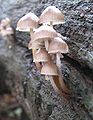
Mushroom
(Unknown)
Thought to be a Blood-Foot mushroom

References
- Tom Volk's Fungus Tom Volk, 2002.
- Mushroom Expert Michael Kuo, November 2004.
- Roger Mushrooms Rogers Plants Ltd., 2001-2009.
- California Fungi—Mycena haematopus by Michael Wood & Fred Stevens, 1997-2009. Myknoweb


