Ten Commandments

The Ten Commandments are laws that have historically been accepted as a summary of the most important rules of behavior which God expects humanity to follow. The Bible says that God wrote these laws on tablets of stone and gave them to Moses while on Mount Sinai.
Within Judaism and Christianity alike, the 10 Commandments are held as a vital part of the Old Testament laws. Although most Christians hold them in high regard, they have rejected most of the other Mosaic Laws as no longer applicable or binding. Many Jews see the Ten Commandments as not meant to apply to non-Jews. The Noahide laws are held as applying to Jews and non-Jews alike.
There are three versions of the Ten Commandments in the Old Testament. They are at Exodus 20:2-17, Exodus 34:12-26, and Deuteronomy 5:6-21. Exodus 20 is the most commonly used set. In addition, the commandments also appear separated in different wording throughout the New Testament.
The Ten Commandments

And God spoke all these words: "I am the LORD your God, who brought you out of Egypt, out of the land of slavery.
- "You shall have no other gods before me.
- "You shall not make for yourself an idol in the form of anything in heaven above or on the earth beneath or in the waters below. 5 You shall not bow down to them or worship them; for I, the LORD your God, am a jealous God, punishing the children for the sin of the fathers to the third and fourth generation of those who hate me, 6 but showing love to a thousand {generations} of those who love me and keep my commandments.
- "You shall not misuse the name of the LORD your God, for the LORD will not hold anyone guiltless who misuses his name.
- "Remember the Sabbath day by keeping it holy. 9 Six days you shall labor and do all your work, 10 but the seventh day is a Sabbath to the LORD your God. On it you shall not do any work, neither you, nor your son or daughter, nor your manservant or maidservant, nor your animals, nor the alien within your gates. 11 For in six days the LORD made the heavens and the earth, the sea, and all that is in them, but he rested on the seventh day. Therefore the LORD blessed the Sabbath day and made it holy.
- "Honor your father and your mother, so that you may live long in the land the LORD your God is giving you.
- "You shall not murder.
- "You shall not commit adultery.
- "You shall not steal.
- "You shall not give false testimony against your neighbor.
- "You shall not covet your neighbor's house. You shall not covet your neighbor's wife, or his manservant or maidservant, his ox or donkey, or anything that belongs to your neighbor. Exodus 20
Violations of the Ten Commandments
All people, materialists in particular, are prone to occasional violation of the Commandments.
First Commandment
Violation of the first commandment is seen in highly polytheistic religions and cults that worship invented gods and false religions. Violators of this commandment would include Muslims with their God 'Allah', Buddhists and 'Buddha', and so on.
Second Commandment
The second commandment is often broken by adherents of humanism, the religion which worships humanity and selfish human nature. Humanism seeks to worship not deities but people, which is inherently wrong. Violation also comes in the form of idolatry and usage of God-substitutes.
Third Commandment
Misuse of the Lord's name is very common both in the direct sense (swearing) and in the indirect sense (describing non-sacred things as of God).
Fourth Commandment
The Sabbath day is the basis of the modern "week" and is evidence of the Christian heritage of the Western World. The Sabbath day is meant to be a day of rest in which one can enjoy quality time with one's friends and family, and working regularly on the Sabbath day violates both the Commandments and family values.
Fifth Commandment
Honoring one's parents is the basis of the nuclear family and of western-style monogamous society. Darwinists challenge the evolutionary benefit of the nuclear family with calls for widespread acceptance of sexual deviance and childhood rebellion.
Sixth Commandment
The sixth commandment against murder is very relevant in the modern world due to the widespread popularity of abortion, and general lawlessness in the forms of other murder-types. Self-murder, such as suicide, is also prominent in the modern society.
Seventh Commandment
Adultery is hardly a social taboo in certain circles thanks to the gradual erosion of Biblical Values and Creationism in mainstream society. Hollywood celebrities regularly practice this crime without remorse for the social and familial disorder it leads to.
Eighth Commandment
Thou shalt not steal, although common sense, is increasingly disobeyed in areas with high crime.
Ninth Commandment
Bearing false witness is an inevitable part of the Washington political world as entrenched interests try to frame their (typically strongly Christian) opponents as being in some way extremist. False testimony is also used extensively by elites and scientists opposed to the findings of creation science to portray that scientific field as violating the scientific method.
Tenth Commandment
Coveting is a common value of redistribution, the Socialist doctrine of fundamentally restructuring society by enabling the elite to take tax dollars of the mainstream and use them for their own material interests.
Legal Issues
For several years, the American Center for Law and Justice (ACLJ) has been actively combating humanist and atheist groups who are attemting to have Ten Commandments monuments removed from public areas in the United States.
The most recent fight involves demands put forth in 2007 by a group called Summum to have the Utah cities of Pleasant Grove City and Duchesne City erect monuments containing what they call the “Seven Aphorisms”.[1][2] This organization is contending that if the Ten Commandments are displayed then their "Seven Aphorisms" must also be displayed. The Tenth Circuit ruled that private parties have a First Amendment right to put up the monuments of their choosing in a city park, unless the city takes away all other donated monuments. In August 2007, the U.S. Court of Appeals for the Tenth Circuit split 6-6 over a request for the full appeals court to rehear two cases. If these lower court decisions are not overturned, cities and states could either be forced to dismantle a host of monuments, memorials, and other displays including long-standing patriotic and historical displays or else let all comers install privately owned monuments or displays, regardless of content. However, on March 31, 2008, the ACLJ announced that the Supreme Court granted ACLJ’s Petition for Writ of Certiorari in the case of Pleasant Grove City v. Summum (No. 07-665).[3]
Gallery
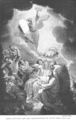
Moses Receiving Law on Mount Sinai

Moses with the law boards by Rembrandt Harmensz. 1659


References
| |||||||||||||||||||||||


