Bear
| Bear |
|---|

|
| Scientific Classification |
|
| Genera |
 |
| A mother Polar Bear (Ursus maritimus) defensively taking care of her cubs. |
Bears are any of the species belonging to the taxonomic family Ursidae. This diverse groups lives in regions varying from the arctic to the jungles of China. These carnivorous, nocturnal creatures are vertebrates. They are known for their large size and dangerous defense mechanisms.
Body Design

Bears are known for their massive, strong build. They can weigh up to 1800 pounds[2] and, on four legs, stand at 2 1/2 to 3 feet, and 4 to 6 feet long from nose to tail.[3] The Sun Bear (Helarctos malayanus) is said to be the smallest bear. The female and male weighing 100 to 145 pounds and standing at 3 to 10 feet tall.[4] They also have stout and broad limbs.Cite error: Invalid <ref> tag; invalid names, e.g. too many Their large heads rest on thick, wide necks and possess extremely short tails[5] (80 millimeters to 125 millimeters).[6] Bear skulls are large, containing unspecialized molars, premolars, long canines, and rounded remaining teeth. They possess 6 upper and lower incisors, 4 slightly hooked canines, 16 premolars, and 4 upper and 6 lower molars. In total, they contain 42 teeth, aiding in the hunting, tearing, and capturing of food.[5]
Although possessing monstrously large elongated skulls, bears have small eyes resulting in poor vision. Also having petite rounded ears, they rely mainly on their keen sense of smell.[7] Their sense of smell is more sensitive than a dog's and a thousand times more sensitive than a human's.
Males grow from 1 to 5 times larger than the females. However, males reach full maturity later than females. Males reach maturity at age 10 to 11 while females reach at age 5. Despite their intense weight and large rear end, bears are able to run or shuffle quickly when necessary (35 miles per hour)[2] and have the ability to stand on two legs. [5]
Bears appear dog-like because of their rough fur that varies in color such as black, white, or brown.[2] The hair length varies for each individual genus (2 centimeters to 20 centimeters) as well as the shape and design of their claws.[5] All bears have non-retractable claws and can grow up from 6 to 10 centimeters in length, depending on the purpose and surrounding environments. For example, Sloth Bears (Melursus ursinus) use their extremely long claws for digging. Sun Bears' claws are more curved, aiding them more in tree climbing. Because bears have more use of their forepaws, the claws tend to be longer than that of the hind feet. Each foot has five toes with each paw characterized with short haired soles. The pads on the inferior of their paws are to reduce friction when walking. The Giant Panda (Ailuropoda melanoleuca) has the exception of a 6th toe, which is actually just an enlargement of the radial sesamoid bone[2] and acts as a false thumb for the eating of bamboo.[5]
Like other mammals, especially humans, bears have a four-chambered heart and a closed circulatory system. However, bears have more veins than any other organ in their body to help direct the blood to the right places in the body. The valves in their veins help the blood flow one way through their body. Because humans are two legged, the path of the blood differentiates.[8]
Life Cycle
Bears exhibit sexual reproduction and only gather and assemble during mating season.[4] Sexual maturity can vary from age 2 to 10, depending on the body’s condition (which also bases off of food supply and environmental surroundings). Brown bears (Ursus arctos) usually give birth around age 5 and Polar Bears (Ursus maritimus) around the age of 10. Breeding abilities mainly stop around the mid-20’s.[5]
Mating seasons are defined amongst specific bears with the Sun Bear (Helarctos malayanus), having no specific mating season, as an exception. The Brown Bear, Black Bear (Ursus americanus), and the Sloth Bear (Melursus ursinus) generally mate during May-July while the Polar Bear and Giant Panda (Ailuropoda melanoleuca) breed in March- June. [5]

As a mating call, bears use scents. They mark scents on trees by standing on their hind legs and rubbing their back and head against the bark. Giant Pandas can often use vocalization to attract mates. Female bears are able to control their ovulation period with sexual encounters. However, their ovulation period can be stimulated without trying to activate any form of sexual activity, resulting in false pregnancies. As the male inserts his male reproductive organ, penis, the female’s ovulation period is stimulated and her eggs fertilize. A single female goes through several mating sessions with 3 to 20 different males in a time period of 2 days to 3 or more weeks. After fertilizing the egg, the embryo begins the blastocyst stage and becomes dormant. This provides the female with the ability to adjust the conception date of the cub. Implantation usually happens approximately 60 days before conception. Gestation period varies from 3 to 15 months in different species. For example, Giant Pandas take 3 to 6 months, Sun Bears take 3 to 15 months, Sloth Bears take 4 to 7 months, and other species average in 6 to 8 months.[5]
Mother bears will take care of their cubs until they are capable of living on their own. They are extremely protective and defensive over their cubs, even willing to kill the father to protect them.[4] The average litter size of species is 4 cubs. Cubs are born in an altricial state, meaning they are born helpless and weak. In Black Bears, the cubs are born blind, with a fine coat, and weigh ½ of a pound. They open their eyes after 25 days. The mother provides milk which is enriched from their fat storage (7% protein and 20% fat). Families most often break up because of negative interactions between the mother and father.[6]
Once grown, the bears undergo the same reproductive lifestyle their parents went through. Throughout their entire life, bears hibernate periodically, taking up a majority of their life cycle. Bears may live up to 35 years on average. It is common for them to live 20 to 25 years in the wild[6], and if in captivity, they can live 50 to 55 years.[2]
Ecology

Bears live in caves, hollow logs, or cavities in tree roots. They take advantage of their surroundings as shelter. To adjust to unfavorable weather conditions, bears hibernate. The hibernation period, the state of inactivity to conserve energy by going into a deep sleep, varies for each bear.[4] Before entering their period of dormancy, the bear stores fat by eating vast amounts of food to last the inactive phase.[6]
Bears are found on all continents of the world, excluding Antarctica and Australia. However, they are found in large quantities in the northern hemisphere. The habitat locations of bears range. Some bears have specific regions they live in. However, some species of bears are able to live almost anywhere. Most brown bears (Ursus arctos) live in the Atlas Mountains,[2] but they can also live in the heat of the Gobi Dessert in Mongolia.[9] Polar Bears (Ursus maritimus) are found in the polar arctic regions. The black bear (Ursus americanus) is found in the United States and Canada.[10]
Bears are classified as carnivores but they also take on herbivorous characteristics. For example, the Panda (Ailuropoda melanoleuca) eats mostly bamboo. Most species eat fish and prefer that over eating other land animals. However, eating land animals is not uncommon. Most bears are nocturnal, but activity during the day is not a rare occurrence.[4] They are said to be active 50-60% of the day.[5]
Avoid Bear Attacks

Always make sure your presence is known. Surprising the bear definitely raises your chances of attack. The bear will see you as a threat.[11] Make yourself known by singing or ringing a loud bell, etc. [12]
Remain away from areas where bears might stay or feed. Those areas mostly include berries.[11] Also keep an eye out for trees that bears have rubbed on. The bark may appear to have pieces of fur stuck to it and the bark will be somewhat stripped. It shows high bear activity.[12]
If you’re camping, keep your food in a plastic bag AWAY from the campsite. Food attracts the bears and hanging the food on a tree 14 feet above the ground and 4 feet away from the trunk helps avoid the attraction of bears. They won’t be able to reach it.[11]
If you come face-to-face with bears, it is very important to keep your distance[11] and remain calm. Sudden movements will surprise the bear. It is also important to remember that a standing bear is there to observe you, not attack.[12]
Try to walk away slowly in a diagonal line. However, if the bear starts to follow, STOP. Do not run! Bears chase fleeing animals.[11]
Do NOT feed bears or throw food at them. Throwing food angers them and views it as an action of defense from you. Instead, throw an object on the ground in attempts to distract it. When distracted, slowly escape.[12]
If a bear attacks, play dead! Play dead. Lay face down on the ground with yours hands behind your neck. The bear will most likely assume you're dead and will back off. It is important to stay still for as long as possible. The bear still sees you from a distance and if he sees movement, he will come back![12]
Video
Bears' hibernation is quite an important part of their life cycle.
Gallery
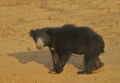
Sloth Bear
(M. ursinus)
Genus:Melursus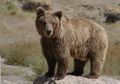
Brown Bear
(U. arctos)
Genus:Ursus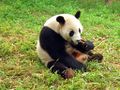
Giant Panda
(A. melanoleuca)
Genus:Ailuropoda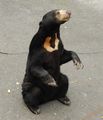
Sun Bear
(H. Malayanus)
Genus:Helarctos


References
- ↑ Unknown Author. Ursidae Wikispecies. Web. Last updated 13 June 2013.
- ↑ 2.0 2.1 2.2 2.3 2.4 2.5 Dewey, Tanya. Myers, Phil. Ursidae Animal Diversity. Web. Last accessed 23 March 2014.
- ↑ Unknown Author. Size The Vince Shute Wildlife Sanctuary. Web. Last accessed 23 March 2014.
- ↑ 4.0 4.1 4.2 4.3 4.4 Unknown Author. Bear a-z animals. Web. Last accessed 23 March 2014.
- ↑ 5.0 5.1 5.2 5.3 5.4 5.5 5.6 5.7 5.8 Unknown Author. HMW 1 - Family text: Ursidae (Bears) Lynx. Web. Last accessed 23 March 2014.
- ↑ 6.0 6.1 6.2 6.3 Unknown Author. Bear Mammals of Kansas. Web. Last accessed 23 March 2014.
- ↑ Unknown Author. Family Ursidae Lethbridge College. Web. Last accessed 23 March 2014.
- ↑ Unknown Author. Circulatory System Weebly. Web. Last accessed 23 March 2014.
- ↑ Shapiro, Leo. Ursidae bears Encyclopedia of Life. Web. Last updated 17 March 2014.
- ↑ Unknown Author. Order Carnivora Family Ursidae Bear Family University of Edinburgh. Web. Accessed 6 March 2014.
- ↑ 11.0 11.1 11.2 11.3 11.4 Kirkwood, Scott. Avoiding Bear Attack National Parks Conservation Association. Web. Accessed 6 March 2014.
- ↑ 12.0 12.1 12.2 12.3 12.4 Himiak, Lauren. Bear Safety Tips About. Web. Accessed 6 April 2014.


