Fruit bat
| Fruit bat |
|---|

|
| Scientific Classification |
|
| Genera |
|
Subfamily Macroglossinae
Subfamily Pteropodinae
|
The fruit bat is fructivorous living off of specifically the fruit and nectar provided by plants. It is also one of the largest, reaching 16 inches in length with a wingspan of five feet. Fruit bats live only in the tropical and subtropical regions of the Eastern Hemisphere like, Africa, Asia, Australasia and Oceania. [3]
Anatomy

Fruit bats are a dark brown color with golden brown fur on their neck, and they have fur that covers most of their bodies. They can grow up to sixteen inches and have a wingspan of up to five feet. Another name that was giving to them are called "flying foxes" since their faces look like a Fox's face.[1]
Teeth type and diet
The Pteropodidae or fruit bat teeth and short jaws are specifically adapted for piercing the rinds of tough fruit.[2] Observing animals with sharp teeth, yet retaining a diet of plant eating presents an inconsistency from an evolutionary presupposition, that is usually present, stating that if an animal has sharp teeth the implication is it is a meat eater. An animals teeth becomes a way to classify it as either herbivore or carnivore. Creation science differs from the occasionally used assumption, predicting that teeth type alone is not sufficient and in fact leads to misleading conclusions. Animals may still be vegetarian with sharp meat eating like teeth, according to the biblical text, because before the fall animals only ate plants. The creationist position remains consistent with observation, while the competing assumption falls short of explanatory power. Long, sharp teeth do not always imply meat eating, but rather were used for the self-defense of the plant-eating animal, such is the case of the finding of a saber-toothed tiger that was a herbivore.[3]
28God blessed them; and God said to them, "Be fruitful and multiply, and fill the earth, and subdue it; and rule over the fish of the sea and over the birds of the sky and over every living thing that moves on the earth." 29Then God said, "Behold, I have given you every plant yielding seed that is on the surface of all the earth, and every tree which has fruit yielding seed; it shall be food for you; 30and to every beast of the earth and to every bird of the sky and to every thing that moves on the earth which has life, I have given every green plant for food"; and it was so. 31God saw all that He had made, and behold, it was very good. And there was evening and there was morning, the sixth day. Genesis 1:28-31 (NASB)
With a prediction of creation science realized, that sharp teeth do not always have to imply meat eating, a more inviting model to extrapolate into the past is exorcised and accurate reflection of past animal anatomy and dietary habits can be pursued. Remaining consistent with observations of nature such as ancient fossils but also the fruit bat, being the finest example of living proof.
Reproduction
In a colony of fruit bats one male will mate with up to eight females. The Giant Indian Fruit Bat (Pteropus giganteus) mating season goes from July to October and the mother usually has a single pup and cares for it up to 6 -7 weeks after birth. They will then begin to fly by 11 weeks, however weaning from the parent occurs after 5 months. [4]
Ecology

You can find fruit bats living within warm, tropical regions of the Eastern Hemisphere in dense forests such as Africa, Asia, Australasia, and Oceania. They sleep high in the trees as a survival mechanism allowing them to stay away from animals that would rather find an easy meal with these creatures down on the forest floor. Usually you can find bats within caves however fruit bats do not visit such places as they are too big and crowding would soon take place easier than with other smaller species.
Most bats depend completely on echolocation to find their way around because they cannot see good at all, however in stark contrast the fruit bat has excellent vision and has no need for echolocation. They also have a keen sense of smell which allows them to easily locate fruit, and flower nectar in the night sky. Bats are very agile fliers, however landing is when they usually have to crash into the branches of trees in an attempt to grab a branch while flying by. [5]
Gallery
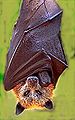
fruit bat:Pteropodidae

Pteropodidae

Megabat in flight:Pteropodidae.


References
- Welcome to the fruit bat world Bat Study and Conservation group of Japan
- Fruit bat HighBeam Encyclopedia
- Giant Indian Fruit Bat Sedgwick County Zoo


