Nebula

A Nebula (Latin: "Name means::cloud"; pl. nebulae or nebulæ) is a cloud of dust particles and gases in interstellar space.
The term comes from the Latin word for mist. Early astronomers used the term to refer to any cloudy astronomical object including galaxies outside the earth's galaxy, the Milky Way. Such galaxies, called extragalactic nebulae, looked like hazy patches of light among the stars. But modern telescopes resolved individual stars in other galaxies and showed that extragalactic nebulae are actually systems of stars similar to the Milky Way. The term now specifically refers to any interstellar cloud of dust, gas, and plasma in the Milky Way and other galaxies.[1]
Types
Astronomers classify nebulae into two general types: diffuse nebulae (not usually associated with specific stars), and planetary nebulae and super nova remnants (associated with a specific star). Both types are also called gaseous nebulae.

Diffuse
Diffuse nebulae are the larger of the two types.
Emission
Emission nebula are frequently described as stellar nurseries, which give birth to new stars. Some diffuse nebulae are believed to contain enough dust and gases to form as many as 100,000 stars the size of the sun. They are called emission nebula because they occur near extremely hot, bright stars. The intense ultraviolet light from the star energizes the gas atoms of the nebula and enables the mass to emit light. A diffuse nebula of that emits light is called an emission nebula.[1]
Dark
A diffuse nebula also may occur near a cool star. In this case, the ultraviolet light from the star is too weak to make the nebula's gas atoms give off light. But the dust particles in the diffuse nebula reflect the starlight. Astronomers refer to this kind of diffuse nebula as a reflection nebula. If a diffuse nebula occurs in an area that has no nearby stars, it neither emits nor reflects enough light to be visible. In fact, its dust particles blot out the light from the stars behind them. Astronomers call such a diffuse nebula a dark nebula.[1]
Planetary

Planetary nebulae are ball-like clouds of dust and gases that surround certain very hot stars that look like White Dwarf stars.[2]They form when a smaller star begins to collapse and throw off the outer layers of its atmosphere. When viewed through a small telescope, this type of nebula appears to have a flat, rounded surface like that of a planet, [1] or has the appearance of a ring since the edges of the sphere of gas seem brighter than the front. Planetary nebulae are much less bright and usually smaller than super nova remnants.
Supernova remnants
- Main Article: supernova remnant
Nebulae are otherwise known as supernova remnants. They are the remains of massive stars that have exploded, or gone supernova. The explosive death of a star comes when its core first undergoes the transition to a neutron star, which then blows off its outer layer to form a nebula.
The Crab Nebula is thought to be the remains of a supernova that occurred in our galaxy and was seen from earth in AD 1054. Danny Faulkner suggests that one major challenge to the standard model is the lack of old Supernova remnants. Theory suggests that supernovae should be visible for several million years, but yet we find almost none that are more than a few thousand years old. Supernova remnants are usually much larger than planetary nebulae, and normally are still hotter and therefore brighter than planetary nebulae.[3]
Nebula theory
- Main Article: Nebula theory

Solar systems
Cosmologists who hold to a naturalistic origin of our solar system believe that it formed from a giant, rotating cloud of gas and dust known as the solar nebula. According to this theory, the solar nebula began to collapse because of its own gravity. Calculations have shown that this is difficult because as the nebula collapses from gravity, it heats up which in turn causes it to expand. Because of this, some astronomers speculate that a nearby supernova (exploding star) triggered the collapse. As the nebula contracted, it spun faster and flattened into a disk.
The nebular theory indicates that particles within the flattened disk then collided and stuck together to form asteroid-sized objects called planetesimals. Some of these planetesimals combined to become the nine large planets. Other planetesimals formed moons, asteroids, and comets. The planets and asteroids all revolve around the sun in the same direction, and in more or less the same plane, because they originally formed from this flattened disk.
Most of the material in the solar nebula, however, was pulled toward the center and formed the sun. According to the theory, the pressure at the center became great enough to trigger the nuclear reactions that power the sun. Eventually, solar eruptions occurred, producing a solar wind. In the inner solar system, the wind was so powerful that it swept away most of the lighter elements -- hydrogen and helium. In the outer regions of the solar system, however, the solar wind was much weaker. As a result, much more hydrogen and helium remained on the outer planets. This process explains why the inner planets are small, rocky worlds and the outer planets, except for Pluto, are giant balls composed almost entirely of hydrogen and helium.[4]
Stars
- Main Article: Stellar evolution
Astronomers also believe some emission nebulae are places where new stars are forming. It is theorized that gravity and a nearby supernova cause a portion of a nebula's dust and gases to contract into a much smaller, denser mass. Pressure and temperature build up within the mass of dust and gases as contraction continues for millions of years. In time, the mass becomes hot enough to shine -- and forms a new star.[1]
Gallery
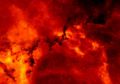
Rosette Nebula
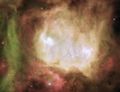
Ghost Head Nebula
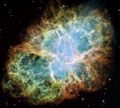
Crab Nebula
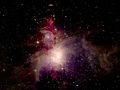
Orion Nebula


References
- ↑ 1.0 1.1 1.2 1.3 1.4 Worldbook at NASA: Nebula by the U.S. Aeronautic and Space Administration.
- ↑ * A Review of Stellar Remnants: Physics, Evolution, and Interpretation by Danny R. Faulkner CRSQ 44(2):76-84. Fall 2007. p 81
- ↑ A Review of Stellar Remnants:Physics, Evolution, and Interpretation by Danny Faulkner, CRSQ Vol 44:2 pp 76-84, Fall 2007
- ↑ Worldbook at NASA: Solar System by the U.S. National Aeronautic and Space Administration


