Rubber tree
| Rubber tree |
|---|

|
| Scientific Classification |
|
| Binomial Name |
|
Hevea brasiliensis |
The Pará Rubber tree (Hevea brasiliensis) is best known for being the plant from which rubber (latex) is harvested. Most natural latex comes from the forests of South America where the trees are grown in plantations. Native Americans discovered and used latex long before it was known by Europeans.
The Rubber tree is a great example of how God has given us everything we need in the nature that he created. It is very apparent that this tree was created for the use of man since we use it in everything from cars to shoes. It’s just another great example of the variety of creation and how God provides needed raw materials.
Anatomy
The rubber tree is a dicot, a plant whose seed has two seed leaves when it sprouts. This tree is an angiosperm which means it produces flowers. It has round shaped leaves and flowers. It produces nuts, which are like seeds that come in a pod. Rubber trees have the same basic structure as any other plant. It has a stem or trunk which provides a highway for nutrients and support for the plant. The leaves are used to collect sunlight to make energy through photosynthesis. The roots absorb water and nutrients from the soil underneath the plant and provide a base or anchor, so that the tree is secure in the ground.
Like all other plants, rubber trees use photosynthesis to make energy. They use sunlight in specialized cells for the production of energy. Trees also take in carbon dioxide and transform it to release pure oxygen. Trees are important to humans because they renew our oxygen supply. As rubber trees are grown, harvested and then replaced with new rubber trees we are helping our environment.
Reproduction
The reproduction of angiosperms happens through pollination of flowers. Often, this occurs by insects pollinating flowers on the tree. The pollen from one tree gets transferred to another and then a seed pod is produced. The flowers on the tree attract pollinators. There is a male and female part on every flower just waiting to be pollinated by a bee or other insect.
Ecology

The Para Rubber tree naturally grows in South America where it is warm and moist. When rubber trees were discovered they grew only in South America. Then when the demand for rubber grew, other places were tried such as Malaysia. Huge tracts of land were cut down and made into rubber plantations. A huge demand for rubber began when the production of cars became important, increasing the size of the rubber industry by more than twenty five percent. Rubber has been exported to meet needs and this is how it got to be in so many different places.
Uses
The unique thing about the Para Rubber Tree is that it can be Rubber Tapped. Rubber Tapping is the process of harvesting latex from the tree. This process does not begin until the tree reaches five to six years of age. Yellow or white latex comes out of the tree in sap form. Workers cut into the tree just deep enough to reach the latex vessels or sap vessels, which run around the tree at around a thirty degree incline. Once the cuts are made, small buckets are place under the cut to catch the leaking sap. The older the tree is the more sap in produces until it stops producing when it reaches its twenty sixth year.
Most of the rubber we see today comes from petroleum but about a third of industrial rubber comes from the natural source of the Rubber Tree[1]. This tree is important because it contributes to the making of many rubber products such as shoes, balls, household items, and many other products we could not live without. Environmentalists appreciate natural rubber because the tree uses carbon taken from the atmosphere, where synthetic rubber takes carbon from the ground. Synthetic rubber is thus more prone to increase carbon dioxide levels in the air.[2]
Fordlandia
Henry Ford hoped to break the monopoly of rubber held by the British with their huge plantations in Malaysia. In 1928 he send men and equipment to Santarem, Brazil to start a huge Brazilian rubber plantation.[3] He had a land grant of one million hectares (2.5 million acres, almost 4,000 square miles) and by 1941 planted more than 3 million rubber trees knowing that it would take five to six years before they would produce latex.[3] However, Brazilian rubber trees had always been tapped where they were found in the jungle, and even today most Brazilian rubber production is from found trees rather than planted trees. A leaf fungus and other pests killed most of the rubber trees and eventually, when a horticultural specialist was hired, he moved the plantation 70 miles to the Belterra location where some rubber production eventually occurred. Ford tried to have the Amazonian Brazilians live in American style houses and eat American food at a factory cafeteria, which went against what the Brazilian workers felt was normal, and caused much unneeded labor problems. Finally, when synthetic rubber was invented in 1945, Ford gave up and sold the plantations to the Brazilian government at nearly a $20 million loss.[3]
The huge Malaysian plantations are always fearful that the Brazilian leaf blight might spread to their plantations. Recently, Michelin researchers working in Itubera, Bahia, Brazil, and Montpellier, France, have found more resistant strains that they hope will provide a long term solution.[2]
Gallery
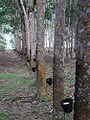
Rubber tree plantation during harvest
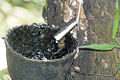
A latex bucket on a tapped rubber tree
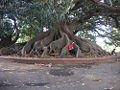
Large rubber tree of a different species


References
- ↑ Latex Accessed 4 January 2012
- ↑ 2.0 2.1 Green Gold - How a Brazilian forest of rubber trees is bouncing back Accessed 4 January 2012
- ↑ 3.0 3.1 3.2 Ford Motor Company's Brazilian Rubber Plantations Benson Ford Research Center. Accessed 4 January 2012.
- Hevea brasiliensis by the U.S. Department of Agriculture.
- Para rubber Wikipedia.
- Rubber Malyasian Rubber Board.


