Anaconda
| Anaconda |
|---|

|
| Scientific Classification |
| Species |
|
Anacondas are cold-blooded vertebrates that were created by God on Day 6 of Creation. They are frequently called water boas because that is where they are often spotted. There are four species, but the most common are the green, "Eunectes Murinus" ("Good Swimmer"), and yellow, "Eunectes Notaeus", anaconda. The anacondas that belong to the Boidae family are not at all venomous although they may have an excruciating bite. The average life span for the anacondas is twenty to thirty years. The size of most anacondas range from ten to forty feet long. They can be one to two feet wide.
Anatomy
Anacondas have difficulty seeing anything that isn’t moving. Their pupils are vertical which helps them to see in the dark when they are most active. No snakes have ears, which means they cannot hear. They feel vibrations through bones in their lower jaws. The tongue is very important to a snake because it aides its sense of smell. When an anaconda rolls its tongue back into its mouth the aromas outside are transferred to the Jacobson’s organ for analysis. The tongue picks up scent particles and brings them back to the mouth, so that without the tongue, the snake would really be unable to function properly. The eyes and nose are located toward the top of the snake's head so it can see and breathe while it’s submerged under water. Scales are smooth because they’re made of skin. Scutes are the scales on an anaconda’s underside.
Reproduction
An Anaconda starts in an egg, where it spends several weeks growing. When fully formed, the oviparous or viviparous hatchling breaks out of its egg. Oviparous means being born in an egg while viviparous means it is born live with its defined shape and form. It hatches at the same rate as the rest of the eggs in its clutch. As soon as it’s hatched, it must move away quickly to escape any predators nearby. The juvenile manages his own food diet. It grows fast and molts as it gets bigger, which is also known as ecdysis. In time the snake becomes an adult, is able to reproduce, and is ready to start a new life cycle all over again. A female anaconda can have twenty to eighty babies. The larger the anaconda the more babies she can have. If you see a cluster of anacondas enfolded together in some kind of knot, it means that the anacondas are in a mating ball consisting usually of one female and two or three males.
Ecology

Anacondas live in tropical river valleys, swamps, marshes, and other watery habitats. Anacondas like slow-moving streams. They like to be tanned anywhere they can be exposed to the sun. Anacondas are found along the Amazon River system in the northern half of South America. They can also be found at the following locations: Columbia, Venezuela, the Guiana’s, and the island of Trinidad, Brazil, Bolivia, Paraguay, Uruguay, Argentina, and Marajo Island. Anacondas use camouflage that allows them to blend in with their surroundings. Camouflage is an anaconda’s best instinct of defense. It can also swim to the bottom of whatever watery habitat it’s in if it is deep enough. A hungry anaconda eats fish, birds, mammals, and other reptiles. It will even eat capybara and caiman. An anaconda executes its prey by wrapping around its prey’s body and squeezing tighter and tighter every time the prey exhales, so it can no longer take any more breaths of air. They swallow their prey completely, which can let them live months without eating again while their prey digests completely.
Poaching

Poaching is an enormous problem for all snakes including especially anacondas, since their skin is large and valuable. Poaching continues even though anyone caught poaching is in danger of fines and prison. Snakeskin has been fashionable to make handbags, belts, watchbands, shoes, and boots. The people who monitor the snake population and goods made from snakes is an organization called the Convention on International Trade in Endangered Species (CITES). Many countries, including the United States, Canada, and Britain, have laws restricting the import of snakeskin products.
MythBusters
True and False questions about Anacondas[1] by Extreme Science:
-Anacondas hypnotize prey (False)
-Anacondas lay huge eggs (False)
-The main threat to anacondas is the jaguar (False)
-Anacondas swim in slow-moving rivers and streams (True)
-Anacondas swallow their food without chewing it at first (True)
-Anacondas live independently and not in groups (True)
-In general, most snakes feel wet and slimy (False)
-Anacondas will go after people to eat them (False)
-Anacondas are naturally aggressive (False)
-Anacondas appetites are never fully satisfied (False)
-People have spoken about spotting an anaconda that was over one hundred feet long (False)
Gallery

Anaconda
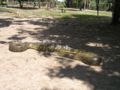
yellow poka dot anaconda
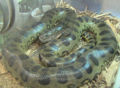
Green Anaconda
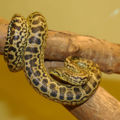
Yellow Anaconda
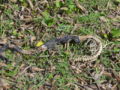
This is the remains of an anaconda
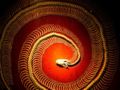
Here is the anaconda's skeleton


Related References
- [2] by Extreme Science
- [3] by Nashville Zoo at Grassmere
- [4] by Wikipedia
- [5] by Enchanted Learning
- [6] by Encyclopædia Britannica Online


