Shrimp
| Shrimp |
|---|

|
| Scientific Classification |
|
| Superfamiles |
| Image Description |
 |
Shrimp are aquatic animals belonging to the taxonomic infraorder Caridea, and are perhaps best known as a gourmet food. There are thousands of different shrimp species in the world, of which some live in fresh water and some live in salt water. Shrimp vary in size from a small fraction of an inch to 9 inches long (22 cm). [1]
Anatomy

No Shrimp have backbones; scientists call them invertebrates. Since they do not have backbones to support their bodies, they have hard exoskeletons in the surface of their skins, which are thin, smooth, and almost transparent. Transparency makes it hard for predators to distinguish them from the background. Their bodies are divided into three main parts: head, thorax and abdomen. [2] They have 5 pairs of swimming legs (swimmerets) on the abdomen, 5 pairs of walking legs, and 3 pairs of maxillipeds which help them feed. Some shrimp have a pair of pincers, which are a part of their walking legs, to catch prey or defend themselves from predators. They also have two pairs of antennae that contain sense organs for touch and taste, a tail fan to swim faster, and compound eyes that help them see in the water and detect predators.[3]
Reproduction
Before shrimp mate, the female molts her hard exoskeleton and her body becomes soft. The male fertilizes the female's eggs, the female carries the mass of eggs for 24 hours and then spawns. They lay hundreds of thousands to millions of eggs. When the larvae are hatched from the eggs, they sink to the bottom of the sea to live. Some shrimp die after they give birth, but others can live for 6 or 7 years. [4]
Ecology

Shrimp are omnivorous scavengers, that usually consume coral, plants, microscopic organisms, or dead animals. They help reduce water pollution by eating the dead organisms in the water. Salt water shrimp live close to the bottom of the sea to eat dead organisms and coral, or live in the mid water to eat plankton.[5]
Shrimp use maxillipeds to eat their food. Many of them live their life alone, but some species live in large groups and the whole group moves together like a single animal. Because their small bodies lack protective body parts, they are easily eaten by many different kinds of predators, such as fish, birds, octopi. Even giant whales filter the water and eat shrimp.[6] However, shrimp have high resistance to toxins made by humans, so when they eat food that has high levels of toxins, they may pass those toxins to the animals who eat them.[7] Also people catch them in seas or lakes; they use shrimp in various ways. People farm shrimp, eat them, and sometimes sell them as pets. [8]
Other
There are some especially interesting kinds of shrimps in the world. Pistol shrimp are very interesting because of their way of catching prey. They have a pair of pincers they use to make loud clanging noises that instantly stun or kill their prey. Cleaner shrimp are very interesting; they move a bit to attract fish and when the fish sees the motion and comes to the shrimp, and the shrimp enters its gill or mouth to get at debris and eat it. There exists a symbiotic relationship between the two species and is how they live. Some of the deep-sea shrimps have the light-producing organs called photophores. People think they produce light to attract other mates in the dark sea. [9]
Gallery
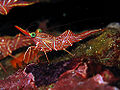
Dancing shrimp
(Rhynchocinetes durbanensis)
Superfamily: Nematocarcinoidea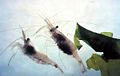
Grass Shrimps
(Palaemonetes pugio)
Superfamily: Alpheoidea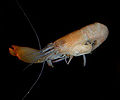
Snapping shrimp
(Synalpheus fritzmuelleri)
Superfamily: Alpheoidea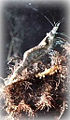
California freshwater shrimp
(Syncaris pacifica)
Superfamily: Atyoidea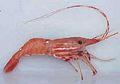
Spot prawn
(Pandalus platiceros)
Superfamily: Pandaloidea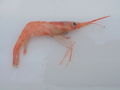
Alaskan pink shrimp
(Pandalus eous)
Superfamily: Pandaloidea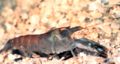
Brown Shrimp
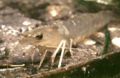
White Shrimp
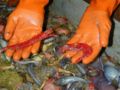
Red Shrimp


References
- Shrimp's anatomy and diet many authors, many publisher, Copyright 1996-2007 .
- Shrimp Anatomy and reproduction unknown author,unknown publisher, copyright 2008.
- Biology of shrimp museum Victoria, established in 1983.


