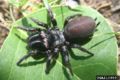
Atypical tarantula
From CreationWiki, the encyclopedia of creation science
| Atypical tarantula |
|---|
| Scientific Classification |
|
| Genera |
| Purse web |
Atypical tarantulas are predatory invertebrates. They are members of the class Arachnida, which includes spiders, scorpions, mites, and ticks. Many spiders hunt by building webs to trap insects; these webs are made of spider silk extruded from spinnerets on the end of the abdomen, a thin, strong protein strand extruded by the spider. All spiders produce silk, even those which do not spin elaborate traps with them. Silk can be used to aid in climbing, forming smooth walls for burrows, cocooning prey, and for many other applications. Atypical tarantulas are also called purseweb spiders and consist of only three genera (genus). In the United States these are Sphodros and Atypus, and in Europe, Asia and Africa only Atypus. Atypus lives in a silken tube parallel to the surface of the ground, while Sphodros usually props its tubes against a tree trunk. The females generally do not leave their silken tubes, but catch insects that crawl on the tube by biting the prey through the silk. [1]
Contents |
Anatomy
The Chelicerata body is divided into two sections the Prosoma or Cephalothorax, which is the head region, and the Opisthosoma or Abdomen which is the rest of the body. Spiders have an exoskeleton that is made up of a tough material called cuticle. Cuticle is a composite material made up of a protein with microfibres of chitin embedded in it. The cuticle is divided into four layers the Epicuticle, the Exocuticle, the Mesocuticle, and the Endocuticle. Spiders get their color from pigment granules contained in the epithelial cells. It is not commonly known but spiders also have a small endoskeleton. This endoskeleton contains no chitin, but is made up of cartilage like material based on collagen fibres and a homogenous ground substance. Attached to the Prosoma are four pairs of walking legs, one pair of Chelicerae (fangs) and one pair of pedipalps. The pedipalps of mature male spiders are modified as copulatory organs. Each of the spiders legs has seven segments. Starting from the body and working outwards they are called Coxa, Trochanter, Femur, Patella, Tibia, Metatarsus and Tarsus. The femur, tibia and metatarsus are normally long where as coxa, trochanter and the patella are short. The tarsus is intermediate in length, but more slender than chunky. The pedipalps have only six segments, they are missing the metatarsus. The pedipalps are normally shorter than the legs, although the relationships between the separate sections is similar. The chelicerae consist of two segments. Nearest the body, and attached to it, is a stout section called the basal segment, beyond this is the fang. The fang is movable and normally serrated on its inner edge. Along the inner edge of the basal segment there is a groove, often with serrated edges that the fang folds into when it isn't being used. [2]
Spiders have an open circulatory system, meaning the organs of the body are bathed an the internal sea of respiratory fluid called haemolymph. The heart is a tube with several ostia. These ostia are small holes that allow the haemolymph into the heart. When the heart muscles contract these holes close and the blood is forced out into the two main arteries that run from each end of it. These arteries are called the anterior aorta (to the prosoma) and the posterior aorta (to the opisthosoma). The heart has valves at either end to ensure the blood always flows in the same direction. These arteries branch out through the whole animal, until they become very small. They have open ends which allows the haemolymph to reach the animals tissues. From here it passes through the book lungs where gaseous exchange occurs. From the book lungs veins take the blood into the pericardium, which is a cavity or space that contains the heart, from where it can enter the heart during diastole and start its journey again. Spiders respire through book lungs. The trachea lies posterior to the book lungs and open to the external world just anterior of the spinnerets, often through a single opening called a stigma. The development of the trachea is quite varied between different spider families. Usually there are two sets of tubes called the lateral and median tubes. Trachea can be very complicated and highly branched or simple and unbranched.[3]
The nervous center of a spider is situated in the prosoma. The central nervous system is compacted with the brain to produce a single mass of nervous tissue. This single mass can be divided into the lower star-shaped subesophageal ganglion and the upper spherical supraesophageal ganglion. A number of nerves arise from these ganglia and spread out to the body, making up the peripheral nervous system. The supraesophageal ganglion can again be divided into the cheliceral ganglion and the brain. The cheliceral ganglion controls the musculature of the chelicerae, the pharynx and the poison glands. The brain is mainly concerned with association activities. It only receives information from the eyes, via the optic nerve. Motor nerves that control the the legs and the pedipalps originate laterally from the subesophageal ganglion. Posteriorly the subesophageal ganglion gives rise to a set of nerves called the 'cauda equina' which pass through the pedicel to control the opisthosoma. [4] Spiders are hairy, and most of the hairs on a spiders body are connected to nerves and serve to give the spider information. The lightest touch can trigger a response. The spines on the legs are also connected to nerves. Spiders also use their hairs to groom themselves, as with all animals keeping clean is important to spiders. Thirdly, many spiders have special groups of hairs on their feet called the scopulae. This is a dense collection of short hairs each of which splits into 500 to 1,000 micro-hairs at its end. Slit sense organs are stress and strain receptors in the spider's exoskeleton. They can be found all over the spider's body but are most common on the legs. Even small spiders have thousands of them. They perform a number of roles including detecting certain sounds, detecting other vibrations, even through water, detecting gravity and stresses in the exoskeleton and thus helping the spider move effectively. Chemical senses are also important to spiders, both those for taste and those for smell. Little is known about some of the spider's sense of smell, though we know they have one. The tarsal organs (small pits on the dorsal side of each tarsus) are now believed to be moisture detectors. Spiders are also known to be sensitive to fine changes in temperature, both inside and outside their own bodies. The tips of the legs and the spinnerets are believed to be the most sensitive areas. [5]
Most spiders have eight eyes. Spiders have simple eyes, meaning there is just a single lens to each eye. They have primary and secondary eyes. In primary eyes the rhabdomeres (the light sensitive part of a visual cell in the retina) is toward the light. In secondary eyes the rhabdomeres face away from the light, (as they do in our eyes). Primary eyes have no tapetum (the reflective layer at the back of the eye that causes eye-shine in a cars headlights in cats and dogs), but secondary eyes do have a tapetum. [6]
Reproduction
Spiders reproduce sexually be means of egg and sperm. The eggs are packed into silk bundles called egg sacs. Atypical tarantulas often use elaborate mating rituals to allow conspecifics to identify each other and to allow the male to approach and inseminate the female without triggering a predatory response. If the approach signals are exchanged correctly, the male tarantula must (in most cases) make a timely departure after mating to escape before the female's normal predatory instincts return. [7]
Sperm transmission from male to female occurs indirectly. When a male is ready to mate, he spins a web pad upon which he discharges his seminal fluid. He then dips his pedipalps, the small, leg-like appendages on the front of his cephalothorax, into the seminal fluid, picking it up by capillary attraction. Mature male tarantulas have swollen bulbs on the end of their palps for this purpose, and this is a useful way to identify the sex of a spider in the field. With his palps thus charged he goes off in search of a female. He transfers his seminal fluid into the female by expanding the sinuses in his palp. Once the sperm is inside her, she stores it in a chamber and only uses it during the egg-laying process, when the eggs comes into contact with the male sperm for the first time and are fertilized. [8]
Ecology
Gallery
purse web spider(Atypus affinis) Genera: Atypus |
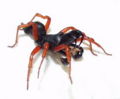
atypical tarantula(Sphodros rufipes) Genera: Sphodros |
Browse |
References
- http://www.earthlife.net/chelicerata/s-anatomy.html written by Mr. Gordon Ramel
- http://www.answers.com/topic/spider?cat=technology&nr=1
- http://www.kipaddotta.com/tarantula.html
- http://ag.arizona.edu/urbanipm/spiders/tarantulas.html R.L. Smith, 1982. Venomous Animals of Arizona. The University of Arizona.
See Also
| |||||||||||