Water spider
| Water spider |
|---|

|
| Scientific Classification |
|
| Binomial Name |
|
Argyroneta aquatica |
 |
Water spider or diving bell spider is a species of spider (A. aquatica) best known for being the one and only spider to live permanently underwater. It has a thin layer of oxygen trapped against it's body to breathe, and only goes to the water's surface to replenish oxygen 7. This particular spider's body is greatly adapted to water, hence the name, the water spider. This spider is: 1. The only spider that lives underwater the entirety of it's life, 2. One of the only spiders that the males tend to be bigger than the females in size, and 3. One of the only spiders where the male's devour the females after reproducing 4. The bite of A. aquatica is not deadly, but to humans the bite can be very irritating and itchy for some time. They use this poison to capture their prey as they move swiftly through the water. Argyroneta is defined as "with a silver net", this is in the scientific name because of the air-bell that these species can create by going to the surface of the water and capturing air between their hind legs. The air bubble is formed and held by the spinnerets and the hind legs and brought down to a small bubble, the spider deposits the air inside of the small bubble, and repeat the process until the bubble is big enough for the spider to enter 8.
Anatomy

The body is greatly adapted to the water. Fine setae covers the opisthosoma which is used as an aquatic lung that allows the spider to breathe underwater by the setae trapping an air bubble against the spider's body and connected to the tracheal spiracles. The oxygen in the water surrounding the air-bell is diffused which can be exchanged in the tracheal system the normal way. Oxygen and Carbon dioxide can be increased and decreased so that the air bubble replenishes it's air 2. The female water spiders can grow to 8mm all the way to 15mm, the male can grow up to 9mm to 12mm and are both light to dark yellow-brown. Although the female has a greater range, the male tends to be bigger to some degree than the females in most cases 3. Like every other spider, the water spider has a cephalothorax and an abdomen. Every part of a normal spider internally is the same as the water spider. Externally the water spider has the fine setae that help the air bubble surround the spider 9.
Reproduction
A. aquatica reproduces sexually with the opposite sex, the females are oviparous. Since it spends most of it's life underwater, they make air-filled bubbles shaped like bells that are used for oxygenating the spider. These bells are also used as mating grounds.
The male will build an air-bell along side the female's bell that was previously made, this makes them so close that they are almost connected. After forming the air-bell, the male will bite through both his and her bubbles, then mates with the female. After the oviparous female lays her eggs in late spring or summer, she will wrap the eggs in a white, silky material and forms a cocoon surrounding the eggs, then places the cocoon near the top of the air-bell. The young spiders hatch within a few weeks. If the eggs are laid in late summer, the male spider will seal the cocoon with a thicker layer of the silky substance 1 3.
Ecology

Water spiders can be found mainly throughout Britain, but can be seen in Central and Northern Europe, Northern Asia, and Siberia. The water spider helps the environment by buzzing around the water in between plants and capturing and eating it's prey with poison. Because they live in ponds and streams and lakes, getting rid of pests is good. So just like other spiders killing pests on land, A. aquatica rids of the equivalent but underwater 8.
You can find them anywhere from ponds, slow moving streams, shallow lakes, and basically wherever you can find lots of aquatic vegetation in the above locations 1. The environment is perfect for the water spider since the spider won't float off down the stream or into another part of the water, it tends to be Southern-bias though. Britain is covered on every side by water, so it makes sense that it is the place with the most Argyroneta aquatica 6.
Reversed Sexual Arachnid Tradition
This particular spider isn't just the only one to live it's whole life underwater, but possibly the only spider to have reversed mating traditions. Arachnid's relationships and mating traditions are usually the female is larger and doesn't care about the size of the male and after the male is used to fertilize the female's eggs the male is devoured by the female and such.
Yet most of these are irrelevant to the water spider. The water spiders are much different since instead of the female being larger, it is the male spider who tends to be bigger than the female. After mating, rather than the female eating the male, the male actually cannibalizes the female. Not every time does the male devour the female, there is a behavioral effect that increases or decreases the likelihood of the female being eaten. If the female avoids the larger, superior male, the chance of getting eaten is high 4.
Gallery
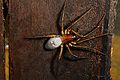
Water spider
(Argyroneta aquatica)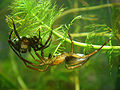
Water Spider
(Argyroneta aquatica)


 Browse |
References
- ARKive D.Schutz, Dr Peter Merrett, 2003.
- American Arachnology Paul A. Selden, University of Manchester, 2002.
- the-piedpiper.co Stuart M. Bennett, Stuart M. Bennett, 2001.
- sexual conflict and mate choice D. Schutz and M. Taborsky, Journal of Arachnology, September 2005.
- Wikispecies author, publisher, date.
- Argyroneta Surfaces Again John Partridge, WBRC, date unknown.
- Bogleech Jonathan C. Wojcik, Bogleech, date unknown.
- Cybaeidae Argyroneta Ed Nieuwenhuys, March 2007.
- spider anatomy Duke NUS, date unknown.


