Amphibian
| Amphibian |
|---|

|
| Scientific Classification |
|
| Orders |
|
Subclass Lissamphibia
Subclass Lepospondyli (extinct) Subclass Labyrinthodontia (extinct) |
Amphibians are an unusual group of cold blooded vertebrates that comprise the taxonomic class Amphibia. They include varieties ranging from frogs to salamanders to caecilians and around 6,500 species found throughout the world. Amphibians are very similar to reptiles, but they are not amniotes, meaning they do not have terrestrially adapted eggs. Most of them lay their eggs in water and have very unique skin that aid in respiration under water.[2]
Amphibians like to stay in moderate areas with a little swampy or forest area. They will spend most of their lives in water which makes them largely aquatic, but they also can live on land. The word Amphibian comes from a Greek word which means double life, referring to their dual nature. They usually start their life in water when they are breaded there, and move to land. They all use a form of metamorphosis and will end up growing to modern animals some people own. Frogs and salamanders are common house pets. They are also used as food in some countries and served as a delicate meal. [3]
Anatomy
Amphibians are seen and characterized by their gaseous exchange mechanism. The skin is moisturized by mucous secretions and is supplied with blood vessels. Some amphibians breathe through their skin and carbon dioxide will pass through their skin. In salamanders they have no lungs so all respiratory occurs through the skin. The heart of a amphibian, though, is generally a tripartite structure, consisting of a divided atrium and a single ventricle. [4] The basic anatomy of a frog is comprised of longer hind legs, webbed feet, protruding eyes, short body and a lack of tail. This anatomy is set perfectly for a frog because it is for jumping on land and swimming in water. The frogs have elongated ankle bones and shorter forelimbs than the hind appendages. This makes it so the frogs can leap instead of walk. The vertebral column has ten free vertebrae with a trunk that ends in a fused tail bone. The frogs have loose skin texture because the skin is not held to inner muscles or bones. The eyes of frogs are very unique in that they have a transparent membrane that protects it underwater. It also has two translucent membranes for terrestrial and aquatic use. They can hear through the tympanum on either side of their head. Surprisingly frogs do have cone shaped teeth in a small ridge in the upper jaw. The maxillary teeth and vomerine teeth do not help the frog in chewing because they swallow their food whole when they eat it. Their webbed feet and sticky toe pads help them in sticking to things and grip to vertical surfaces. [5]
Reproduction

Reproduction in Amphibians occurs between the male and female through sexual reproduction. All lay eggs, usually in the water and fertilization in most is external. The male will usually take the amplexus pose (see picture at left) where the male releases its sperm over the females eggs. The male frog is normally smaller and gets on top of the female frog. The salamander on the other hand releases a packet of sperm called spermatophore. Then the female will pull it off the ground into her cloaca where the fertilization occurs internally. This can happen where it deposits the sperm right into the females intromittent organ.[6]
The frogs and toads have a tadpole stage that is different and requires metamorphosis. The metamorphosis usually takes 24 hours with a disappearance of the gill pouch that makes the front legs visible. The jaw will also get bigger and the transformation of the digestive system. Then it will have a sudden growth around the eyes and the formation of the skin. The tail will usually disappear later, then after that the animal will be ready to leave the water. [7]
Ecology
Amphibians can be found in ponds, streams, wetlands, and usually in any rural forest area. The animals stay in warm humid conditions because that is where they are great in numbers and diverse. Amphibians remain active all year round in wet tropics, but in temperate areas they become inactive because of the cold temperature. In autumn they strive the best because it drives them to muddy ponds for hibernation. When conditions get too dry, though, most frogs and salamanders bury themselves to stay moist. Amphibians have another way of avoiding desiccation by covering its skin with a waxy substance. The coat then provides waterproofing to lower the frog's rate of water loss.[8]
Amphibians are also known for the loud noises you hear when you go by a pond. Only males can croak and make noise to call to the females. It is a part of a mating process. On the other hand salamanders are lead to each other by chemical cues and complex courtship behaviors. When the amphibian is not mating, it will eat anything it can fit in its mouth. The amphibians range from very fast eaters to slow and deliberate. Most frogs are known for using there tongue to catch small prey and swallow them whole. Since they can not chew most animals then use there legs to stuff it down their throats. Sometimes toads pull their eyeballs into their skull to help swallow the food. Most amphibians feed on invertebrates and a few small vertebrates.[8]
Predation and Poison

Frogs play a big role in the population of mosquitoes and the reduction of diseases. Since there are so many mosquitoes in the world and all of them are spreading diseases to humans and animals. Both frogs and salamanders have a knack for mosquitoes after previous study to show that most of the food they eat are flies. The frogs use their massive tongues to catch the mosquitoes easily.[9]
Amphibians also have a defensive poison that is mostly found in frogs, but some salamanders and toads have it as well. Toads have poisonous glands behind their eyes or on the top of their head. The frogs poison can be deadly to humans or other animals, such as the such as the poison dart frogs. You can usually tell if a frog is poisonous because of the bright colors or the multi-color on their body. In South America some tribes extracted the poison from frogs onto their tips of their arrows. There are two species of frogs though, that have the same color pattern as the poison frogs but really are not. They use this coloration as a self defense. Some scientist found out that the poison is useful for some other stuff. It can be used for protection of HIV infection and a painkiller that is 200 times for effective than morphine. Some of the skin secretions of toads contain bufotoxins that are used as recreational drugs, or the skins are dried and smoked. [10]
Gallery
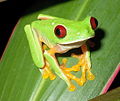
Red-eyed tree frog
(Agalchnis callidryas)
Order: Anura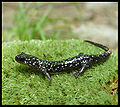
Northern Slimy Salamander
(Plethodon qlutinosus)
Order: Urodela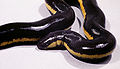
Caecilian
(Icthyophis kohtaoensis)
Order: Gymnophiona
Blue poison dart frog
(Azureus dendrobates)
Order: Anura


Amphibians
References
- ↑ Amphibia Unknown Author, Wikispecies, 23 December 2010, at 22:15.
- ↑ Amphibian Unknown Author, Wikipedia, 25 February 2011 at 02:13.
- ↑ Amphibian William E. Duelman, Encyclopedia Britannica , Access 2/27/11.
- ↑ Circulation Unknown Author, 2011 Encyclopedia Britannica, Inc, Access Date February 03, 2011.
- ↑ Anatomy of a Frog Gaynor Borade, Buzzle.com, Access Date February 3, 2011.
- ↑ Reproduction Paul Hebert, EOA earth, Access date Tuesday 25, January 2011.
- ↑ Amphibian Unknown Author, Wikimedia Foundation, Inc, 3 February 2011.
- ↑ 8.0 8.1 Amphibian ecology and evolution Paul Hebert, Environmental Information Coa, August 29, 2008, 2:02 pm.
- ↑ Amphibian predation on larval mosquitoes Sarah E. DuRant, 2011 Microsoft corporation, Accessed Date 2/27/11.
- ↑ Frog Unknown Author, Wikimedia, 17 February 2011 at 20:00.


