Sickle cell anemia

Sickle cell anemia is a serious circulatory system disorder affecting the integrity of red blood cells. Its name is derived from the shape of the cells, which become round and flat resembling a sickle.[1]
Normal red blood cells are smooth and round and move easily through blood vessels to carry oxygen to all parts of the body. Sickle-shaped cells don’t move easily through blood because they’re stiff and sticky and tend to form clumps and get stuck in blood vessels. The clumps of sickle cells block blood flow in the blood vessels that lead to the limbs and organs. Blocked blood vessels can cause pain, serious infections, and organ damage.[2]
Sickle cell anemia affects millions of people worldwide. There are excellent treatments for the symptoms and complications of the condition, but in most cases there’s no cure. (Some researchers believe that bone marrow transplants may offer a cure in a small number of cases.)[2]
Symptoms
Anemia (uh-NEE-me-uh) is a condition in which a person’s blood has a lower than normal number of red blood cells, or the red blood cells don’t have enough hemoglobin (HEE-muh-glow-bin). Hemoglobin is an iron-rich protein that gives blood its red color and carries oxygen from the lungs to the rest of the body.[2]
Red blood cells are made in the spongy marrow inside the large bones of the body. Bone marrow constantly makes new red blood cells to replace old ones. Normal red blood cells last about 120 days in the bloodstream and then die. Their main role is to carry oxygen, but they also remove carbon dioxide (a waste product) from cells and carry it to the lungs to be exhaled. In sickle cell anemia, a lower-than-normal number of red blood cells occurs because sickle cells don’t last very long. Sickle cells die faster than normal red blood cells, usually after only about 10 to 20 days. The bone marrow can’t make new red blood cells fast enough to replace the dying ones. The result is anemia.[2]
Poor circulation due to sickle cell blockage causes acute chest syndrome which results in pain in the chest, coughing, difficulty breathing, and fever. Hand-foot syndrome is when the hands and foot become swelled and painful. A person who has the sickle cell disease can get infection easily than others. When you have fever and the body temperature goes up to 38 Celsius you should consider it as sickle cell disease. Splenic sequestration crises is a symptoms cause paleness, weakness, an enlarged spleen, and pain in the abdomen. Also it can cause stroke because of the poor oxygen in the brain occurs headache, seizures, weakness of the arms and legs, speech problems, a facial droop, and loss of consciousness. [1]
Cause

Sickle cell anemia is an inherited, lifelong condition. People who have sickle cell anemia are born with it. They inherit two copies of the sickle cell gene, one from each parent (genetically homozygous). People who inherit a sickle cell gene from one parent and a normal gene from the other parent (heterozygous) have a condition called sickle cell trait. Sickle cell trait is different from sickle cell anemia. People with sickle cell trait don’t have the condition, but they have one of the genes that cause the condition. Like people with sickle cell anemia, people with sickle cell trait can pass the gene on when they have children.[2]
The sickle cell gene makes abnormal hemoglobin. Hemoglobin is the protein inside red blood cells that carries oxygen to all parts of the body and gives blood its red color).[3] The causal mutations are those within genes responsible for beta globins (blood proteins). [2] In sickle cell anemia, the abnormal hemoglobin sticks together when it gives up its oxygen to the tissues. These clumps are like liquid crystals that cause red blood cells to become stiff and shaped like a sickle, or “C.” It takes two copies of the sickle cell gene for the body to make the abnormal hemoglobin found in sickle cell anemia.[3]
People who inherit only one copy of the sickle cell gene (from one parent) will have sickle cell trait, but will not develop anemia. People who have sickle cell trait generally have no symptoms and lead normal lives. Like people with sickle cell anemia, however, they can pass the sickle cell gene on to their children.[3] There is 50% probability of sickle cell disease or trait if one of the parents has sickle cell anemia (homozygous) and the other has sickle cell trait (heterozygous). And if they both have sickle cell trait, the chance is 25%. [3]
Treatment

Effective treatments are available to help relieve the symptoms and complications of sickle cell anemia, but in most cases there’s no cure. The goals of treating sickle cell anemia are to relieve pain; prevent infections, eye damage, and strokes; and control complications if they occur. The treatments include medicine, blood transfusions, and specific treatment for complications.[4]
Some researchers believe that bone marrow transplants may offer a cure in a small number of cases.[4] Because bone marrow makes red blood cells, a bone marrow transplant may be the only way to cure sickle cell.[4] Although the operation has been successful for several affected kids, rejection of the bone marrow transplant is more common in adults.[5]
Researchers are looking for new treatments for sickle cell anemia, including gene therapy and safer and more effective bone marrow transplants. People who have sickle cell anemia need regular medical care. Some doctors and clinics specialize in treating people with the condition. Doctors specializing in sickle cell anemia are often hematologists (doctors who treat people with blood disorders)—or pediatric hematologists (if they also treat children).[4]
With proper treatment, people with sickle cell disease can live about mid-40s. [6] People with the disease take penicillin, to prevent other infections. Folic acids, vitamin supplement are also helpful because it increases new red blood cells in bodies.[7] Normal blood cell lives about 120 days but the sickle cell lives only for 10 to 20 days because the bone marrow cannot make new red blood cells that fast.[8] Some require blood transfusions to give them fresh and new red blood cell which decreases the chance of blood vessel blockage. These are only temporary treatments.[9]
Gallery
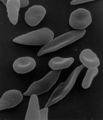
Misshapen red blood cells characteristic of sickle cell anemia.

References
- ↑ About Sickle Cell Disease Sickle Cell Disease Association of America, Inc. . Accessed January 4, 2012.
- ↑ 2.0 2.1 2.2 2.3 2.4 What Is Sickle Cell Anemia? by the National Heart Lung and Blood Institute.
- ↑ 3.0 3.1 3.2 What Causes Sickle Cell Anemia? by the National Heart Lung and Blood Institute.
- ↑ 4.0 4.1 4.2 How Is Sickle Cell Anemia Treated? by the National Heart Lung and Blood Institute.
- Do You know about sickle cell anmia Barbara P. homeier, MD
- Sickle Cell Disease James Fahner, MD
- What is Sickle Cell Disease Sickle Cell Disease Association of America, Inc.
- Sickle Cell Disease Dolan Dna learning Center
| ||||||||||||||||||||


