Strata

Strata (singular "stratum") is a "layer". In geology, the term refers to a layer of sedimentary rock that generally has the same sediment (particulates) throughout and normally has other layers above and below it. The study of layered rocks, their distribution, origin, fossil content, and relative age is known as stratigraphy.
The characteristics of strata have led to several principles of stratigraphy:
- Principle of original horizontality
- Principle of continuity
- Principle of superposition
- Principle of cross-cutting relationships
- Principle of inclusion

Geologic Time
From the results of studies on the origins of the various kinds of rocks (petrology), coupled with studies of rock layering (stratigraphy) and the fossils they contain (paleontology), geologists have associated layers of rocks with sequence of events thought to have occurred over hundreds of millions of years. For example, it is believed that during a particular episode the land surface was raised in one part of the world to form high plateaus and mountain ranges. After the uplift of the land, the forces of erosion attacked the highlands and the eroded rock debris was transported and redeposited in the lowlands. During the same interval of time in another part of the world, the land surface subsided and was covered by the seas. With the sinking of the land surface, sediments were deposited on the ocean floor. Such recurring events as mountain building and sea encroachment and believed to be recorded in rock layers that comprise units of geologic time. Geologists have divided the Earth's history into Eras -- broad spans based on the general character of life that existed during these times -- and Periods -- shorter spans based partly on evidence of major disturbances of the Earth's crust.[1]
Principles of stratigraphy
Original horizontality

The Principle of Original Horizontality states that when a stratum is formed, the lower surface and surfaces of its sides corresponded with the surfaces of the adjacent bodies. The upper surface was parallel to the horizon, as far as that is possible. With the exception of the lowest stratum, all the strata were contained in two parallel planes to the horizon and were at one time parallel to the horizon.
The problem here is that strata in ocean deposits are not always horizontal and rates of sedimentation are not uniform on a global scale. This is shown to be the case by both seismic records and sub-marine coring.
Lateral continuity

The Principle of Lateral Continuity states that layers of sediment initially extend laterally in all directions (they are laterally continuous). Due to this principle, scientists have assumed the ability to correlate layers at various location, which was the basis for the development of the geological column.
The principle is based on how sediments settle from fluids. As stratum forms, it must be bordered on its sides by a barrier, otherwise the sediments will extend indefinitely (potentially around the entire earth). When the bare sides of strata are found, a geologist will tend look for its continuation elsewhere.
The problem here is that it has never been confirmed from sedimentary rocks deposits that a layer of stratum can truly be traced continuously around the Earth. In Studies in Flood Geology, John Woodmorappe provides maps of locations were the so called geologic ages are found, showing significant gaps.[Reference needed]
Superposition
The principle of superposition, now known as the scientific law of superposition, is an axiom that forms one of the bases of the sciences of geology, archaeology, and other fields dealing with stratigraphy. It was first put forth in the 17th century by the Danish scientist Nicolas Steno.

In its plainest form, it states that layers of rock (strata) are arranged in a time sequence, provided that they have been unaltered since their formation. In other words, each layer or stratum is younger than the one beneath it and older than the one above it, so that the youngest stratum will be at the top of the sequence and the oldest at the bottom. This interpretation follows from the basic logic that a layer of sediment cannot accumulate unless there is already a substrate on which it can collect, and when the lower stratum forms, none of the strata above it existed. The principle is derived in part, from the Principle of Original Horizontality.
The main problem with the principle of superposition is that it takes into account only one particular case of sedimentation. That is the case of an absence of current. In such cases the strata form vertically, that is bottom to top, implying succession of time on a global scale in accordance with the vertical sequence of strata.

Superposition ignores the general case of sedimentation in moving water and most bodies of water have moving water. In moving water, sediment layers form horizontally. The process of sedimentation in moving water has been demonstrated in laboratory experiment. In these examples, thin layers of sediment built horizontally at a noticeable rate with these layers forming one on top of the other as the edge moved forward. There were other layers beneath them but the two on top were easier to watch. In fact it can be shown that Superposition goes against both experiments and observations in sedimentology.[2]
Principle of Cross-cutting Relationships
- Main Article: Principle of cross-cutting relationships
Principle of inclusion
- Main Article: Principle of inclusion
Discussion
All these concepts form the basic assumptions of modern geology regarding the formation and history of rocks. But there are good scientific reasons for concluding that these assumptions are wrong.
The fact is that strata are formed by sediments in a fluid but the standard stratigraphic model seems to ignore the effect of the fluid on sediments. So the chronology resulting from this model does not take into account the fact that currents exist in present day oceans. The simple fact is that the standard stratigraphic model does not correspond with observational data from contemporary sedimentology.
Stratification is characterized by segregation of particles according to size in bedding plane partings, but the standard stratigraphic model interprets strata as a succession of sedimentary layers and so it is contrary to both observation and experimentation (more at Hydrological sorting).
Gallery

Geologic ages assigned to exposed strata in North America.
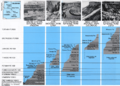
Strata correlation of various U.S. locations.


References
| ||||||||||||||||||||


