Plesiosaur
| Plesiosaur |
|---|

|
| Scientific Classification |
|
| Orders |
|
The Plesiosaur (Greek plēsios/πλησιος meaning 'near' or 'close to' and sauros/σαυρος meaning 'lizard') is a type of carnivorous aquatic reptile which was created by God on Day 5 of the Creation Week. While Plesiosaurs (alongside their close relatives the Pliosaurs) have been known to people throughout Antediluvian history under a wide variety of names, the most common title which is often given to them is that of "Sea Serpent" or "Sea Dragon".
Today, the name "Plesiosaur" is applied both to 'true' Plesiosaurs (namely, those within the Superfamily Plesiosauroidea) and to the larger taxonomic rank of Plesiosauria, which also includes the Pliosaurs. Plesiosaur fossils are usually found in strata identified as Jurassic or Cretaceous. Although Plesiosaurs and Pliosaurs are often incorrectly called "Sea Dinosaurs", "Swimming Dinosaurs" or "Marine Dinosaurs", they are actually completely unrelated to the Dinosaurs.
Anatomy

Generally, Plesiosaurs ranged from between 10-100 ft in length. They had a long neck and appealing plump body, and four gigantic paddle-shaped flippers. The plesiosaur uses its flippers to walk on land and swim in the water. The plesiosaur would use its front flippers in the same motion someone would make to accelerate a rowboat. The back flippers were used for steering and balance. Since the flippers made it very hard for the plesiosaur to walk on land, they had to walk with a waddling movement. Their tails had a variation of lengths. The plesiosaur was known to have enormously sharp teeth and a very muscular jaw. It is assumed that the plesiosaur had developed from the Nothosaur or Pistosaurus, which were both mid-Triassic reptiles. The Plesiosaur was known to have probably very little trouble maneuvering its way around in the water and has quicksilver reactions or reflexes and speed as fast as lightning. The name Plesiosaur means, "near lizard,” which means if it was a lizard or reptile it was most likely a cold-blooded animal, but is not proven or supported by facts and scientists can only presume that is was cold-blooded. The plesiosaurs habits are typically related to modern day sea turtles and seals although they are not related.[1][2]
Reproduction
The consideration is that a female plesiosaur will go to a muddy or sandy area whether it is on the sea floor or out on the shore. It will dig a big enough hole with its flippers for it to lay its eggs in and after the eggs are laid it will cover the hole where the eggs are so that the babies will not be susceptible to danger. She will pack the top of the sand down hard to keep it securely tucked away and as it ventures away back to go out into the water; it will get rid of any evidence that would lead a predator to the babies. When the babies’ hatch they are on their own and will crawl back out to sea and have to learn the way of life on its very own. Somehow, the babies manage to make it on their own in their big blue world.[3]
Ecology
The Plesiosaur habitat was the open oceans. The Plesiosaurs would eat ballasts so it would help pulverize food in their stomach so that digestion was not so problematical and to help them dive deep in the water to the beyond. Plesiosaurs ate all kinds of numerous types of fish and any other swimming animal or organism. They had no problem chewing with their strong jaws and no difficulty mincing another fish to bits with its various razor sharp teeth. The other frequent thing that the Plesiosaur would like to eat was Ammonites. Ammonites are known by almost all because of the commons similar designs on their shell. Ammonites were free-swimming creatures associated to squid and octopuses. They would attack their prey with stretching tentacles coming out of their shell and their shell was filled with gas and liquid to keep them buoyant and free swimming. How they maneuvered themselves around was by flapping their flippers like crazy back and forth.[4][5]
Living Plesiosaur
- Main Article: Living Plesiosaur
The Loch Ness Monster also known as Nessie is a cryptid animal which is reputed to inhabit Loch Ness in the Highlands of Scotland. The most common eyewitness description of Nessie is that of a plesiosaur.
However, several problems with this theory have been noted. Scientists claim it can't be a plesiosaur because they are cold blooded. The average temperature of Loch Ness is about 42°F, thus it would die. Even if the plesiosaurs was warm-blooded, there wouldn't be nearly enough food to keep it alive. Also, there is no indication that plesiosaur have sonar capability. Having this would be necessary in the loch since visibility is poor in the Loch because of a high peat concentration. Fossil evidence indicates [plesiosaurs] were sight hunters. It is highly unlikely that the loch's peat-filled water would allow such animals to hunt the limited food supply and be able to survive. In addition, Leslie Noè of the Sedgwick Museum in Cambridge pointed out that, "The osteology of the neck makes it absolutely certain that the plesiosaur could not lift its head up swan-like out of the water", precluding the possibility that Nessie is a plesiosaur.[6]
In 1977, a Japanese trawler named Zuiyo-maru was fishing off the coast of New Zealand and pulled up a carcass of an unidentified animal. After some pictures and measurements were taken, the carcass was thrown back because of its unpleasant odor, logistic difficulties of carting it to shore, and to avoid spoiling the fish already caught. Japanese scientists originally identified the carcass as an extinct animal, possibly a Plesiosaur. Subsequent analysis suggests the creature was some sort of shark, not a Plesiosaur. The specimen does not form an airtight argument for modern sightings of dinosaurs, and is considered an argument creationists should not use.
Gallery
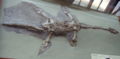
This Plesiosaur remains in a glass display case in a museum.

This is another Plesiosaur on display.


References
- Plesiosaur by Wikipedia
- PLESIOSAURS: "Near-lizards" by Enchanted Learning
- Our Fossils by CHARMOUTH HERITAGE COAST CENTRE
| |||||||||||||||||


